AI Dungeon vs DreamGen (2026): Which Free-to-Try Story Site Fits You?
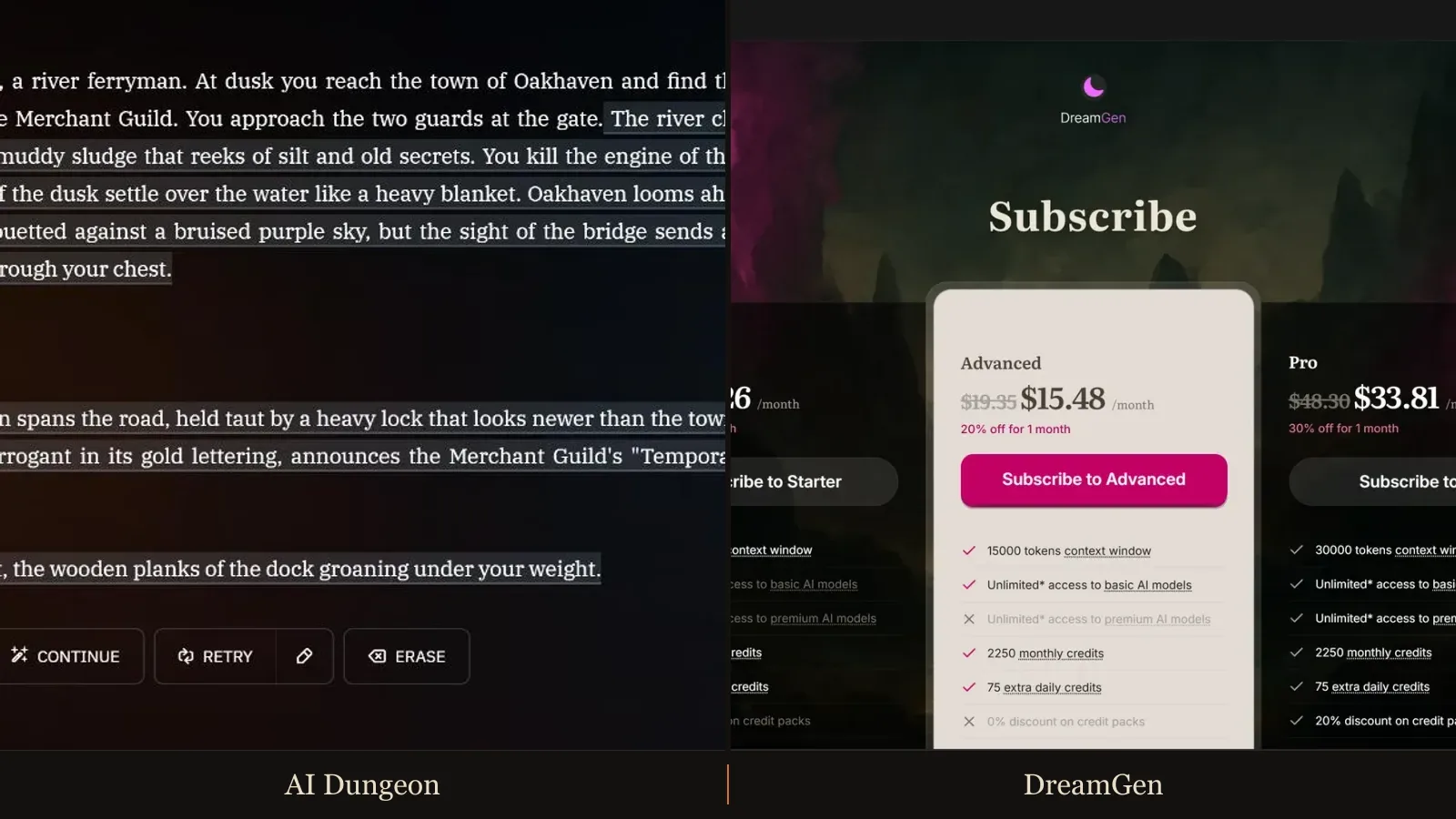
AI Dungeon and DreamGen both let you try an AI story for free and then charge for a bigger memory and better models. AI Dungeon is a single-player story you steer with actions. DreamGen is a role-play site where several characters talk in one session and you can direct the scene with an instruction.
We have played and scored AI Dungeon. Its score on our seven-axis methodology is 2.6 out of 5. We have not played DreamGen, so it has no score, and nothing below is a verdict on how well it writes. What we say about DreamGen comes from its own site, pricing page, documentation and terms, read on 23 October 2026. It moved to a new version in early 2026, so anything you read about the old one may be out of date. Our DreamGen guide has the detail. What we say about AI Dungeon comes from our review and our directory entry, with prices checked in August 2026.
The Short Version
| AI Dungeon | DreamGen (version 2) | |
|---|---|---|
| Our score | 2.6 out of 5 | Not scored (not played) |
| What it is | An open story with no built-in rules | A role-play and story site, built on “scenarios” |
| Free tier | No turn limit on free models | All current models, limited credits |
| Paid | $14.99 to $99.99 a month | $7.83, $19.35 or $48.30 a month, as shown to us |
| Free context window | Up to 4,000 tokens | About 4,000 tokens |
| Top context window | 32,000 on most models | 30,000 to 60,000 on Pro, by model |
| Several characters | No party system | Yes, many named characters in a session |
| Directing the AI | Author’s Note, Story Cards | An “instruction” turn inside the chat |
| Where it plays | Browser, iPhone, Android, Steam | Browser; we found no app |
| Age | App stores rate it 12+ and Teen | Its terms say you must be 18 or older |
If you only read one line: AI Dungeon if you want one story with you at the centre and a phone app, DreamGen if you want a cast of characters and a director’s chair.
What Each One Is
AI Dungeon, made by Latitude, began the genre in 2019. You type what you do and the AI writes what happens, in any genre. There are no dice or character sheets unless the author of a scenario scripts them. It has a large library of adventures made by players. See our AI Dungeon review.
DreamGen describes itself as “AI games and stories”. It has two parts. In role-play, you pick a scenario and talk with one or more characters in a chat-like screen. In story writing, you give a premise and it writes. A scenario is the base of both: the world, the characters, the plot and the style, like a game master’s notes and character sheets in one place. Most parts are optional.
The simplest way to see the difference: AI Dungeon makes you the main character in a story. DreamGen puts you in a room with a cast.
How Play Feels
AI Dungeon is a loop. You choose Do, Say or Story, you write a line, and the AI continues. Because nothing outside the text exists, you can try anything, and the AI usually accepts it. We scored it Player Agency — 4 for exactly that freedom. The price of it is that nothing you try can fail, which is a fairness problem we cover below.
DreamGen splits a session into three kinds of turn, which it calls interactions:
- Narrative. The narrator describes the scene.
- Character message. A named character speaks, acts or thinks. You can have many in one session.
- Instruction. A direction to the AI that is not part of the story, such as “the scene moves to the next morning” or “make the next message at least 200 words”.
The third kind is the feature AI Dungeon does not have. It is a director’s chair inside the chat. DreamGen’s documentation also lists behaviour modes: Take-Turns, where the AI plays the others and stops when it is your turn, Spectate, where the AI plays everyone including your character, and NPC Only. You can retry a reply with a different model, make it longer or shorter, edit any turn, pin an important turn so the memory gives it priority, and fork a new session from any point.
If you like steering one scene at a time, DreamGen gives you more controls. If you like to type an action and see what comes, AI Dungeon is quicker.
Memory: Two Small Windows
Both sites send the AI a context window, which is the amount of text it can see at once. Anything outside is gone unless you put it back. Our guide to why AI campaigns forget explains why this limit is built into the technology.
| AI Dungeon | DreamGen | |
|---|---|---|
| Free | Up to 4,000 tokens | About 4,000 tokens |
| Cheapest paid | Journey, up to 8,000 | Starter, 5,000 |
| Middle | Legend, up to 16,000 | Advanced, 15,000 headline |
| Top | Mythic and Ultimate, up to 32,000 | Pro, 30,000 headline |
Both numbers are headlines. On AI Dungeon, context is set per model, and some models sit below the figure on the plan. On DreamGen, the pricing FAQ gives different sizes by model, for example 8,000 to 15,000 on Advanced and 30,000 to 60,000 on Pro. A token is about four characters, so 4,000 tokens is roughly 3,000 words of story and setup together.
What each gives you to push back:
- AI Dungeon: Story Cards, Plot Essentials and an Author’s Note. We scored it Memory & Continuity — 3. See the Story Cards guide.
- DreamGen: a pinned turn, a per-session copy of the scenario you can edit while you play, and an instruction turn. Its documentation warns that a scenario definition which is too long for the window gives an error, and suggests keeping it under about 2,000 tokens for a 4,000-token window.
The bottom line is the same on both: on the free tier you have a few paragraphs of memory, and a long story will drift. DreamGen’s biggest windows reach higher than AI Dungeon’s, but only on its dearest plan, and we have not tested how well they hold.
Models
AI Dungeon lists eight models on the free tier and eighteen on its top plan, from free ones such as Muse, Wayfarer Small 2, Hearthfire and Fable up to Nova, Wayfarer Large, Equinox, Hermes 3 405B and DeepSeek V4 Pro. Our model guide sorts them.
DreamGen says it offers two groups:
- Seven first-party models, which it hosts and fine-tunes, including Gemma 4, Qwen 3.5, GLM 4.7 and GLM 5.2. Two older ones, Lucid Base and Lucid Max, are marked as legacy and due to be deprecated.
- About two dozen third-party models, which cost credits, among them DeepSeek V4 versions, several GLM and Kimi versions, MiMo, MiniMax, Mistral Large 4 and Muse.
DreamGen says it may change first-party models at short notice and third-party models at any time. Both lists change, so check the picker in each. Our best model guide for roleplay helps with the open models.
Cost: Where “Free” Ends
AI Dungeon is the simpler one. The free tier, Wanderer, has no turn limit on its free models. Paid plans buy better models and more context, not more turns.
| Plan | Monthly cost | Max context |
|---|---|---|
| Wanderer | Free | up to 4k tokens |
| Journey | $14.99 | up to 8k tokens |
| Legend | $29.99 | up to 16k tokens |
| Mythic | $49.99 | up to 32k tokens |
| Ultimate | $99.99 | up to 32k tokens |
DreamGen meters everything in credits. Its pricing page on 23 October 2026 showed:
| Free | Starter | Advanced | Pro | |
|---|---|---|---|---|
| Price a month | $0 | $7.83 | $19.35 | $48.30 |
| Monthly credits | Limited | 375 | 2,250 | 2,250 |
| Extra daily credits | Limited | 45 | 75 | 75 |
| Models at zero credits | None | None | Smaller first-party | All current text models |
At zero credits, DreamGen calls a model “unlimited”, with a fair-use rule against bots, scripts and account sharing. Monthly credits reset on a date tied to your subscription and do not roll over. Daily credits start only after you have used the monthly ones. Credit packs are for subscribers only. Images cost credits on every plan.
Three things to know. First, the dollar amounts are odd, which suggests they were converted from another currency for us, so check your own price. Second, DreamGen shows first-month offers of 20% off on Starter and Advanced and 30% off on Pro. Third, on refunds its pricing FAQ says it offers prorated refunds by email, while its terms say purchases are final with listed exceptions. We cannot say which applies to you, so ask support before you rely on either.
Putting them side by side: if you play for hours every day on a free model, AI Dungeon is cheaper, because it can stay at zero. If you want a bigger window or a stronger model, DreamGen’s entry plan is cheaper than AI Dungeon’s entry plan, but DreamGen’s Starter window is smaller than Journey’s. What each plan buys is different, so compare the memory and the models, not only the price. Our guide to what AI RPGs cost explains the common pricing styles.
Worlds and Building Your Own
Both games are as much about other people’s setups as the engine.
AI Dungeon has the larger library of player-made adventures and a scenario editor, with Story Cards and scripting for authors who want rules. See our guides to scenario creation and scripting.
DreamGen’s scenario editor goes down to scene level if you want, or stays at one sentence for the plot and lets the AI fill in the rest. A scenario wizard, a chat that helps you brainstorm, can build one. Scenarios can be published, listed or unlisted. Each session gets its own copy, so you can change a relationship in the middle of a story without touching the original.
For the craft of writing a world for a model, our guides to SillyTavern lorebooks and how to open an AI RPG apply to both.
Rules and Fairness
AI Dungeon scores Mechanical Depth — 2 and Determinism & Fairness — 2. It has no rules unless a scenario adds them, and the AI decides every result. Our guide to difficulty in AI RPGs explains why that is the most common failure in the category.
DreamGen is a role-play tool, not a rules engine. We found no dice, stats or fail states in its documentation, and we did not test it. Its control is of a different kind: you decide what happens by instruction, which is power but not fairness. If you want a game that can beat you, neither is it. Look to Voyage, made by AI Dungeon’s own studio, which has dice and permadeath.
Where You Can Play and Who Can Play
AI Dungeon plays in a browser, has apps for iPhone and Android and has a Steam version.
DreamGen runs in a browser at v2.dreamgen.com. We found no app linked from its site. Its terms, updated on 23 March 2026, say you must be at least 18 and of the age of majority where you live. They prohibit content that is illegal in the United States, the EFTA countries or your own jurisdiction, and sexual content involving minors, including fictional minors. They say the content you generate is fiction and that you are responsible for it. We did not find a general adult-content filter described in the pages we read, and we did not test one, so we do not say what it will or will not write.
What We Cannot Tell You
- How good DreamGen’s writing is. We have not played it, and a model name says little.
- How its memory holds over a long session. The free window is small.
- Whether “unlimited” slows down. The fair-use rule targets abuse, but we did not test heavy use.
- Your price. The figures are what we were shown, in dollars.
- A score. DreamGen is not on our board. The 2.6 is AI Dungeon’s alone.
Which Should You Choose?
Choose AI Dungeon if:
- You want to be the one main character, and play in any genre.
- You want a free tier with no turn limit.
- You play on a phone or on Steam.
- You are under 18.
Choose DreamGen if:
- You want several characters in one scene and a way to direct them.
- You want to retry a reply on a different model, or tell the AI to change direction.
- You are 18 or over and happy with a browser.
- You will pay a monthly fee for a bigger window or a stronger model.
A simple test: do you want to play a part, or run a scene? To play a part, AI Dungeon. To run a scene with a cast, try DreamGen’s free tier with one scenario on two models.
If Neither One Fits
Both have the same weak point: the memory is a window and the rules are loose. For more structure, see our ranking for long campaigns. For other sites like these, see AI Dungeon alternatives, and DreamGen against NovelAI if writing quality is the question. If you want a story game with community worlds and a choice of strong models, read AI Dungeon vs Infinite Worlds.
Checklist
- Want to try DreamGen? Make a free account and play one scenario on two models.
- Story feels forgetful on DreamGen? Check your plan’s window and keep the scenario short.
- Want the scene to change on DreamGen? Add an instruction, not a long edit.
- Want to try AI Dungeon? Start free and read the per-model context before you pay.
- Story drifting on AI Dungeon? Pin the fact in a Story Card.
- Paying for either? Check your own price and read the refund terms.
- Under 18? AI Dungeon, not DreamGen.
Frequently Asked Questions
Is DreamGen better than AI Dungeon?
They are built differently. AI Dungeon is a single-player story you steer with actions, with apps on iPhone, Android and Steam. DreamGen is a role-play and story site with several characters in one session and an instruction option that lets you direct the scene. We have played and scored AI Dungeon, 2.6 out of 5. We have not played DreamGen, so it has no score.
Is DreamGen free like AI Dungeon?
Both have a free tier, with a catch. AI Dungeon’s free tier has no turn limit on its free models and a context window of up to about 4,000 tokens. DreamGen’s free tier gives access to all current models, but with limited monthly and daily credits and a window of about 4,000 tokens.
How much does DreamGen cost compared with AI Dungeon?
On 23 October 2026 DreamGen showed Starter at $7.83 a month, Advanced at $19.35 and Pro at $48.30. AI Dungeon’s plans on our entry run from $14.99 to $99.99 a month. DreamGen’s odd amounts suggest conversion from another currency, so check what your own page shows.
Which has better memory, AI Dungeon or DreamGen?
Neither remembers a long story without help. Both send the AI a limited context window. DreamGen’s runs from about 4,000 to 5,000 tokens on the free and Starter plans and up to 60,000 on Pro, depending on the model. AI Dungeon’s depends on the model and reaches 32,000 on most models on its top plans.
Can you play with several characters in AI Dungeon and DreamGen?
DreamGen is built for it: one session can have many named characters, and you choose whether the AI plays them all or waits for your turn. AI Dungeon has no party or character system, so its characters are whatever the story and the model introduce.
Does DreamGen have an app like AI Dungeon?
We found no app linked from DreamGen’s site. It runs in a browser. AI Dungeon runs in a browser, has iPhone and Android apps and has a Steam version.
What happened to the old DreamGen?
DreamGen’s migration guide says its first version became read-only on 15 January 2026 and was to shut down in March 2026. Subscriptions and credits carry over to the new version at v2.dreamgen.com, and an import tool brings scenarios and sessions across.
AI Dungeon’s score is the one published on its entry in our directory, on our seven-axis methodology. DreamGen is not scored. We have not played it, and what we say about it was read from its own site on 23 October 2026. AI Dungeon, DreamGen and the models named on this page are third-party products, and all names are used nominatively. Arcanum is independent and is not affiliated with Latitude, DreamGen or any model maker named here.