DreamGen vs NovelAI (2026): Role-Play Site or Writing Studio?
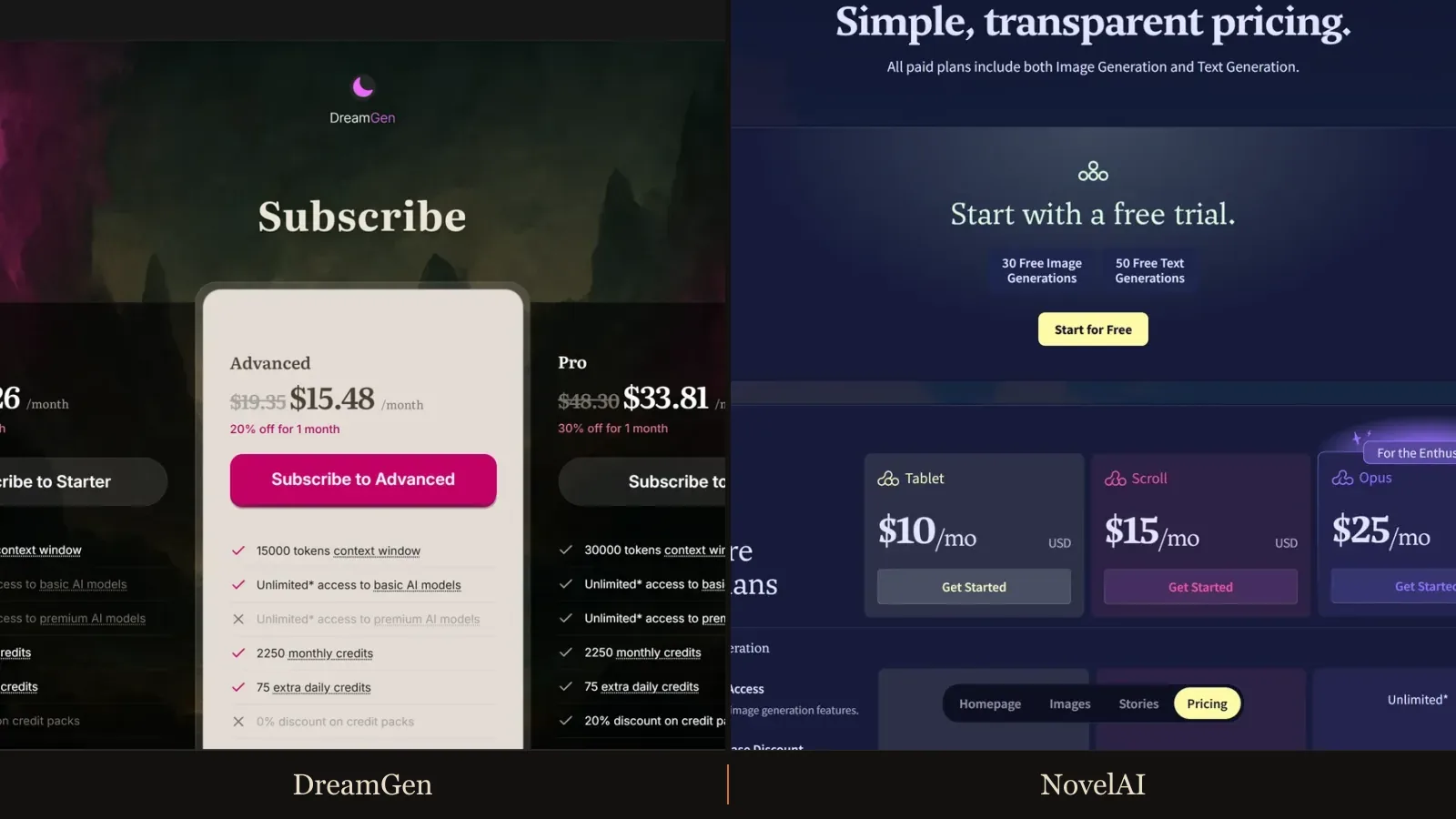
DreamGen and NovelAI both sell AI fiction by the month. NovelAI is a writing studio: you write in an editor and the AI continues. DreamGen is a role-play and story site: you play a scenario with a cast of characters and direct the scene with instructions.
Neither is scored on our seven-axis methodology. NovelAI is a writing tool and not a game, so we do not score it. We wrote our NovelAI review in June 2026 and read its plans and pricing on 29 September 2026, in our NovelAI pricing guide. We have not played DreamGen’s second version. What we say about it comes from its own site, pricing page, documentation and terms, read on 23 October 2026, and our DreamGen guide has the detail. So this is a comparison of facts we have read, with dates on them, and not a verdict on which writes better.
The Short Version
| DreamGen (version 2) | NovelAI | |
|---|---|---|
| What it is | Role-play and story site built on scenarios | AI writing studio with an editor |
| Free | Free tier, limited credits | Trial only: 50 text and 30 image generations |
| Cheapest paid | Starter, $7.83 a month | Tablet, $10 a month |
| Top plan | Pro, $48.30 a month | Opus, $25 a month |
| Memory, entry plan | 5,000 tokens | 8,192 tokens |
| Memory, top plan | 30,000 to 60,000 by model | 28,672 tokens |
| Models | 7 first-party, about 24 third-party | Its own: GLM-4.6 355B, Llama 3 Erato 70B, Xialong |
| World notes | Scenario, pinned turns, editable copy per session | Lorebook |
| Several characters | Yes, built in | Not a feature of the editor |
| Images | Cost credits | Pay as you go, or unlimited on Opus with limits |
| Prices read | 23 October 2026 | 29 September 2026 |
If you only read one line: NovelAI if you are writing prose and want a Lorebook and a bigger entry-level memory, DreamGen if you want a cast of characters and a free tier to try first.
What Each One Is
NovelAI, made by Anlatan, is an editor. You write, the model continues, and you steer by rewriting, retrying and shaping the direction. Its models are tuned on fiction, and that shapes everything about it. Our June review found the prose “genuinely different” from assistant-style models, and found it weaker as a game: its reasoning is weaker than the current alternatives, it does not browse for live knowledge, and in long play it creates plot holes. It is a writing studio first.
DreamGen says its second version is for “AI games and stories”. It has two parts. In role-play, you pick a scenario and talk with one or more characters in a chat-like screen. In story writing, you give a premise and it writes. Its welcome screen still labels the second version “2.0 beta”.
So the question to ask first is not “which is better” but “am I the author, or one of the cast?” If you want to sit above the page and shape every sentence, NovelAI. If you want to be in the scene, DreamGen.
How You Steer a Story
NovelAI works like a document. You can retry, edit the text, add to a Memory box and write Lorebook entries. The AI is a co-writer, and you do most of the directing by writing.
DreamGen splits a session into three kinds of turn:
- Narrative. The narrator describes the scene.
- Character message. A named character speaks, acts or thinks.
- Instruction. A direction that is not part of the story, such as “the scene moves to the next morning”.
Its behaviour modes decide who the AI plays: Take-Turns, where it plays the others and stops when it is your turn, Spectate, where it plays everyone including your character, and NPC Only. You can retry a reply on a different model, make it longer or shorter, pin a turn so the memory gives it priority, and fork a new session from any point.
The practical difference: in NovelAI you steer by writing. In DreamGen you can steer by telling it what to do, without writing the scene yourself.
Memory
Both sites send the model a limited window of text and lose what falls outside it. Our guide to why AI campaigns forget explains why this is built into the technology. A token is about four characters, so 8,192 tokens is roughly 6,000 words.
| Plan level | DreamGen | NovelAI |
|---|---|---|
| Free | About 4,000 tokens | Trial only |
| Entry | Starter, 5,000 | Tablet, 8,192 |
| Next | Advanced, 15,000 headline (8,000 to 15,000 by model) | Scroll, 12,288 |
| Top | Pro, 30,000 headline (30,000 to 60,000 by model) | Opus, 28,672 |
The headline row on DreamGen’s pricing page is a summary. Its FAQ gives different sizes by model. NovelAI’s figures are the ones on its plan table.
Two things stand out. At the entry level NovelAI gives more memory for a few dollars more, and at the top DreamGen’s biggest models can see more, for nearly twice the money. And on NovelAI the plans differ mostly in memory. Our pricing guide found that Scroll is Tablet with more memory and nothing else, and that Opus alone gets the best writing model.
World Notes: Lorebook or Scenario
This is where the two are most different.
NovelAI’s Lorebook is the feature it is best known for. You write entries for characters, factions, places and rules, and the model pulls them in when they are relevant, so the detail of your setting stays in play across a long manuscript. Our review calls it a worldbuilder disguised as a memory feature. It stores lore well. It does not fix how the model handles that lore, and we found drift over long sessions.
DreamGen has no lorebook that we found. It has the scenario, which holds the world, characters, locations, objects, plot and style, and the AI fills in what you leave out. Each session gets its own copy of the scenario, which you can edit while you play. A pinned turn gets higher priority in memory. Its documentation warns that a scenario definition too long for your window gives an error, and suggests keeping it under about 2,000 tokens for a 4,000-token window.
If you build big worlds with many entries that should appear only when mentioned, NovelAI’s design is closer to what you want. If you want a small cast and a plot that you adjust as you go, DreamGen’s is. For the same idea in free software, see our guide to SillyTavern lorebooks.
Models
NovelAI gives you its own models, and which ones depends on your plan. As we read it on 29 September 2026: every plan includes GLM-4.6 355B; only Opus includes Llama 3 Erato 70B and Xialong, which NovelAI describes as its most capable writing model, a finetune of GLM-4.6. NovelAI says it has no immediate plans to bring Xialong to cheaper tiers.
DreamGen gives you a menu in two groups:
- Seven first-party models that it hosts and fine-tunes, including Gemma 4, Qwen 3.5, GLM 4.7 and GLM 5.2. Two older ones, Lucid Base and Lucid Max, are marked legacy.
- About two dozen third-party models that cost credits, including DeepSeek V4 versions, GLM, Kimi, MiMo, MiniMax, Mistral Large 4 and Muse.
DreamGen says its model list can change on short notice. NovelAI’s can too. For help picking among open models, see our best model guide for roleplay.
The difference in approach: NovelAI says “here is our writing model”. DreamGen says “here are many models, try them”. If you trust one studio’s tuning for prose, NovelAI. If you want to compare models on the same scene, DreamGen lets you retry a reply on another one.
Cost
NovelAI, read on 29 September 2026, in US dollars:
| Plan | Price | Memory | Text models |
|---|---|---|---|
| Tablet | $10 a month | 8,192 tokens | GLM-4.6 355B |
| Scroll | $15 a month | 12,288 tokens | GLM-4.6 355B |
| Opus | $25 a month | 28,672 tokens | Adds Llama 3 Erato and Xialong |
All paid plans include unlimited text generation and image generation. Images are pay as you go on Tablet and Scroll, paid in credits called Anlas, and unlimited on Opus at normal sizes, with a usage limit on the newest image model since August 2026. There is no free plan, only a trial. NovelAI’s pricing panel listed monthly prices only. Unused subscription Anlas are lost when you cancel. Please check its pricing panel today, because our read is from September.
DreamGen, read on 23 October 2026, as shown to us in dollars:
| Free | Starter | Advanced | Pro | |
|---|---|---|---|---|
| Price a month | $0 | $7.83 | $19.35 | $48.30 |
| Monthly credits | Limited | 375 | 2,250 | 2,250 |
| Models at zero credits | None | None | Smaller first-party | All current text models |
Credits pay for text and images. A model at zero credits is called “unlimited”, under a fair-use rule. The odd amounts suggest conversion from another currency, so check your own page. On refunds, its pricing FAQ says prorated refunds are available by email, while its terms say purchases are final with listed exceptions.
So which is cheaper? For trying, DreamGen, because it has a free tier. For a steady monthly price with unlimited text, NovelAI’s Tablet at $10 is simple, and DreamGen’s Starter at $7.83 is cheaper but meters your credits and gives a smaller window. At the top, NovelAI Opus at $25 costs about half of DreamGen Pro at $48.30, and includes unlimited images at normal sizes. Our guide to what AI RPGs cost explains the pricing styles.
Rules, Content and Age
Neither is a rules engine. We found no dice, stats or fail states in DreamGen’s documentation, and NovelAI is an editor. If you want a game that can beat you, look to Voyage or the platforms on our board.
DreamGen’s terms, updated on 23 March 2026, say you must be at least 18. They prohibit illegal content and sexual content involving minors, including fictional minors. We did not find a general adult-content filter described in what we read, and we did not test one, so we do not say what it will or will not write.
For NovelAI, our earlier comparison, AI Dungeon vs NovelAI, reports that it applies no content filter and is built around privacy, with encrypted stories. We have not re-checked those two points for this page, so read NovelAI’s own terms before you rely on them.
What We Cannot Tell You
- Which writes better. We have not played DreamGen’s second version, and our NovelAI review is from June.
- How DreamGen’s memory holds over a long session.
- Whether NovelAI’s prices have changed since 29 September.
- Your price. DreamGen’s figures are what we were shown, in dollars.
- A score. Neither is on our board.
Which Should You Choose?
Choose NovelAI if:
- You are writing prose and want to shape every line.
- You want a Lorebook for a large world.
- You want unlimited text for a flat monthly price.
- You want images included on a top plan.
Choose DreamGen if:
- You want a cast of characters in one scene, and a way to direct them.
- You want a free tier to try before you pay.
- You want to retry a reply on a different model.
- You are happy to count credits.
A simple test: do you want to write a story, or run a scene? To write, NovelAI. To run a scene with a cast, DreamGen. DreamGen requires you to be 18 or over, and you should check NovelAI’s own terms for its age rule.
If Neither One Fits
Both sell a window of memory and a model. If you want a free route, read NovelAI alternatives and best free AI roleplay. If you want to bring your own model, SillyTavern vs NovelAI covers it. For the game side, see AI Dungeon vs DreamGen.
Checklist
- Want to try before paying? DreamGen’s free tier, one scenario on two models.
- Want to try NovelAI? Use the trial of 50 text generations, knowing it will not show you long-story memory.
- Large world with many notes? NovelAI’s Lorebook.
- Several characters? DreamGen.
- Paying for NovelAI? Spend your Anlas before you cancel.
- Paying for DreamGen? Check your own price and read the refund terms.
- Using DreamGen? You must be 18 or older.
Frequently Asked Questions
Is DreamGen better than NovelAI?
They do different jobs. NovelAI is a writing studio: an editor where you write and the AI continues, with a Lorebook for world notes. DreamGen is a role-play and story site built on scenarios, with several characters in a chat-like session and an instruction option to direct the scene. We reviewed NovelAI in June 2026 and have not played DreamGen’s second version. Neither is scored.
Which is cheaper, DreamGen or NovelAI?
DreamGen has a free tier and its cheapest paid plan, Starter, showed $7.83 a month on 23 October 2026. NovelAI has no free plan, only a trial of 50 text and 30 image generations, and its cheapest plan, Tablet, was $10 a month when we read it on 29 September 2026. Compare the memory size as well as the price.
Does NovelAI have a free tier like DreamGen?
No. NovelAI has a free trial of 30 image generations and 50 text generations, then it needs a subscription for text. DreamGen has a free tier that gives access to all current models with limited credits and a window of about 4,000 tokens.
Which has the bigger memory, DreamGen or NovelAI?
On the entry plans, NovelAI: Tablet gives 8,192 tokens against DreamGen Starter’s 5,000. At the top, NovelAI Opus gives 28,672 tokens and DreamGen Pro 30,000 to 60,000 depending on the model. A token is about four characters. Neither remembers a long story without help.
Which has better lore tools, DreamGen or NovelAI?
NovelAI’s Lorebook is its best-known feature: entries for characters, places and rules that the model pulls in when they matter. DreamGen has no lorebook that we found. It has a scenario with characters, locations and objects, a pinned turn that gets priority in memory, and an editable copy of the scenario in each session.
What models do DreamGen and NovelAI use?
NovelAI’s plan table lists GLM-4.6 355B for all plans, plus Llama 3 Erato 70B and its own Xialong on Opus. DreamGen lists seven first-party models, including Gemma 4, Qwen 3.5 and GLM 5.2, and about two dozen third-party ones. NovelAI gives you its own models; DreamGen gives you a menu.
Which is better for role-play with several characters?
DreamGen. A session can hold many named characters, and you choose whether the AI plays them all or waits for your turn. NovelAI is built for writing prose in an editor, and our June review found that it is weaker as a game than as a writing tool.
Neither platform is scored on Arcanum’s seven-axis methodology. NovelAI facts are from our June 2026 review and our 29 September 2026 pricing read; DreamGen facts were read from its own site on 23 October 2026 and may change. DreamGen, NovelAI and the models named on this page are third-party products, and all names are used nominatively. Arcanum is independent and is not affiliated with Anlatan, DreamGen or any model maker named here.