DreamGen in 2026: Free Tier, Plans, Models and How Its Role-Play Works
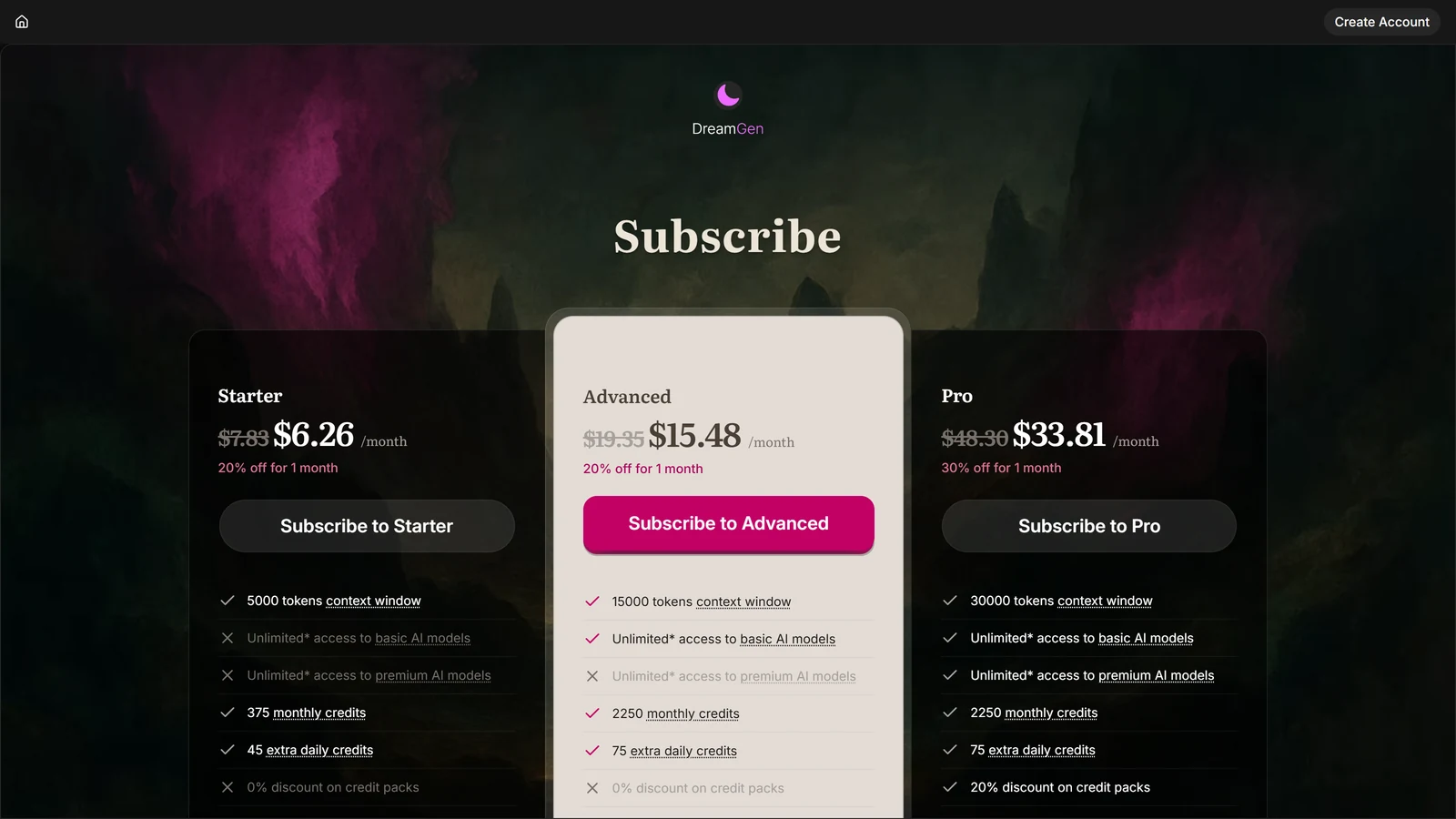
DreamGen is a website for AI role-play and story writing. You play scenarios, which are a world, some characters and a plot, as a chat with several characters at once, or you write a story and steer it. Its second version replaced the first in early 2026.
We have not played DreamGen, and this page is not a review: it is not rated on our benchmark. Everything below comes from DreamGen’s own site, pricing page, documentation and terms, read on 23 October 2026. Where we could not confirm something, we say so.
The Short Version
| Question | Answer on 23 October 2026 |
|---|---|
| Is there a free tier? | Yes, with limited monthly and daily credits and a small context window |
| What do plans cost? | Starter $7.83, Advanced $19.35 and Pro $48.30 a month, as shown to us in dollars |
| Is there a discount? | Yes, shown as 20% off the first month on Starter and Advanced, and 30% on Pro |
| What are the models? | Seven first-party models and about two dozen third-party ones, and the list changes |
| What does “unlimited” mean? | Some models cost 0 credits on some plans, under a fair-use rule |
| Who can use it? | Its terms say you must be 18 or older |
| What happened to V1? | Its migration guide says V1 became read-only on 15 January 2026 and shut down in March 2026 |
If you only read one line: DreamGen’s free tier lets you try every model with a small memory, and the real change between plans is how many tokens the AI can see and which models cost nothing.
What DreamGen Is
DreamGen’s own tagline is “AI games and stories”. It describes two things:
- Role-play. You pick a scenario, such as a fantasy world called Eldoria, a librarian character, a necromancer’s apprentice or a wasteland trader. You talk with one or more characters in a chat-like screen, and you can steer what happens.
- Story writing. An AI story writer for fiction in any genre, where you give it a premise and it writes, and you steer.
A scenario is the foundation of both. Its documentation says a scenario defines the world, characters, plot and style, and compares it to a game master’s guide combined with character sheets and world notes. Most parts are optional: plot, setting, style, characters, locations, objects, an opening scene and examples of how it should be written.
It also has an image generator. Pictures cost credits, and the cost is shown before you generate.
How Role-Play Works
DreamGen’s role-play does not work like a plain chat window. It splits a session into interactions, and there are three kinds:
- Narrative. The narrator describes the scene.
- Character message. A message from a named character: their speech, actions and, if you want, thoughts. You can have many characters in one session.
- Instruction. A direction to the AI that is not part of the story, such as “the scene moves to the next morning” or “make the next message from Harry at least 200 words”.
That third kind is the feature that sets it apart from most chat apps. It gives you a director’s chair inside the conversation.
The guide lists the other controls that matter:
- Behavior modes. Take-Turns is the default: the AI plays the other characters and stops when it thinks it is your turn. Spectate has the AI play everyone, including your character. NPC Only limits it to characters already defined or already in the story.
- Retry options. Retry, retry with a different model, retry as a different character, make it longer, make it shorter, or ask for a rewrite with your own instruction. Each retry makes an alternative version you can flip between.
- Edit and pin. You can edit any interaction, yours or the AI’s. A Pinned interaction gets higher priority in the AI’s memory, and the guide says to use it sparingly. Hidden and Excluded hide text from you or from the AI, mainly for scenario creators.
- Fork. You can start a new session from any point, keeping everything above it or below it.
- Choose the next step. Also called CYOA. It suggests next steps under the latest reply, in the form of your character’s message, an instruction, or a short narrative. You can turn it on for any session.
- A role-play assistant. A helper in the sidebar that can see your scenario and recent history, for ideas and for checking whether a character is acting consistently.
Each session gets its own copy of the scenario, which you can edit while you play. That is useful for updating a relationship or adding a character as the story goes. It does not change the original scenario. The migration guide says syncing updates from the original is coming.
For how this compares with other platforms’ approach to steering, see our guides to SillyTavern and Wyvern Chat.
The Free Tier and the Plans
DreamGen says its free tier gives you access to all current models, with limited monthly and daily credits and a basic context window of about 4,000 tokens.
The plans, as shown on its pricing page on 23 October 2026:
| Free | Starter | Advanced | Pro | |
|---|---|---|---|---|
| Price a month | $0 | $7.83 | $19.35 | $48.30 |
| First-month offer shown | $6.26 (20% off) | $15.48 (20% off) | $33.81 (30% off) | |
| Headline context window | About 4,000 tokens | 5,000 tokens | 15,000 tokens | 30,000 tokens |
| Monthly credits | Limited | 375 | 2,250 | 2,250 |
| Extra daily credits | Limited | 45 | 75 | 75 |
| Basic models | Pay credits | Pay credits | Unlimited* | Unlimited* |
| Premium models | Pay credits | Pay credits | Pay credits for the larger ones | Unlimited* |
| Credit packs | No | Yes, full price | Yes, full price | Yes, 20% off |
| Third-party model discount | None | None | None | Up to 60% on select models |
*Unlimited means 0 credits are used for the listed models on that plan, and a fair-use rule applies.
Two warnings about these figures. First, the dollar amounts are odd, such as $7.83, which suggests they were converted from another currency for our location, so check what your own page shows. Second, the pricing page’s FAQ gives different context sizes by model than the headline row. For example, a table there shows Advanced with 8,000 tokens on some models and 15,000 on others, and Pro with 30,000 to 60,000. The headline numbers are a summary, not a promise for every model.
What credits and tokens mean
Credits are what you spend on text and images. For text, the cost depends on the model, how long the story is so far, how long the reply is, and your plan. On the unlimited models it is zero. For images, the credits are shown before you generate.
Tokens are how a model counts text: about 4 characters each, so 1,000 tokens is roughly 750 words. A context window is the AI’s working memory, the total text it can look at once. DreamGen’s FAQ gives its own scale: 30,000 tokens is about 100 pages of fiction.
For play, the context window is the number that matters most, because it decides how much of your story the AI can see. A 5,000-token window holds about 3,750 words of story and scenario together. The documentation says it trims the oldest parts when the text gets too long. Our guide to why AI campaigns forget explains why that limit exists on every platform.
Monthly and daily credits
The rules on its pricing page are plain:
- Monthly credits reset on a date tied to your subscription start, or your account creation if you are not subscribed. They do not roll over.
- Daily credits are a safety net. They only start after you have used your monthly allowance, and they do not accumulate.
- Credit packs are for subscribers only. Bought credits are used after the recurring ones run out.
- When a subscription ends, the limits drop back to the free tier at once.
Cancelling and refunds
You can change plan at any time, and the change takes effect immediately. Upgrades are charged pro rata; downgrades are credited to your account balance, not refunded to your card. Cancelling keeps the plan until the end of the billing period. The pricing FAQ says DreamGen offers prorated refunds, by email, judged on days left, credits used and past requests. Its terms of service, updated on 23 March 2026, say purchases are final and non-refundable, with exceptions that the terms list. We cannot tell you which applies to you, so read both before you pay.
The Models
DreamGen says it offers “a large selection” of models, in two groups.
First-party models are the ones it hosts and fine-tunes. Its list on 23 October 2026 shows seven:
| Model | Unlimited on |
|---|---|
| Gemma 4 26B A4B | Advanced and Pro |
| Qwen 3.5 27B | Advanced and Pro |
| Lucid Base (legacy, to be deprecated) | Advanced and Pro |
| Gemma 4 31B | Pro |
| GLM 4.7 | Pro |
| GLM 5.2 | Pro |
| Lucid Max, “Chonker” (legacy, to be deprecated) | Pro |
Third-party models cost credits. The list is long: DeepSeek 3.2, V4 Flash, V4 Pro and V4.1 Flash, several GLM versions from 4.7 to 5.3, Kimi K2.6, three MiMo versions, MiniMax M3, Mistral Large 4, several Muse versions, Inkling, Inkling Small and Reflection Beam 1.0. For help picking among the DeepSeek and GLM models, see our best model guide for roleplay.
DreamGen says it may change first-party models on short notice, and third-party models may change at any time because of provider updates. That means this section is the most likely to be out of date. Check the model picker.
Scenarios and Publishing
The scenario editor is where the depth is. Its documentation says you can be as vague as one sentence for a plot or as detailed as scene by scene, and the AI fills in the rest. There is also a scenario wizard, a chat that helps you brainstorm and build a scenario.
For length, it gives limits that matter: if the scenario definition is too long for the model’s context window, you get an error. It recommends keeping the definition under about 2,000 tokens for a 4,000-token window, under 5,000 for 8,000, and under 8,000 for 15,000 or more. The advice is to write less, because the model can fill in most detail itself.
Scenarios can be published, publicly listed or unlisted. Publishing is optional.
If you are writing a world for a language model, our guides to SillyTavern lorebooks and how to open an AI RPG cover the same craft on other platforms.
What Changed From V1
The migration guide says DreamGen V1 became read-only on 15 January 2026 and was to be fully shut down in March 2026, and that V1 subscriptions and credits carry over to V2. V2 is at v2.dreamgen.com. The changes it lists:
- Each session has its own copy of the scenario.
- Two themes, Basic and Immersive, with font and background choices.
- New third-party models, including DeepSeek and GLM.
- A scenario wizard and a publishing system.
- A setting section in scenarios for world, time, lore and atmosphere.
- Retry with instructions, and the assistant moved into the sidebar.
Its welcome screen still labels V2 “2.0 beta”. If you wrote about, or relied on, V1, check that what you remember still applies.
Content Rules and Who Can Use It
DreamGen’s terms, updated on 23 March 2026, say you must be at least 18 and of the age of majority where you live. They prohibit generating content that is illegal in the United States, the EFTA countries or your own jurisdiction, and content that depicts, describes or promotes sexual content involving minors, including fictional minors. They also say content is fiction, and you are responsible for what you generate.
The terms give DreamGen a broad licence to use your content to run and improve the service, and say it does not claim ownership of what you generate. We did not find a description of a general filter on adult themes in the terms or the pages we read, and we did not test one.
What We Could Not Confirm
- How good the writing is. We have not played it, and a model name says little.
- How the memory holds over a long session. Its context window is small on the free and Starter plans.
- Prices in your currency. The figures above are what we were shown.
- Whether the “unlimited” models slow down. The fair-use rule says it monitors for automated use and abuse, not heavy human use, but we did not test it.
- A phone app. We found none linked from the site; it runs in a browser.
Where It Sits Among the Alternatives
| If you want | Look at | Our guide |
|---|---|---|
| A free place to try character chat | Several | Best free AI roleplay |
| More control and your own model | SillyTavern | SillyTavern guide |
| A story game with many community worlds and a model choice | Infinite Worlds | Infinite Worlds |
| A free app with worlds and dice | Wyvern Chat | Wyvern Chat |
| The open story most people know | AI Dungeon | AI Dungeon alternatives, and AI Dungeon vs DreamGen |
| A writing studio with a Lorebook | NovelAI | DreamGen vs NovelAI |
| A game with real rules and a lasting memory | Scored platforms | Best AI roleplay platforms |
What sets DreamGen apart, from what we have read, is the instruction interaction and the multi-character structure. What it shares with every site on this list is that the memory is a window, and the free tier’s window is small.
A Short Checklist
- Want to try it? Make a free account and test the same scenario on two models.
- Story feels forgetful? Check your plan’s context window, and keep the scenario short.
- Want the AI to change direction? Add an instruction, not a long edit.
- Need a certain character to answer? Use the character selector or “Retry as”.
- Paying? Read the pricing FAQ and the terms on refunds, and check your own price.
- Under 18? You cannot use it.
Frequently Asked Questions
Is DreamGen free?
Yes, to start. Its free tier gives access to all current models with limited monthly and daily credits and a basic context window of about 4,000 tokens. Subscribers get more credits or unlimited use of some models, a larger context window and faster responses.
How much does DreamGen cost?
On 23 October 2026 its pricing page showed Starter at $7.83 a month, Advanced at $19.35 and Pro at $48.30, with first-month offers of 20% off on the first two and 30% off on Pro. The odd amounts suggest conversion from another currency, so check your own page.
What does unlimited mean on DreamGen?
On the listed models, the credit cost is zero on that plan. Advanced is unlimited on its smaller models and Pro on all current text models, while images still cost credits. A fair-use rule applies: DreamGen says it monitors for bots, scripts, account sharing and similar abuse.
What models does DreamGen use?
It offers seven first-party models, including Gemma 4, GLM 4.7, GLM 5.2 and Qwen 3.5, and about two dozen third-party models such as DeepSeek V4, GLM, Kimi, MiMo, MiniMax, Mistral Large 4 and Muse. Its list changes, so check the model picker.
What is the DreamGen context window?
It is the amount of text the AI can see at once, measured in tokens. Its pricing page shows about 4,000 to 5,000 tokens on the free and Starter plans, 8,000 to 15,000 on Advanced and 30,000 to 60,000 on Pro, depending on the model.
What happened to DreamGen V1?
Its migration guide says V1 became read-only on 15 January 2026 and was to shut down in March 2026. V1 subscriptions and credits work in V2, and an import tool brings over scenarios, sessions and templates.
Is DreamGen NSFW or unfiltered?
We did not test it. Its terms prohibit illegal content and sexual content involving minors, including fictional minors, and require users to be 18 or older. We did not find a general adult-content filter described on the pages we read.
Can I get a refund from DreamGen?
Its pricing FAQ says it offers prorated refunds by email, based on days left, credits used and whether you have asked before. Its terms say purchases are final, with exceptions the terms list. Read both, and ask support before you rely on either.
DreamGen and the models named on this page are third-party products and names are used nominatively. Arcanum is not affiliated with DreamGen or any model maker named here. Everything on this page was read from public pages on 23 October 2026 and may change.