Infinite Worlds in 2026: Free Turns, Credits, Models, and Why It Forgets
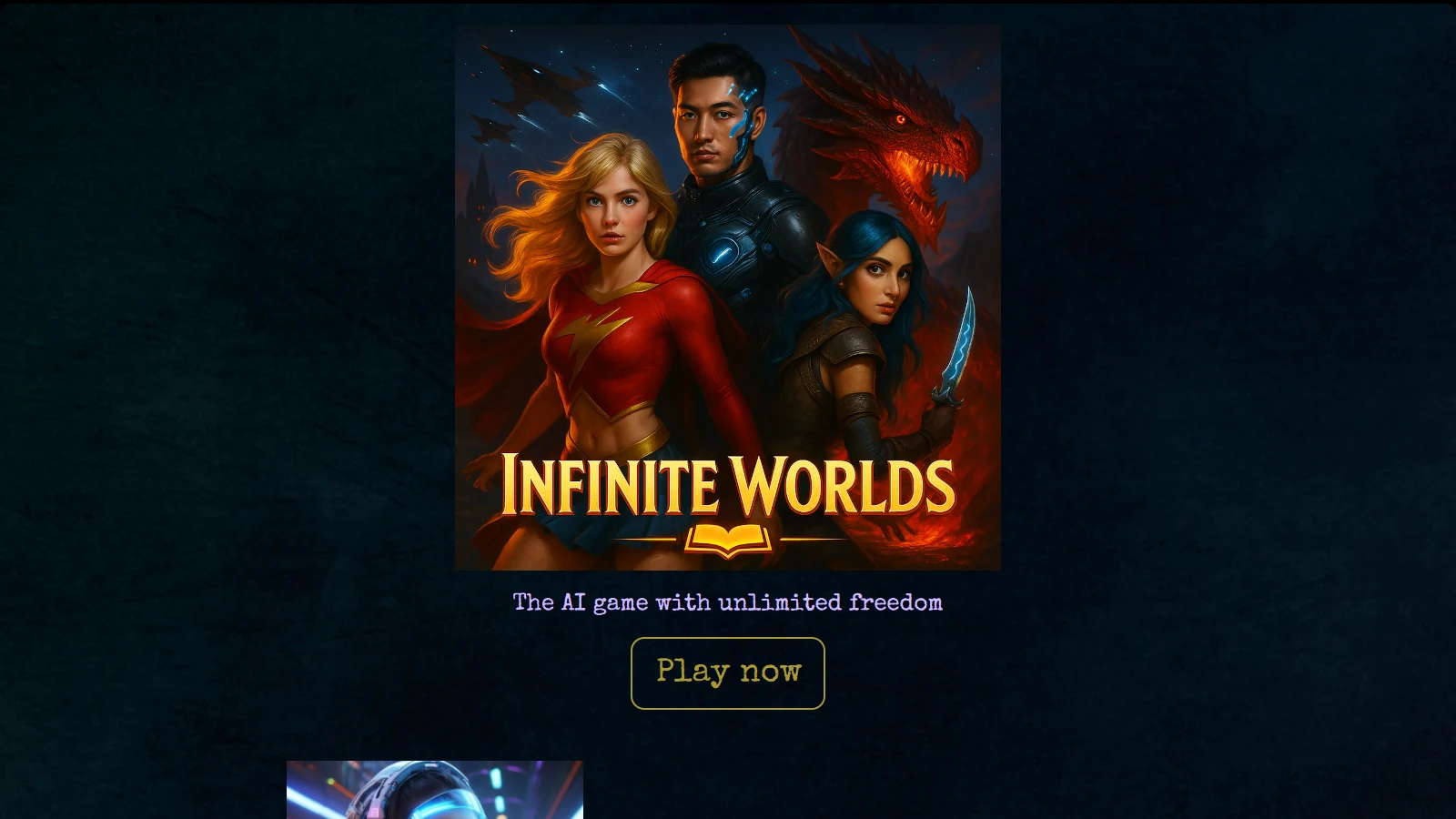
Infinite Worlds is a browser game where an AI tells a story and draws pictures for it, and you can play worlds that other people built or describe your own in a few words. It is made by one developer, Friendly Fox Games, and you pay for it with credits and a small daily allowance of free turns.
We have not played Infinite Worlds, and this page is not a review: it is not rated on our benchmark. Everything below comes from Infinite Worlds’ own site, read on 23 October 2026, and from its community-maintained wiki, which says it is written by players and has a list of pages that need updating. Where the wiki is the only source, we say so. Where we could not confirm something, we say that too.
The Short Version
| Question | Answer on 23 October 2026 |
|---|---|
| What is it? | An AI story game with illustrations, community worlds and a world builder |
| Who makes it? | Friendly Fox Games, an independent developer working on it since November 2023 |
| Is it free? | Partly. Registered accounts get a few free turns a day; everything else costs credits |
| Is there a subscription? | No, according to the community wiki. You buy credits |
| Can I choose the AI model? | Yes. Its wiki lists 14 storyteller models, from Claude and Gemini to GPT and its own |
| Does it remember well? | Not perfectly. It sends the last few turns and a summary, and the summary loses things |
| Who can play? | Its terms say you must be 18 or older and have an account with an email address |
If you only read one line: Infinite Worlds is a good fit if you want many community-made scenarios, a choice of models and tools to fix the story when it goes wrong, and you are happy to count credits.
What It Is
The site’s own pitch is “The AI game with unlimited freedom”. It says you can do whatever you want, “or at least you can try to”, because your character might fail. It also says you can build your own worlds “in minutes” and share them with friends.
The developer says it started as a hobby project, fitted around a full-time job and childcare. After ChatGPT came out, he spent a lot of time trying to make choose-your-own-adventure games work in it, and found that the AI kept forgetting what was happening. Since November 2023 he has been building a system to get more out of newer models.
Three things make up the game:
- A library of worlds. Your own, example worlds, and community worlds that anyone can publish. You can filter community worlds for “Mature” and “NSFW” content.
- A way to play them. Type an action, and the AI writes the result and suggests next actions. Illustrations come with it.
- A toolkit to make worlds. You describe an adventure in anything from a few words to many paragraphs, and a world generator fills in the instructions, skills and player characters. You can then edit all of it.
When you start a game, the game copies the world. Editing the original later does not change a game already in progress.
How a Turn Works
The site’s FAQ describes it simply. Each time you act, a request goes to an AI. The request explains that you are playing a game, says what has happened so far and asks what happens next. The AI also writes instructions for an image generator, which draws the illustrations.
The wiki gives more detail. On every turn the storyteller AI is sent:
- The world’s main instructions.
- Your action.
- The last 2 to 8 turns, word for word.
- A summary of everything before that.
Then it writes the outcome, a list of suggested actions, a hidden field called secretInfo, and any updates to tracked items (such as inventory or relationships). From turn 8, and every 6 turns after that, a separate summary AI rewrites the summary of the story so far. The wiki says that summary AI is currently Kimi K2.5.
The wiki makes one more point that matters for memory: the storyteller models do not remember anything on their own. Infinite Worlds keeps the state and sends it each turn. That is why you can switch models in the middle of a game.
Why It Forgets, and What You Can Do
The wiki’s FAQ opens with this question: why does the AI forget things all the time? It gives two reasons.
- The AI makes mistakes. Even when it has the information, it can get confused and miss it.
- It does not see the whole history. It relies on the summary, and the summary loses information. Once something is gone, the AI has no way to know.
This is the same limit every AI story game has, and the wiki is honest about it. Our guide to why AI campaigns forget explains the cause. What is useful about Infinite Worlds is that it gives you tools to push back:
- Storyteller Mode. You turn it on from the menu. It shows the hidden fields, lets you edit the current turn, and adds a box where you can tell the AI what should happen next. The wiki says anything you change in the current turn is treated as true by the AI in the next one.
secretInfo. The wiki says the summary AI pays special attention to it, so important facts written there are more likely to reach long-term memory.- Tracked items. A world’s author can track things such as skills, inventory and relationships, with a limit of 10,000 characters per item. The wiki says items longer than that get shortened.
- A warning about switching models. The wiki says moving from a high-end model to a low-end one can cause memory problems, because the cheaper models miss more details.
The wiki also says there is no official way to see everything in long-term memory. It shares a community-written command that asks the AI to print its summary, and says it is not supported and may need several tries.
The Models
You choose the storyteller model from the main menu. The wiki’s table of active models, read on 23 October 2026, lists these:
| Name in the game | Model behind it, per the wiki |
|---|---|
| Wildcat | Hermes 3, 405B |
| Lynx, Lynx-Thinking | Claude Haiku 4.5 |
| Smilodon, Smilodon-Thinking | Claude Sonnet 4.5 |
| Massivecat, Massivecat-Thinking | Claude Opus 4.6 |
| Grimalkin | GPT 4.1 |
| Leopard | Gemini 2.5 Pro |
| Leopard-2 | Gemini 3.1 Pro |
| Puma | Gemini 3.8 Flash |
| Caracal | Xiaomi MiMo-V2.5-Pro |
| Wampus | Aion-2.0 |
| Dolphin | A custom-trained model |
Infinite Worlds does not host the models. The wiki says it sends your game text to each model’s provider, and it links the game’s page on OpenRouter, a service that routes requests to many models.
The wiki rates each model from 1 to 5 on instruction following, cost, inventiveness, pace and turn length, and adds pros and cons written by players. Several entries are marked as untested or unfinished, and the page says its ratings are “knowledge from experience” and not measurements. Treat it as player opinion. What it says, in short:
- Wildcat is the best very cheap model. It writes short turns, does not handle complex worlds well, and is good for simple conversation turns.
- Lynx is cheap, with quality the wiki compares to Smilodon, but it misremembers details and sometimes ignores instructions.
- Grimalkin is called an excellent free-turn model and a very capable mid-range one. It can get stuck in a rut, and its turns are shorter.
- Smilodon follows instructions well and writes clever, long turns. The wiki warns that it is wordy, which makes it expensive, and that it can write a long backstory for every minor character.
- Leopard is clever and good for worlds with many mechanics, but is described as putting too much weight on skill tests and leaning dark. It is usually the most expensive.
- Caracal and Wampus are described as relaxed about adult content. Caracal can take more than a minute to write a turn.
- Retired models such as Lion and Ocelot appear in the wiki’s history, which tells you how fast the list changes.
The model list is the part of this page most likely to be out of date first. The wiki itself keeps a “pages needing updates” list, and one section still says a retired model handles memory. Check the in-game menu before you choose.
Credits, Free Turns and Cost
Infinite Worlds charges in credits. The wiki says credits are spent according to the number of words in the instructions sent to the AI and the words it writes back, including tracked items, hidden fields and your own input. So the cost of a turn varies with the world, not only with the model.
What the wiki says about size:
- Its “cost” scale runs from about 30 to 60 credits a turn for the cheapest models to 150 or more for the dearest, before any extra instructions.
- Images cost a small amount, typically 3 to 5 credits each.
- The summary process is paid for by the developer, according to the wiki, and does not use your credits.
- It advises world authors to play 10 to 20 turns and note the average cost, and to put that in the world’s description.
Free turns. Registered accounts get a few free turns a day. The wiki’s table lists 1 to 3 free turns for each model and adds a warning: the maximum is 3 free turns a day in total, however you split them across models. Its credits menu shows the free turns left for the model you have selected.
Buying credits. The credits menu has an “add credits” button with amounts that go up in steps, and payment happens on an outside website. We could not see the prices, because they are shown inside the account and not on its public pages, so we do not quote any. The site’s FAQ says almost all of the income from credits goes on paying for the AI. The wiki says the developer has said no to a subscription, because he cannot cover the costs without either unfair pricing or outside funding.
If you want to compare how other games charge, our guide to what AI RPGs cost explains the common models.
Bonus Credits: A Referral Scheme
The site has an unusual system for earning credits, and it is explained on its own FAQ. If you share a world, yours or someone else’s, and another player follows your link and starts playing it, you earn bonus credits:
- 3% of all the credits that player spends, with no end date.
- 5% of what they spend on the shared world, or 10% if you created the world yourself. The author of someone else’s world also gets 5 credits per 100 spent.
You can spend bonus credits on play. The FAQ also says that with 50,000 bonus credits or more, a cash-out option appears in the credits menu at $50 per 50,000 credits, paid by PayPal. It says some players who shared the game in online communities have earned over a million.
The developer says he wrote this because he is bad at marketing and the game spreads by word of mouth. He asks players not to spam. For you, as a reader, the practical point is simple: a link to a world on a forum may be a referral link, and a world’s author may have a reason to promote it.
Building a World
The world builder is what the developer calls the most unique feature. The wiki lists what a world can contain:
- Main instructions and a description, an objective, and victory and defeat conditions.
- Player characters and other characters.
- Tracked items, for skills, inventories and relationships.
- Triggers, which change the instructions when something happens in the story.
- An author style and instructions for the illustrations.
- PawScript, a scripting language added on 14 July 2026, along with a newer format for tracked items that the AI can update in parts.
There are six models that can generate a new world from your description, and the wiki says Smilodon is the best general choice. Editing is recommended for worlds with a very specific setting or a mostly fixed plot, and for steering around a model’s habits, such as the wiki’s remark that one older model liked listening devices and grand conspiracies.
If you want to write rules and a world bible for a language model, our guides on mechanics in AI RPGs and SillyTavern lorebooks cover the same ideas on other platforms.
Content Rules and Who Can Play
The terms, last updated on 1 October 2024, say you must be at least 18 years old and have an account with a valid email address. They say you keep the rights to the text and illustrations you generate, and may share them outside the game. They prohibit content that glorifies or encourages self-harm, suicide or violence, and real-world illegal activity such as fraud or hacking.
The wiki says turns are checked by a moderation system, and that when a turn is flagged, a second AI evaluates the risk and shows the result to you. It adds that these systems “are not terribly smart” and make some silly mistakes. Community worlds have a “Mature” and an “NSFW” filter.
Its privacy policy, effective 1 October 2024, says it does not sell or rent personal information and may share some data with service providers. Read both policies before you sign up.
What We Could Not Confirm
- Prices. Credit packs are priced inside the account, and we did not see them.
- Whether the model list is current. We read the wiki’s table, and it is community-written.
- How good the writing is. We have not played it, and a model name tells you little about a particular world.
- Whether there is a phone app. We found none linked from the site; it runs in a browser.
- How it compares in score. It is unrated here. For the games we have scored, see our ranking.
Where It Sits Among the Alternatives
| If you want | Look at | Our guide |
|---|---|---|
| The best-known open story, with no rules | AI Dungeon | AI Dungeon review, and AI Dungeon vs Infinite Worlds |
| A list of platforms like AI Dungeon | Several | AI Dungeon alternatives |
| More free options | Several | Best free AI roleplay |
| A game with real rules and a memory that lasts | Scored platforms | Best AI roleplay platforms |
| Pictures with your story | Several | AI RPGs with images |
| An AI strategy sandbox where you run a country | Pax Historia, Open Historia | Pax Historia and Open Historia |
From what we have read, what sets Infinite Worlds apart is the combination of a large library of community worlds, a choice of strong models and an editor that lets you fix the story from inside it. What it shares with the others is that the memory is a summary, so the longer a game runs, the more you will need those tools.
A Short Checklist
- Want to try it? Make an account, use your free turns and pick a cheap model first.
- Not sure which model? Start with a cheap one such as Wildcat or Lynx for simple worlds, and a stronger one for complex worlds, and check the cost of a few turns.
- The AI forgot something? Turn on Storyteller Mode and edit the turn, or put the fact in
secretInfo. - Switching models mid-game? Go from strong to cheap with care, because cheaper models miss more details.
- Building a world? Play 10 to 20 turns, note the cost per turn and write it in the description.
- Sharing a world? Remember it can earn you bonus credits, and do not spam.
- Under 18? You cannot register.
Frequently Asked Questions
Is Infinite Worlds free?
Partly. A registered account gets a few free turns each day, and its community wiki says the maximum is 3 free turns a day however you split them across models. Everything beyond that costs credits, which you buy. It has no subscription according to the wiki, and we could not see the credit prices on its public pages.
How much does Infinite Worlds cost?
The wiki says a turn costs from about 30 to 60 credits on the cheapest models to 150 or more on the dearest, before any extra instructions, and that images cost about 3 to 5 credits each. The price of credits is shown inside the account, and we did not see it, so we cannot give a cost in money.
What AI model does Infinite Worlds use?
You choose. The wiki lists 14 storyteller models, including Claude Haiku 4.5, Sonnet 4.5 and Opus 4.6, GPT 4.1, Gemini 2.5 Pro, 3.1 Pro and 3.8 Flash, Hermes 3 405B, Xiaomi MiMo-V2.5-Pro, Aion-2.0 and a custom-trained model, under names such as Lynx, Smilodon, Massivecat, Grimalkin, Leopard, Wildcat and Dolphin. The list changes, so check the in-game menu.
Why does Infinite Worlds forget things?
The storyteller sends only the last 2 to 8 turns word for word, plus a summary written every few turns. The wiki says the summary loses information, and once it is lost the AI has no way to know. You can use Storyteller Mode to edit a turn, or write important facts in the hidden secretInfo field, which the summary pays special attention to.
How do bonus credits work in Infinite Worlds?
If another player follows your link to a world and plays it, you earn 3% of all the credits that player spends, and 5% of what they spend on that world, or 10% if you created the world. With 50,000 bonus credits or more, you can cash them out at $50 per 50,000 credits through PayPal, according to the site’s own FAQ.
Is Infinite Worlds NSFW?
It allows adult worlds. Community worlds have separate Mature and NSFW filters, and the wiki describes some models as relaxed about adult content. Its terms prohibit content that glorifies or encourages self-harm, suicide or violence, and real-world illegal activity. You must be 18 or older to register.
Is there an Infinite Worlds app?
We found no app linked from its site on 23 October 2026. It runs in a browser.
Who makes Infinite Worlds?
Friendly Fox Games, an independent developer. The About page says it began as a hobby project alongside a full-time job and childcare, and that he has been building it since November 2023.
Infinite Worlds and the models named on this page are third-party products and names are used nominatively. Arcanum is not affiliated with Friendly Fox Games, Anthropic, OpenAI, Google or any model maker named here. Everything on this page was read from public pages on 23 October 2026 and may change.