How to Play Worldtable (2026): Free Turns, Joining a World, Delves, Costs and the Rules You Should Know
Worldtable is an AI game master where the AI writes the story and ordinary game code rolls the dice, prices what you do and keeps the record of what you own. That split decides how you play it well. You say what your character tries; the engine rules on it; the storyteller makes it a scene. This guide takes you from sign-up to your first hour, with the costs and the traps, using Worldtable’s own docs (read 4 November 2026) and what we found in our Extended review.
Disclosure: Worldtable gave us 250 free credits for our review. No conditions were attached, and our coverage is independent and unpaid.
What this page is built from. Our review played Worldtable’s own worlds at length and rated it 4.5, first of thirty-one platforms on our benchmark. It did not test the World Studio (the builder), rule systems or the newest updates, so anything below about those comes from Worldtable’s pages and is marked. Prices are from Worldtable’s credits page as we read it on 3 November 2026, and its terms call the service early access, so they can change.
The Short Version
| Question | Answer |
|---|---|
| Cost to start | Free. 50 credits on a new account, once. One credit is one turn |
| After the free turns | Packs from $5, or $12 a month for 650 credits |
| How to sign in | Google, or an email and password. You pick a username |
| Getting into a world | Press Play now on an open world, use an invite link, or ask to join |
| One thing to do on turn one | Write what you attempt, not what happens |
| Undo | Your latest turn only, with limits |
| Who it is for | Adults. It is early access |
Step 1: Sign Up and Use Your 50 Free Turns
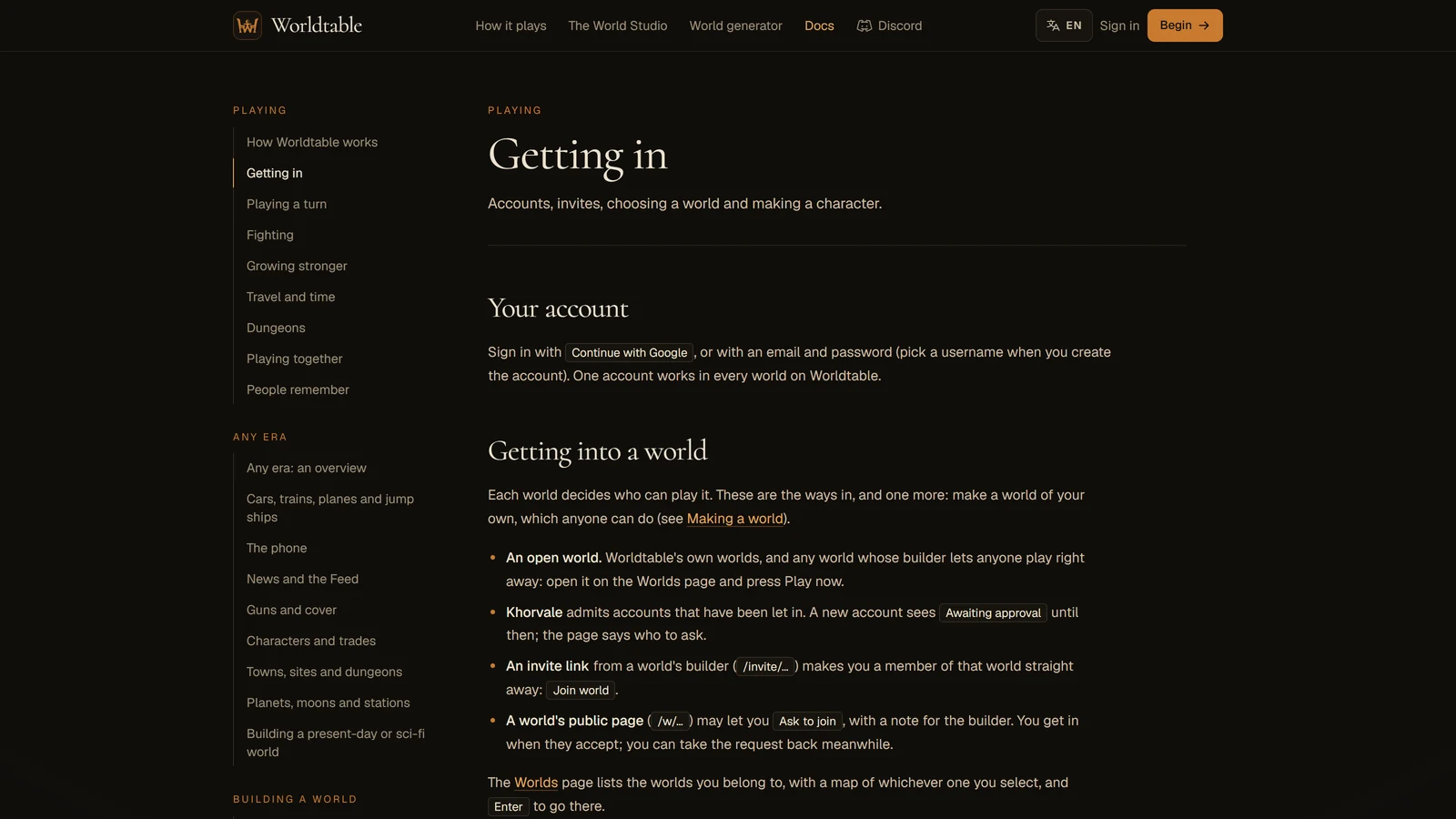
You sign in with Google or with an email and a password, and you choose a username. One account works in every world, and each character belongs to one world, so making a character in a new world leaves your others alone.
The 50 credits are given once and are the whole free allowance. One credit is one turn, so 50 turns. A voice on a turn costs one more credit and a picture costs one, so a session with voice and pictures turned on will use them faster. A turn the world never answers is given back, and so is a picture that fails to paint.
Step 2: Get Into a World
There are four ways in, from Worldtable’s getting-started page:
- An open world. Some worlds let anyone play. Open one from the Worlds page and press Play now.
- A builder’s invite link. An invite link adds you to that world straight away.
- Ask to join. Some public world pages let you request access. You are in once the builder accepts, and you can withdraw the request before then.
- A world that needs approval. Khorvale is the docs’ example. A new account sees “Awaiting approval” until it is admitted.
Worldtable also drafts a world for you from six questions in a minute or two, if you would rather start from your own idea than someone else’s world. That is part of the builder side, which we did not test.
Step 3: Make a Character
Each character belongs to one world. You can use Create with AI, which offers four possible lives, or start from scratch. The steps are lineage, backstory, appearance and name, power and magic points, belongings, up to two kinds of magic if the world has them, and a starting region.
Backstories are checked. The docs say nonsense, abuse, or content that contradicts the world’s canon is sent back, and that claiming godhood earns nothing: at best, a new character is a capable adventurer. Write a person the world could contain.
Step 4: Your First Turn
You begin in a town square with a road leading out. The in-game Codex offers a short tour the first time you open it. Then you type what your character does.
Write what you attempt, not the result. The docs’ own example is “I lunge for the captain’s sword arm”, not “I cut off the captain’s arm”. The engine decides what happens. You can write in your own person, tense and length, and the storyteller matches your style. Speech in quotation marks is heard by people nearby. Thoughts are narrated, but nobody in the scene reacts to them.
In our review this was the thing that made it feel different from most AI game masters: it did not narrate our character doing things we never typed, and it did not steer us back to a plot. That is the Player Agency 5 in the review.
What the Engine Decides and What the Storyteller Decides
Worldtable is unusually open about this, and it is worth reading before you play.
| Decided by | What |
|---|---|
| The engine (code) | Whether an attack lands and how hard, stamina and mana costs, where places are and how long roads take, what you own and what it is worth, whether you live |
| The storyteller (AI) | What people say, want and do, how clever your plan was, and judgment calls such as whether overwhelming damage kills outright in a world with final death |
The engine acts through tools that check the world’s rules first: spawning people, starting fights, moving you and handing over items. It also records the turn, the clock and what each NPC remembers about you. The storyteller reads your action, then looks up the place, the people present, your history with them and the world’s lore.
Steering Notes, Undo and Death
Steering notes. Put a note in brackets, such as (OOC: slow down), to speak to the storyteller outside the fiction. Requests about pacing and tone are honoured, but tone never changes health, injuries, death or the result of a fight, and requests for gold, items, stats or a character’s decisions are declined. The docs say notes are paraphrased before the storyteller sees them, and a world’s builder can turn steering off.
Undo. Undo rewinds only your most recent turn, and reverses its narration, costs, items, NPC memories, money, experience, any fight it started and any death it caused. It does not work while a turn is resolving, while another player acts in the same room, in a party fight or inside a dungeon. NPC trust is not rolled back, so a character who saw you do something still remembers it.
Death. At zero health you are downed, and a clock runs: twelve in-game hours in Khorvale. Healing above zero saves you. When the clock runs out, death is final in Khorvale and in worlds set that way, while other worlds may wake you barely alive. Check a world’s rule before you take a risk, and use the undo before you take another turn.
Turns keep running if you close the tab, because they run on the server, and a character can only run one turn at a time. Rooms are shared, turns in a room are resolved one at a time, and the storyteller never speaks or acts for another player’s character.
What Things Cost
From Worldtable’s docs on players and costs, and our review’s pricing section.
| Item | Cost | Who pays |
|---|---|---|
| A turn | 1 credit | The player taking it |
| A party fight round | 1 credit per acting player. Guarding is free | Each player |
| Read-aloud | 1 credit for the first play. Replays are free | The player |
| A portrait, gallery picture or NPC portrait | 2 credits | The player who asks |
| The world wizard’s first draft | 2 credits | The builder |
| Background work such as story memory and NPC memories | Nothing | Nobody |
| Plan | Price | What you get |
|---|---|---|
| New account | Free | 50 credits, once |
| Credit packs | $5, $10 or $20 | 200, 450 or 1,000 credits. Bought credits never expire |
| Adventurer | $12 a month | 650 credits a month, with unused ones carried over for a month, up to 1,300 |
On our review’s figures a turn costs about 1.8 cents on the plan and 2 to 2.5 cents on the packs. The terms allow a refund request within 14 days, less the credits already spent. A world that runs on its builder’s own AI key, or on a player’s own Claude Code or Codex used as the storyteller, does not use credits.
Playing With Friends and Delves
Who pays in a group. The docs say each player pays for their own turns, pictures and read-aloud. A builder can cap each player’s turns per day and pictures in total, and a player who hits a limit is told and has to ask the builder for more. If the builder adds their own AI key, nobody in the world spends credits.
Delves. Worldtable’s announcement of 20 October describes Delves as quick runs of up to three friends through one of 34 dungeons, with no account needed for your friends. Its front page says you send a link, guests join, and the host pays for the turns. That is different from the general rule in the docs, where each player pays, and the docs page on dungeons does not say who pays in a Delve. Treat the front page as the answer for Delves until the docs say otherwise, and check the cost before you invite anyone.
Worldtable’s docs describe dungeons built into a world as one to four levels, drawn in about two minutes, with treasure set when the dungeon is made and no random loot tables. A party shares one run: one position, one fog, one alarm and one set of foes. We did not test Delves or dungeons.
The Traps We Found, and What To Do About Them
Our review scored Worldtable 3.5 on Determinism & Fairness, and all three findings were about items. They are the ones to know before you rely on the economy.
- An item sold, then back again. We were given a valuable item in a quest, sold it and made good money, and later in the same quest we had it again. The developer traced it to the quest listing the item as a main step, which the game weighed above our sale. What to do: do not count on a quest item staying sold until the quest is over, and do not build a plan around that.
- Two ways to loot, and both pay. You can loot in the story or press a loot button, and doing both could pay out twice at times. What to do: pick one way for a given body or chest.
- Looting more than once in the story. With careful wording we could loot narratively more than once. What to do: if you want a fair record, take it once.
We are not telling you to exploit these. We are telling you the engine’s record of items did not always stay ahead of the storyteller, and that this is where the 3.5 comes from. The other thing to know is that characters know too much: people in a new scene sometimes already knew what you did elsewhere. Worldtable’s docs say that is a leak and not the design.
Languages, Eras and Rule Systems
Worldtable’s front page lists play and building in English, Spanish, Japanese, Korean, Portuguese, German, French and Arabic, with each world played in one language. It says each world is set in fantasy, the present day or science fiction, and that the setting changes the engine itself: parchment maps and coins in fantasy, road atlases, cars, trains and phones in the present day, and maglevs, credits and jump ships in science fiction.
It also lists rule systems, in beta, with six ready-made ones (Classic d20 based on the SRD 5.1, Forged in the Dark, Moves in the style of Powered by the Apocalypse, Investigative d100, Grim d100, and Hope and Fear), your own system built from four questions, or a rulebook you upload. We did not test any of this, and no score reflects it.
Is It for You?
It suits you if you want a game that enforces its own rules, with a map you cross by distance and hour, people who remember you, and a long campaign. It will frustrate you if you want the storyteller to bend a rule for the story, because the engine will not. If you want to see how it compares with other top platforms, read our review, and for the two platforms it sits above, our Craft vs Voyage comparison.
Frequently Asked Questions
Is Worldtable free? Starting is free. Every new account gets 50 credits, once, and one credit is one turn in any world. After that you buy credits in packs, from $5, or take a monthly plan at $12 for 650 credits, according to Worldtable’s credits page as we read it on 3 November 2026. Worldtable’s terms call the service early access, so prices may change.
How do I join a world in Worldtable? Open a world that lets anyone play from the Worlds page and press Play now, follow a builder’s invite link, or use Ask to join on a world’s public page and wait for the builder to accept. Some worlds, such as Khorvale, need approval and show Awaiting approval until you are admitted.
Can I undo a turn in Worldtable? You can undo your most recent turn. Worldtable’s docs say it reverses that turn’s narration, costs, items, NPC memories, money, experience, any fight it started and any death it caused. You cannot undo while a turn is resolving, while another player is acting in the same room, during a party fight or inside a dungeon, and NPC trust is not rolled back.
Who pays for turns when I play with friends? By Worldtable’s docs, each player pays for their own turns, pictures and read-aloud, and builders pay for building work. A builder can instead run a world on their own AI key, and then nobody in it spends credits. Worldtable’s front page says that in a Delve, which is a quick dungeon run with friends, guests join by link and the host pays for the turns.
Does the AI decide whether my attack hits? No. Worldtable’s docs say the engine, which is ordinary game code, decides outcomes, stamina and mana costs, items and money, and the AI storyteller writes what people say and do. That is why the docs tell you to describe what you attempt and not the result.
Is Worldtable for children? No. Our review notes it is for adults only. Worldtable’s getting-started page does not state an age rule, so check its terms for the exact wording before you sign up.
Worldtable is a third-party platform. Arcanum is independent and unaffiliated.