Worldtable Review: The Storyteller Writes It, the Engine Rolls It, and the Seams Still Show
Access disclosure: Worldtable gave us 250 free credits for this review. No conditions were attached to our coverage. This review is independent and unpaid.
Worldtable is an AI game master that splits the job in two: an AI storyteller writes every scene and plays every character, and ordinary game code, with a database behind it, rolls the dice, prices what you do, keeps the map and records what you own. It runs in a browser and is for adults only.
It scores 4.5 out of 5, first of the thirty-one platforms on our benchmark, ahead of Voyage and Craft. It earns a 5 on three axes (Signature Design, Mechanical Depth and Player Agency), and a Longevity of 4.5, the first above 4 that we have given. Its lowest score is Determinism & Fairness, at 3.5, and the reason is specific: the game’s record of what you own can still be moved by the story.
We ran our Extended tier against it, the long test, on worlds that Worldtable made itself. Worldtable also lets players build their own worlds in a tool called the World Studio. We did not build one, so nothing below scores the builder, and what we say about the Studio comes from Worldtable’s own pages. Its terms call the product early access. Its name before this one was ChronicleRPG.
What It Is
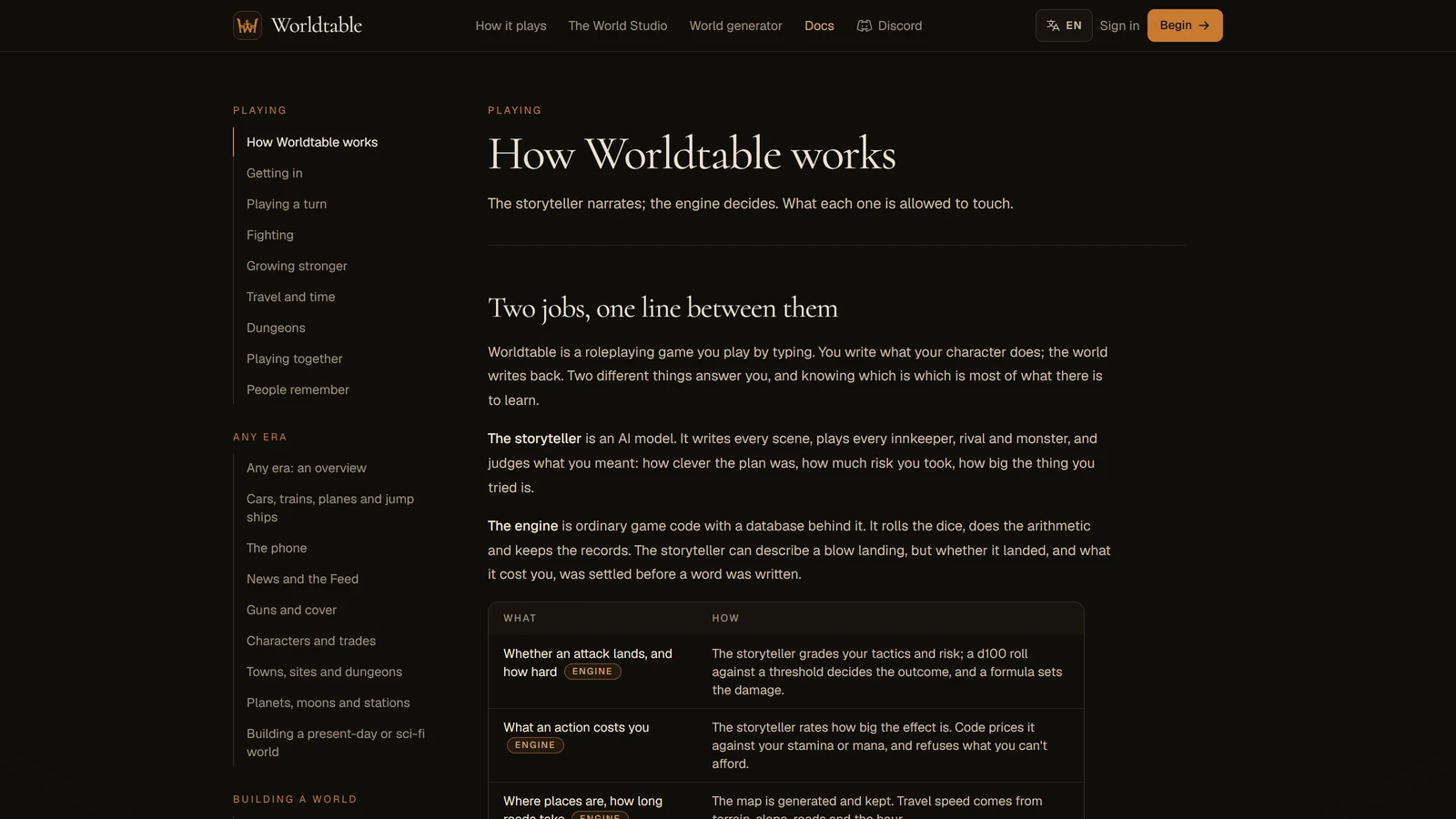
You type what your character does, in your own words. The storyteller answers. What makes Worldtable different is how openly it says which part does what. Its docs mark every mechanic with a tag: ENGINE means code enforces it and nothing typed can argue past it, and STORYTELLER means the AI is told and trusted to follow.
| Decided by | What |
|---|---|
| The engine | Whether an attack lands and how hard, what an action costs you in stamina or mana, where places are and how long roads take, what you own and what it is worth, whether you live |
| The storyteller | What people say, want and do, and how clever your plan was |
The terms of service go one step further: where the engine and the story disagree, the engine’s record, meaning health, items, money and the map, is what counts. That is the claim we tested hardest, and it is where the platform lost points.
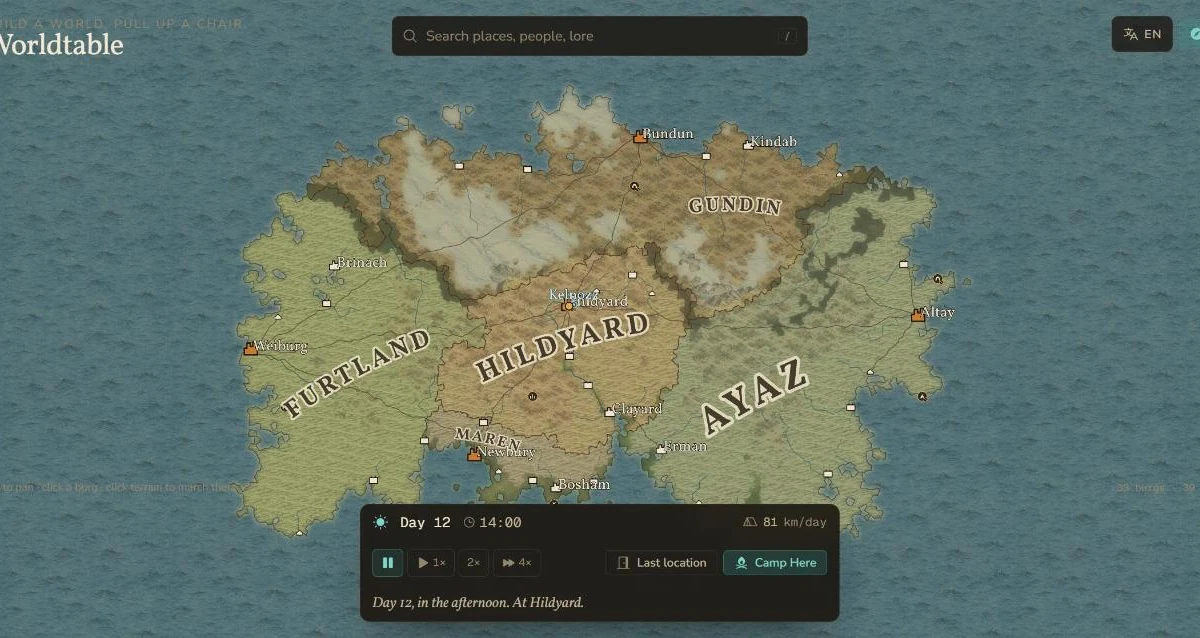
The worlds we played were Worldtable’s own. According to its docs, each comes with a generated map, peoples, a cast and rules about how dangerous things are and whether death is final. You travel the map by distance and hour, people keep their own record of you, and a chronicler writes your adventures up as chapters. Worldtable also offers rule systems, from a d20 system to ones a builder writes. We did not test them, and no score reflects them.
Signature Design — 5
This is the highest score we give. Eight of the thirty-one platforms on our board now hold it.
We cannot name a platform we have reviewed that has more features than this one, and none is built quite like it. By its own documentation, Worldtable has a generated map you cross kilometre by kilometre, travel that depends on terrain, roads and the hour, fights on a battle map, crafting, markets that differ by town, news of your deeds that spreads over days, sea voyages, a story book written for your character, and a World Studio for building all of it. That is a lot of design in one product, and the ambition is the reason the score is a 5.
Mechanical Depth — 5
Depth here is breadth with substance. There are so many mechanics that Worldtable does not need each one to be perfect to earn a 5. Where we saw limits, they came from the creativity of whoever built the world, or from what the models can do, not from systems that were missing. Only Craft and Friends & Fables have scored a 5 on this axis before.
Player Agency — 5
No puppeting and no railroading. The storyteller did not narrate our character doing things we never typed, and it did not steer us back to a plot. The docs describe friction instead of a rail: say what you attempt, not what happens, and the world answers. It surprised us. Two platforms had scored 5 here before, NOPOTIONS and Everweave.
NPC Fidelity — 4.5
The people we met were distinct in what they wanted, what they feared and who they were. It was good flavour, and it held. What would make it perfect is more distinct ways of talking: we did not meet a character whose quirks of speech stood out at once, without checking their details or learning more of their story. Make the difference loud, in the voice, and this is a 5.
Longevity — 4.5
Most of what makes a game worth playing for months is here, and it passes our longevity tests as Voyage does, with less confusion about geography. It stops short of a 5 because an imperfect axis can still exert a toll on the players who most value it. That is the first Longevity above 4 on our board; Voyage, Hidden Door and WyrdTale hold 4.
Memory & Continuity — 4
We found some gaps, and most of them were on details. One gap was bigger, and A1, Worldtable’s developer, explained it to us, so it sits below under Determinism & Fairness, where it belongs. The gaps are small enough that you would not notice them if you were not testing for them.
The real memory problem is the opposite of forgetting: characters know too much. Something happens, you move to the next scene, and the people there already know what happened and act smug about it. It is the habit of a game master who forgot that the character was not in the room. Worldtable’s docs say every named person keeps their own record of you, so a character knowing what happened elsewhere is a leak, not the design. The docs also describe a separate system for news of your deeds, which reaches other towns days later. That is not what we saw: the knowledge was instant. A little forgetfulness and a lot of knowing add up to a 4.
Determinism & Fairness — 3.5
This is the weakest side, and it is weak where Worldtable’s own promise is strongest. Three findings, all about items.
An item sold, then back again. We were given a valuable item as part of a quest, sold it at once and made good money. Later in the same quest we had the item again. A1 looked into it and found the root cause: the quest we had accepted listed the item as a main part of its steps, so the game gave the quest more weight than our sale. The explanation makes sense. It also means the mechanic can be exploited, in more than one way, to produce rewards we had not earned.
Two ways to loot, and both pay. The game lets you loot in the story or press a loot button. Pressing the button and also looting in the story could pay out twice, at times.
Looting more than once in the story. With some careful wording, we could loot narratively more than once.
The engine’s record of items did not always stay ahead of the storyteller, and items are the case where Worldtable’s terms say the engine decides. At 3.5 the score says the design is right and the seams are not finished.
Pricing
Worldtable is free to start, with 50 credits for a new account. One credit is one turn. Prices are from its credits page on 3 November 2026.
| Plan | Price | What you get |
|---|---|---|
| New account | Free | 50 credits, once |
| Credit packs | $5, $10 or $20 | 200, 450 or 1,000 credits; bought credits never expire |
| Adventurer | $12 a month | 650 credits a month; unused ones carry over for a month, up to 1,300 |
A voice on a turn costs 1 more credit, and a picture costs 1. A turn the world never answers is refunded, and so is a picture that fails to paint. On the plan, a turn costs about 1.8 cents, and on the packs 2 to 2.5 cents. A world that runs on its builder’s own AI key, or on a player’s own Claude Code or Codex, does not use credits. The terms allow a refund request within 14 days, less any credits already spent. Worldtable’s terms describe the service as early access, so features and prices may change.
Verdict
Worldtable is the most complete AI game master we have tested. It gives the dice, the map, the money and the fights to code, keeps the AI for the story, and the result is the highest Longevity we have given. Its characters are distinct, and its world pushes back without taking the wheel. What holds it from a higher score is the one place where the code should be strictest: items. A sold item that comes back and loot that pays twice make the economy something a player can bend. At 4.5 it is first on our board.
Playing it yourself? How to play Worldtable covers sign-up, joining a world, costs, undo and death rules.
Product names and trademarks are the property of their respective owners. Arcanum is not affiliated with Worldtable.