Craft vs Voyage (2026): The Toolkit or the Game? Our Top Two Compared
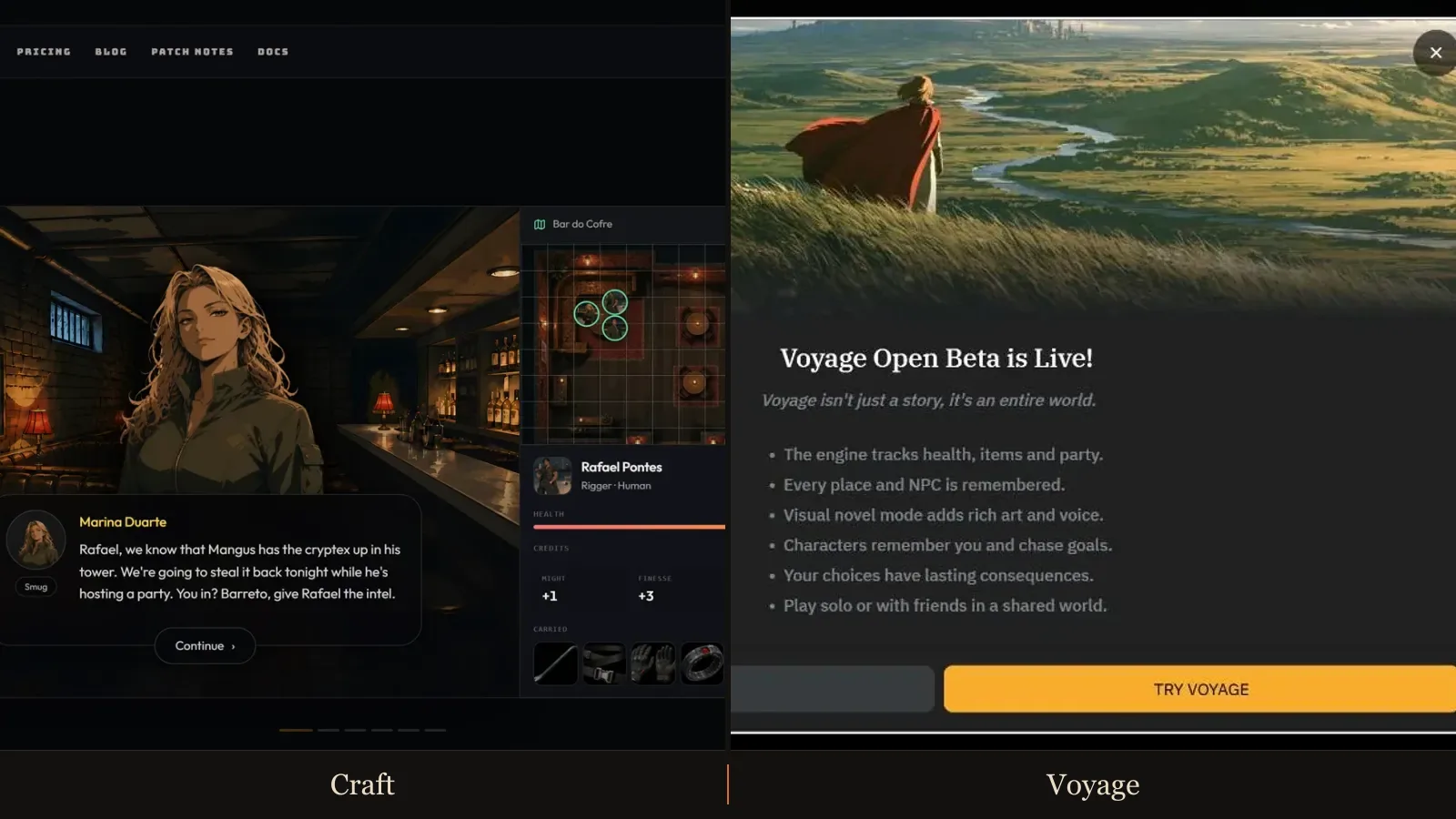
Access disclosure: Latitude provided beta access to Voyage, and Craft’s developers provided beta access and a subscription for our coverage of Craft. No conditions were attached to either, and this comparison is independent and unpaid.
Voyage and Craft are the second- and third-highest-scored platforms on our board, and they are good in different ways: Voyage is a finished-feeling game with the best memory and characters we have measured, and Craft is a toolkit that lets a worldbuilder write the rules, the narrator and the memory.
Voyage scores 4.4 and Craft scores 4.3. Nothing on either sheet falls below 3.5, and no other platform can say that. So this is not a choice between a good one and a bad one. It is a choice between two kinds of ambition, and the number alone will not tell you which kind you want.
The Short Version
| Voyage | Craft | |
|---|---|---|
| Overall | 4.4 | 4.3 |
| Memory & Continuity | 4.25 | 4 |
| Player Agency | 3.5 | 3.5 |
| NPC Fidelity | 5 | 4 |
| Mechanical Depth | 4 | 5 |
| Determinism & Fairness | 5 | 5 |
| Longevity | 4 | 3.5 |
| Signature Design | 5 | 5 |
Scores from each platform’s entry in our directory, on our seven-axis methodology. Both were tested at the Extended tier in August 2026, and we have not re-run either since.
| Voyage | Craft | |
|---|---|---|
| What it is | A game with consequences: dice, hit points, permadeath | A creator platform: you write the ruleset, narrator and memory |
| Who builds the rules | Latitude, and you build inside them | The worldbuilder, down to new systems written as code |
| Playing with others | Public servers of up to eight, private co-op for up to four | We found no multiplayer play; up to four more editors can build a project with you |
| Free | Unlimited play on public servers and Scenarios | Limited use of the Core models, 10 projects and 10 games |
| Paid | $14.99 to $99.99 a month | $19.99 to $199.99 a month |
| Where it plays | Browser, iPhone and Android | Browser, installable to your home screen |
If you only read one line: Voyage if you want to play a game, Craft if you want to build one, or to play the best worlds other people have built.
What Each One Is
Voyage is made by Latitude, the studio behind AI Dungeon. Where AI Dungeon gives you total narrative freedom, Voyage runs a proprietary engine that adds skill checks, hit points, positioning and permanent death. It has game master personalities from cozy to punishing, and it is designed for the phone and for short sessions. Voyage opened to everyone in August 2026, and Latitude’s CEO told us a full release is expected by early 2027. Our Voyage review has the full account.
Craft is made by the studio behind Friends & Fables, and it is a ground-up rebuild, not an upgrade. The team told us F&F was built on older, less capable models and was too hard to modernise. Craft has no house ruleset: a worldbuilder defines the rules, writes the narrator’s voice and behaviour, and authors memory structures in markdown for each world. It looks like a visual novel, with character sprites, expressions that change as people speak, and in-game cinematics. It left closed beta on 31 July 2026. Our Craft review has the full account.
That is the whole difference in one line. Voyage is one game, very well made. Craft is the tools to make many.
The Axes Where They Tie
Both score Player Agency — 3.5, Determinism & Fairness — 5 and Signature Design — 5. The reasons behind these ties are more interesting than the numbers.
Player Agency, 3.5 each, for the same reason. Railroading is a non-issue on both: we left the path and the game came with us. Puppeting is the cost. On Voyage your character speaks in a cleaned-up version of what you typed, and occasionally does small things you never ordered, such as a movement or a gesture. On Craft the narrator occasionally decides what your character does and what your character says. Both are mild, and both are noticeable. On Voyage it hurts most when you are lying to a character: if you do not tell the game master you are lying, the engine can read your intention wrongly and put a different meaning in your character’s mouth. Craft’s narrator is written per world, so a disciplined worldbuilder can probably beat this score. We rate the platform as most players will meet it.
Fairness, 5 each, by opposite routes. Voyage earns it because the combat will beat you. Steamroll into a fight and the party gets wiped, with no talking your way out afterwards, so what you achieve feels earned. Craft has no house rules to enforce, so what it guarantees is faithful execution of someone else’s rules: in a full campaign we did not catch it overriding, fudging or narrating around its own systems. If a Craft world is unfair, the honest complaint goes to the author of the world. That is a real 5, and it comes with a condition. On Craft, picking a well-built world is part of the job. Our guide to difficulty in AI RPGs explains why most platforms never get here.
Signature Design, 5 each, for different gifts. Voyage has a personality of its own. The design is smart, the characters mean something, and its fights are the most enjoyable we have played in an AI RPG. Craft earns the score for handing the design surface to its players. Its feature list is limited by its users’ imagination and not by its roadmap, and nothing else in our directory does that. Craft’s presentation deserves its own line: it is one of the two best-looking things in the category, with Tidefall.
Where Voyage Wins: Memory, Characters, Staying Power
Memory & Continuity. Voyage scores 4.25, and Craft scores 4. This is the quarter point doing its one job: separating two platforms that both pass our planted-fact test.
Voyage held a fact we planted early across an extended campaign and slipped only once or twice over the whole run. It is the best memory result we have measured on a platform you can play today. Part of why is architectural: hit points, positioning and death are game state in its engine, not claims the model has to hold in its head.
Craft passed the same probe, and then garbled what had happened recently. Not the deep lore, the recent history. Events were misremembered in their particulars. And the failure that stuck with us: NPCs forgetting promises they had made themselves. A promise is a commitment the player has been building around, and a world that quietly withdraws it makes the last few hours mean less. The studio names context management as its hardest open problem.
One update changes how to read Voyage’s number. Its pricing page now sells memory: Mythic includes “enhanced memory” and Ultimate includes “max memory”. Latitude publishes no figures for either, and our score measures what the engine did in our campaign, not what a plan costs. But it is no longer true that every player gets the same depth. Our Voyage pricing guide works through the choice.
NPC Fidelity. Voyage scores 5, and Craft scores 4. Voyage’s characters hold distinct personalities across turns. They do not drift towards agreement over a long session or become interchangeable when the plot needs them to cooperate. It is the first 5 on this axis earned by characters the system generates and not by a cast somebody wrote by hand. Craft’s characters hold their personalities and pursue their own goals, the same standard its predecessor set, and the promise-forgetting above bleeds into it: a character who does not remember what they swore to you is consistent right up until the moment they are not.
Longevity. Voyage scores 4, and Craft scores 3.5. Voyage earned it simply: we kept playing after the testing window closed. Craft is held down by one thing, and it is not a design flaw.
It is the waiting. Turns on Craft take a long time to process, long enough that we spent roughly as much of the session waiting for a turn as we did reading and acting on one. We are not publishing a figure, because it varies with the world and the model band. What we can say is the experience: half the evening is dead air. It does not break a campaign, and it is why the score stays high, but it makes long sessions tiring in a way that has nothing to do with the writing. Our Voyage review does not report waits of that kind. Our Craft review calls latency the one problem in it that is cleanly fixable.
Craft has a strength here that Voyage does not need to state: errors do not snowball, and you can correct them on the fly. The same authored-memory layer that makes memory a worldbuilder’s problem makes it a worldbuilder’s fix, so a campaign that has drifted can be steered back. Our ranking for long campaigns shows how rare that is.
Where Craft Wins: Mechanical Depth
Craft scores Mechanical Depth — 5, and Voyage scores Mechanical Depth — 4. This is the only axis where Craft is ahead, and it is the axis that defines the difference between them.
Voyage has a world editor, and you can build a great deal inside it. But you build inside Latitude’s ruleset. The clearest example from our review is a ledger. We wanted passive income and expenses in a world we were making, and Voyage has no bookkeeping system and no way to add one. So we built the effect out of the parts it has: a resource bar of the kind that normally holds health or mana, renamed Copper, set not to regenerate on rest, with the game master moving the number up and down. It works, and it is a workaround.
Craft is ruleset-agnostic. A worldbuilder can write complex new gameplay systems as code, and they run inside the platform as first-class rules. On Craft a ledger is not a repurposed health bar, it is a system you write. That is why a platform with no house ruleset ties the most mechanically complete tabletop in our directory.
Voyage has one more deduction on this axis, and it is a bug and not a limit: inventory and equipment still misbehave, often enough over an extended campaign to belong in the score. Our guide to mechanics in AI RPGs explains why a rules layer outside the model is what lifts this axis.
The consequence of Craft’s approach is the one its review states plainly: its mechanical ceiling is a property of whoever built the world you loaded. An empty toolkit is not a game, and a careless world will feel thinner than anything Voyage ships.
Playing With Other People
This is the clearest practical difference after the rules.
Voyage runs multiplayer in two ways. Public servers, hosted by Latitude, are free to join, with parties of up to eight. Private co-op lets a host invite up to four players into a persistent campaign, and the party shares the weight of permadeath together. Only the host uses usage, so friends join and play without spending their own. Voyage’s pricing page says “joining multiplayer is always free”, and that paid plans let you play and host.
As far as we can find, Craft is single-player to play. When we reviewed it, the cofounder told us on 25 August 2026 that multiplayer project editing would come within days and multiplayer gameplay “sometime within the next month hopefully”, and said it was a plan and not a release date. The first half arrived the next day: since 26 August 2026 an owner can invite up to four more editors to build a project with them. The second half is the one that matters for a group, and on 20 October 2026 we found no mention of multiplayer play on Craft’s pricing page, in its documentation menu, or in its patch notes through 29 September. We have not played it since our review, so we cannot say it has not shipped. We can say that we could not find it, and that the cofounder’s own word for the plan was “hopefully”.
If you play with friends, this settles it in Voyage’s favour today.
What Each One Costs
They charge in different ways, and the free tiers are different games.
Voyage sells one Latitude subscription. It covers Voyage and AI Dungeon, and Voyage Unlimited makes core play unlimited on every paid plan. Each tier then adds a weekly budget for premium extras: better story models, voice narration, Studio AI and custom images. If the budget runs out, you keep playing on the plan’s included settings. From Voyage’s own pricing page, read on 20 October 2026:
| Plan | Monthly | Billed yearly | What it adds |
|---|---|---|---|
| Free | $0 | Unlimited play on public multiplayer servers and Scenarios, with a starting balance of usage for solo play | |
| Journey | $14.99 | $140.04 | Unlimited solo play, and hosting multiplayer worlds |
| Legend | $29.99 | $272.04 | More weekly premium usage |
| Mythic | $49.99 | $476.04 | Voice narration and enhanced memory |
| Ultimate | $99.99 | $949.99 | Voice narration and max memory |
The page now offers annual billing, which our pricing guide of 12 September does not mention; the monthly prices are the same. Voyage also has two ways to play: Worlds, which are persistent RPG worlds, and Scenarios, which are open-ended stories in the AI Dungeon style. When we read it on 12 September, higher plans sat above this ladder and were not shown on the main page, and our Voyage pricing guide covers them.
Craft meters play in daily energy, and part of it rolls over. Every tier includes the Core models, and the wider roster unlocks from Starter. From Craft’s own pricing page, read on 20 October 2026:
| Plan | Monthly | Core models | Daily energy | Rollover | Slots |
|---|---|---|---|---|---|
| Free | $0 | Limited usage | Not listed | Not listed | 10 projects, 10 games |
| Starter | $19.99 | Increased usage | 100 | Up to 20% | 50 and 20 |
| Plus | $39.99 | Unlimited | 200 | Up to 30% | 75 and 30 |
| Pro | $59.99 | Unlimited | 300 | Up to 40% | 100 and 40 |
| Max | $99.99 | Unlimited | 500 | Up to 50% | 150 and 60 |
| Ultra | $199.99 | Unlimited | 1,000 | Up to 50% | 250 and 100 |
Craft’s prices are the same as when we read them on 12 September. What changes is its Core band, which the studio revises in public. Its patch notes for 24 September 2026 added GPT-6 Luna and Space Bunny Alpha to Core and retired Mercury 2.5. If a particular model is what you are paying for, check the patch notes first.
The two are close at the top and apart at the bottom. At $14.99 Voyage gives you unlimited solo play. On Craft the first tier with unlimited Core use is Plus at $39.99, which is the one we would point a serious worldbuilder at, and the $19.99 Starter plan is still metered. A Voyage player who wants to try a fight without paying can do it on a public server today.
Where to Play
Voyage was designed phone-first. It has apps on the App Store, where it has been since 26 August 2026, and on Google Play, and it also runs in a browser at voyage.io. Short sessions on a phone are what it is built for.
Craft is played in a browser, and our AI RPG apps guide records it as an installable web app and not a store app. Its site also describes a command-line tool that lets you build a world on your own computer with a coding agent. We tested Craft on a computer, not on a phone.
Which Should You Choose?
Choose Voyage if:
- You want a game with stakes, where a party that steamrolls gets wiped.
- You want the best memory and the strongest characters we have measured.
- You play on your phone, in short sessions.
- You want to play with friends, in a public party or a private co-op.
Choose Craft if:
- You want to write your own rules, narrator and memory.
- You want a visual novel’s presentation and worlds built to the standards of their authors.
- You can live with long waits between turns.
- You play alone, or you build with up to four other people.
A simple test: do you want to play a game, or build one? If you want to play, Voyage. If building is half the fun, Craft.
If Neither One Fits
If your group needs rules for six and not four, Friends & Fables seats up to six players in one campaign, and Friends & Fables vs Voyage compares the two. If you are weighing the move from F&F to its successor, see Craft vs Friends & Fables. For the free-form game Voyage was built from, see Voyage vs AI Dungeon. The platform comparison table sorts everything on our board by any axis, and our benchmark has all of them side by side.
Checklist
- Want dice and consequences without building anything? Voyage.
- Want to write your own rules? Craft.
- Playing with friends? Voyage, for now.
- Hate waiting between turns? Voyage.
- On Voyage, check which plan includes enhanced or max memory before you pay for it.
- On Craft, pick a well-built world: its fairness is the author’s.
- On Craft, check the patch notes for the current Core models before you subscribe.
- Our scores are from August 2026. Neither platform has been re-tested since.
Frequently Asked Questions
Is Craft or Voyage better?
Voyage scores higher on our seven-axis methodology, 4.4 against 4.3 for Craft, and they are second and third on our board, behind Worldtable. Voyage is ahead on Memory, NPC Fidelity and Longevity. Craft is ahead on Mechanical Depth, and they tie on Player Agency, Fairness and Signature Design. If you want a game with consequences, choose Voyage. If you want to write your own rules, choose Craft.
Is Craft like Voyage?
Only in how good they are. Both are structured AI RPGs with real consequences and both score 5 on Determinism & Fairness. Voyage is one game, built by Latitude, with its own rules and permadeath. Craft has no house rules: a worldbuilder writes the ruleset, the narrator and the memory, and the platform runs them as written.
Which has better memory, Craft or Voyage?
Voyage, 4.25 against 4 on Memory and Continuity. Both passed our planted-fact test. Voyage held the fact across an extended campaign and slipped only once or twice, while Craft garbled recent events and let NPCs forget promises they had made. Voyage now sells enhanced and max memory on its top two plans, and Latitude publishes no figures for either.
Which is better for playing with friends?
Voyage. It has public servers for parties of up to eight and private co-op for up to four, and only the host uses usage. As far as we found, Craft is single-player to play: since 26 August 2026 up to four more editors can build a project with you, but we found no multiplayer play on 20 October 2026.
Which is cheaper, Craft or Voyage?
Voyage starts lower for solo play. Its paid plans cost $14.99, $29.99, $49.99 and $99.99 a month, with unlimited core play on every one, and annual billing is available. Craft costs $19.99 to $199.99 a month, meters play in daily energy, and has unlimited Core model use from $39.99. Both have a free tier: Voyage’s is unlimited on public servers, and Craft’s is limited Core use with 10 projects and 10 games.
Does Craft have long waits between turns?
In our review it did. Turns took long enough that we spent roughly as much of a session waiting as playing. We did not publish a figure, because it varies with the world and the model band. It is the main thing holding Craft’s Longevity at 3.5.
Can I play Craft and Voyage on my phone?
Voyage, yes: it has apps for iPhone and Android and runs in a browser. Craft is played in a browser and can be installed to a home screen as a web app, but it has no store app. We tested it on a computer.
Both platforms are scored on Arcanum’s seven-axis methodology; the axis values quoted here are the published scores on each platform’s entry as of 20 October 2026. Latitude provided beta access to Voyage, and Craft’s developers provided beta access and a subscription; no conditions were attached, and Arcanum is independent and unpaid. Craft and Voyage are third-party platforms and all names are used nominatively. Arcanum is not affiliated with Latitude or Craft.