Pax Historia in 2026: Tokens, Free Play, AI Models, Multiplayer and Patron
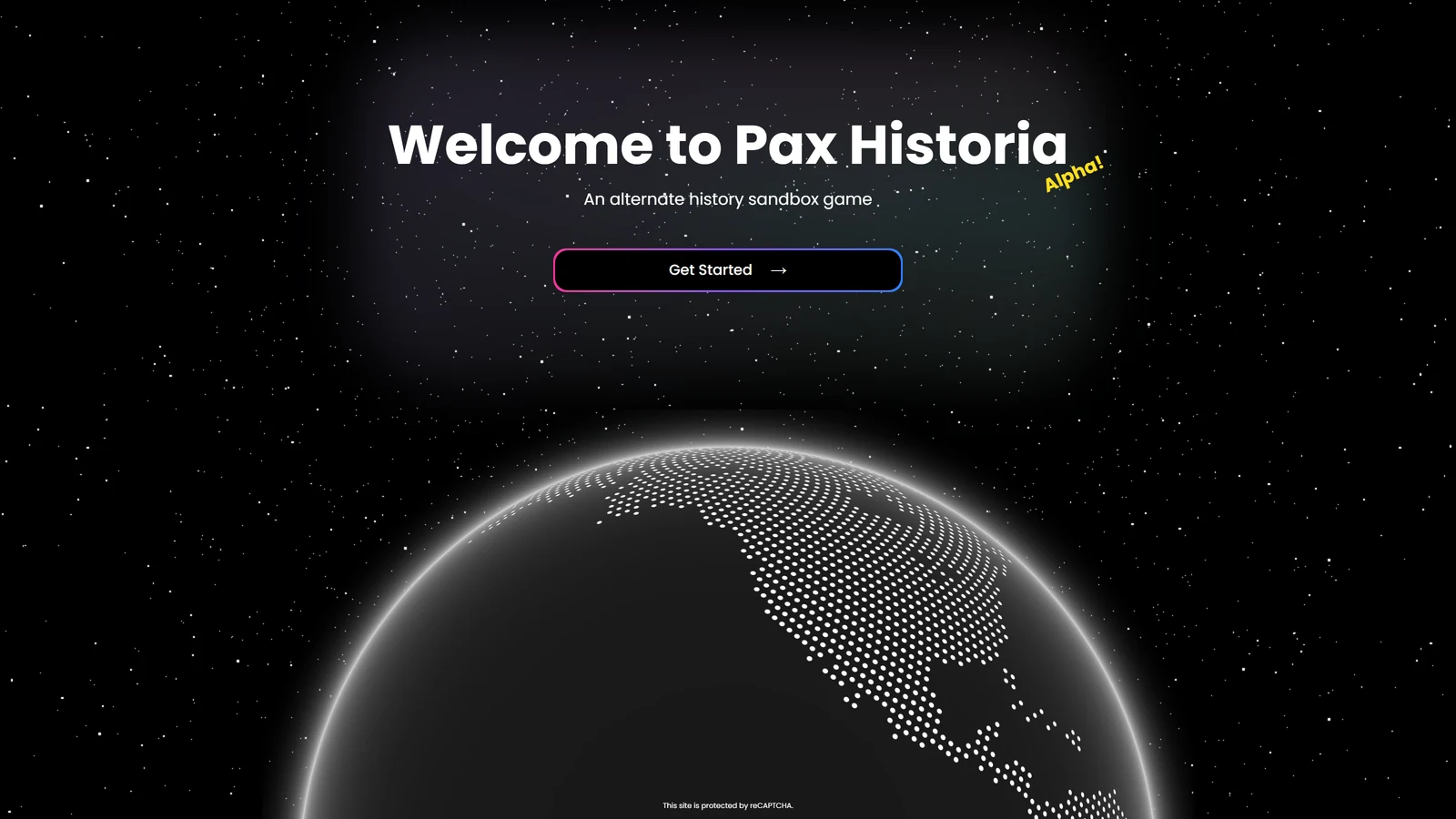
Pax Historia is a browser game where you play a country in a world run by AI. You type orders in plain English, talk to AI leaders, skip forward in time, and read the events the AI writes. You can start from real history, an alternate history or a made-up world.
We have not played Pax Historia, and this page is not a review: it is not rated on our benchmark. Everything below comes from Pax Historia’s own home page, its support FAQ, its terms of service and privacy policy, and its community wiki, read on 24 October 2026. The wiki describes itself as community guides, and it was last edited on 27 September 2026, so we say so where it is the only source. Where we could not confirm something, we say that too.
The Short Version
| Question | Answer on 24 October 2026 |
|---|---|
| What is it? | A grand-strategy sandbox powered by generative AI, played in a browser |
| Is it an AI RPG? | Not in the usual sense. You run a country, not one character. It is closer to a world simulator |
| Is it free? | Partly. A Google account gets $1 in tokens once and up to $0.20 a day |
| How do you pay for play? | In tokens, shown in dollars. Stronger AI models cost more per turn |
| Is there a subscription? | Yes. Pax Patron is $12 a month after a free first month, according to the wiki |
| Can I bring my own model key? | Yes, through OpenRouter, as a Patron |
| Is there multiplayer? | Yes, on its beta site, with the token cost split between players |
| Who can play? | Its terms say 13 or older, and under 18 only with a parent or guardian |
| Is it finished? | Its home page labels it “Alpha” |
If you only read one line: Pax Historia is easy to start for free, and the cost that matters is the AI model you pick, because each time you skip forward it spends tokens.
What It Is
The wiki’s description is a “grand strategy sandbox game powered by generative AI to simulate and reshape history”. You pick a preset, which is a scenario with a map, a time period and rules, and play a polity, which is a country or any other group the preset defines. Official presets include Modern Day and World War II, and the community has made many more, in real history, alternate history and fantasy or science fiction. You can also make your own in a map editor.
The wiki says the game started with two college roommates, Eli Bullock-Papa and Ryan Zhang, who wanted players to go down their own paths in games like Hearts of Iron IV and Europa Universalis V, with AI taking the place of fixed scripts.
The map is divided into land, coastal, ocean and strait regions. Regions belong to a nation or to nobody, and they can hold cities, armies or landmarks.
How a Turn Works
You do four things, then you advance time:
- Actions. You write what your country does this turn, for example “We start building military bases in Scotland”. You can write as many as you like, but the wiki warns that a very large number can overload the AI, which may then ignore or forget some of them, especially on lower-quality models. There is a button to brainstorm ideas and another to enhance an action.
- Chats. You can message one country or several at once. The wiki says everything you say is taken seriously: proposing an alliance, threatening war or making a trade deal can be recognised and acted on. Deleting a chat removes it from the AI’s context.
- Advisor. An AI helper that gives advice on foreign policy or on what is happening inside your nation.
- Jump forward. This is the only way time moves. You can jump to the next major event or to a date from one week to one year ahead. The AI then generates the events, and each jump costs tokens.
While events are being generated you can Intervene, which stops at the event you are looking at and discards the rest. The wiki warns that this may leave “potential problems or historical flaws” in your game.
Your difficulty setting runs from Very Easy to Impossible. The wiki says Normal is the default and recommended setting, and that difficulty changes how well your actions go, not how many tokens you spend. It also says the difficulty you actually feel depends on the AI model.
Why it is not quite an RPG
You do not play a character with a sheet and dice. You write instructions for a government, and the AI decides what happens. That makes it closer to Altworld, which we rated 2.9 and which positions itself against Pax Historia, than to a tabletop-style game. If you want to know how we score games that work this way, see our methodology. Pax Historia is not scored.
Free Play: What the Token System Gives You
Tokens limit how much you can use the AI. Pax Historia counts them in dollars, and they are shown at the top right of the screen. The wiki lists these sources:
| Source | What you get |
|---|---|
| Google account sign-up | $1 in tokens, once |
| Daily tokens | Up to $0.20 a day. They reset every 20 hours and do not stack |
| Guest account | $0.04 once, and no daily tokens |
| Pax Arena vote | $0.03 for each completed response, on desktop only |
| Buying tokens | A one-time purchase or a token subscription in the shop |
| Preset earnings | 10% of tokens spent on your preset, once it passes 150 rounds |
Guests cannot buy tokens, save games across devices, upload presets or appear on the leaderboard. There is no way to sign up without a Google account, so without one you are limited to guest mode.
Pax Arena is a feature where you compare two AI-written responses and vote on the better one. The wiki says you can take part while using the free model, and sometimes you can keep the response you voted for at no extra cost.
The wiki explains why daily tokens do not stack: running the AI costs money, and a cap limits how much unused free currency can pile up.
What a Turn Costs
The cost of a turn depends on the model, how many events are generated, how long your messages are, how many regions the map has and how much detail the game feeds the AI. Its FAQ says you can switch models mid-game: open the three-dot menu, choose Cheats, then AI Model.
The wiki’s model page gives estimated cost per turn for each model. These are community estimates, not Pax Historia prices, and the models change often, so treat them as a rough scale:
| Model tier on the wiki’s page | Estimated cost per turn |
|---|---|
| Gemini Flash Lite models | about $0.02 to $0.06 |
| GLM 5.3 Flash, Qwen Flash models | about $0.03 to $0.10 |
| GLM 5 to 5.2, Gemini Flash models, Claude Haiku 4.5 | about $0.04 to $0.20 |
| Gemini 3.1 Pro | about $0.10 to $0.30 |
| Claude Sonnet 4.5 and 4.6 | about $0.15 to $0.40 |
| Claude Opus models | about $0.30 to $0.80 and up |
By our arithmetic from those figures, the free $0.20 a day covers roughly two to ten turns on a cheap model and about one turn on an expensive one, and the one-time $1 covers perhaps 10 to 50 cheap turns. The wiki gives the same advice in words: free players should use lower-end models so they do not drain their daily tokens fast. It also warns that the Pro model “can and will” put you into negative tokens if you live off the daily $0.20.
Three more points from the wiki:
- Long jumps cost more than short ones, because more events are written. A longer game also costs more, because the AI is sent more history.
- Cheaper is not always worse. The wiki says standard AI benchmarks do not test Pax-style storytelling, and a faster, cheaper model can write more consistent narratives than a pricey one in a light game. Stronger models are the safer choice for long, heavy games with many rules.
- Signs a model is struggling: events stop generating, become vague or repeat, or the AI contradicts recent history or ignores your rules.
If your balance goes negative, the wiki says to wait for it to refill. It lists three causes: letting the AI brainstorm, talking to the advisor, and using an expensive model.
Pax Patron
Pax Patron is the subscription, and the wiki says it does three things: it supports the preset creators who keep the game lively, it gives you free requests through an outside provider, and it lets you connect your own key.
| Month 1 | Month 2 onward | |
|---|---|---|
| Price | $0 with an eligible card | $12 a month, charged automatically |
| Provider requests | 300 a day on either Chutes or Canopy Wave | 300 a day on the one you pick for the billing cycle |
| Your own key via OpenRouter | Yes | Yes |
| Creator reward tokens | Not on the free trial | 5 a month |
| Patron badge | Not yet | Yes |
Creator reward tokens cannot be spent on play. They are for donating to presets you like, and the author receives them as regular tokens. They stack and do not expire.
The wiki’s guide to bringing your own key goes through Google AI Studio and OpenRouter, so that Pax Historia sends requests through your own key. It says the key is stored with AES-256 encryption, and it advises you to avoid loading extra funds into the account and to stay on Google’s free tier. Our guide to OpenRouter for roleplay explains the service.
One caution. The support FAQ says the new Patron system had just been rolled out, that several issues were being fixed and that the provider models are “generally speaking not very high quality right now”. Read the FAQ again before you subscribe.
Multiplayer and the Beta Site
Pax Historia has a beta site where the team tests new features. The wiki lists what it had on 28 September 2026:
- Live games. A newer engine, nicknamed “Pax 2”, that supports longer games, multiplayer, perspectives, spending limits and reports. It uses workflows and not the older prompts.
- Catalysts. Special narrative events where you write an action and the AI continues the story. The wiki warns they get expensive when prolonged.
- Assets and dimensions. Audio, video and image assets, and extra maps inside the same preset.
Multiplayer works like this. One person hosts a game and shares a link. Every player’s actions go to the AI and are simulated together. There are three game modes, Realtime, Flex and Async, which are presets for how long each player has to take a turn. The token cost is split between the players by default, so a shared game is usually cheaper than a solo one. Players who cannot pay become spectators, and the host can choose to cover the cost.
A warning from the wiki: some multiplayer games may keep using your tokens while you are not playing. If your balance falls for no reason, open each multiplayer game, use the three-dot menu on its thumbnail and choose “Become Spectator”.
Making Your Own Presets
You can build a preset in the map editor, draw regions, write simulation rules and publish it. The wiki’s update log says the new map editor reached the main site on 26 August 2026, that dimensions and friends arrived on 12 August 2026, and that preset monetization began on 27 August 2025. Our guides to writing a world for an AI, such as SillyTavern lorebooks, cover the same craft on another platform.
Age, Content and Privacy
Pax Historia’s terms of service, last updated on 5 February 2026, say you must be at least 13, or the minimum age of digital consent where you live, and that under-18s may use the service only with a parent or guardian involved.
Its FAQ says that on public parts of the platform, including published presets, comments, its Discord and multiplayer games, it does not allow glorifying or normalising human rights abuses, slurs, threats or sexual language. It also says in-game moderation exists only in the new live engine on the beta site. Legacy games rely on the AI provider’s own guardrails, which Pax Historia says it does not control.
On privacy, the FAQ says it does not sell personal information, but that information may be shared with service providers and partners. It asks you not to type detailed personal information into any game, because it cannot guarantee removal.
When Something Goes Wrong
- The map does not load. The wiki has a troubleshooting page for it.
- Tokens are negative. Wait for your balance to refill, and use cheaper models.
- Tokens drain with no play. Check multiplayer games and become a spectator.
- Daily tokens do not refill. Check your account settings under Tokens. If the daily section already shows $0.20, the allowance is full.
- Responses were cut short. The wiki says there is little you can do except reset to the date before the jump, and you cannot get the spent tokens back.
- A bug. In a game, use the three dots in the top left and choose Report Bug. For urgent problems, the FAQ gives an email address for support.
What We Could Not Confirm
- How it plays. We have not played it, so we cannot say how good the AI’s events and diplomacy are.
- Token pack prices. The wiki says only “varied”, and the shop is inside the account.
- Whether the model estimates are current. They are community figures.
- How stable Patron is. The FAQ itself says it is new and being fixed.
- A store app. We found none linked from its home page.
Where It Sits Among the Alternatives
| If you want | Look at | Our guide |
|---|---|---|
| A free, open-source game in the same style | Open Historia | Open Historia |
| A world simulator that produces a history of your choices | Altworld | Altworld review |
| An AI story game with community worlds and a model choice | Infinite Worlds | Infinite Worlds |
| Every AI simulation game side by side | Several | AI simulation games |
| More free AI games | Several | Best free AI roleplay |
| A scored game with real rules | Scored platforms | Best AI roleplay platforms |
A Short Checklist
- Want to try it? Sign in with Google, start with an official preset such as Modern Day, and use a cheap model.
- Running low on tokens? Write fewer actions, jump in small steps and avoid the advisor.
- Subscribing to Patron? Read the FAQ’s Patron notes first, and remember the first month is free only with an eligible card.
- Playing with friends? Check who pays, and become a spectator when you stop.
- Under 18? You need a parent or guardian involved.
Frequently Asked Questions
Is Pax Historia free?
Partly. A Google account gets $1 in tokens once and up to $0.20 a day, which refills every 20 hours and does not stack. Guests get $0.04 once and no daily tokens. Anything beyond that costs tokens, which you buy, or a Patron subscription.
How much does a turn cost in Pax Historia?
It depends on the AI model. The community wiki estimates about $0.02 to $0.06 a turn on Gemini Flash Lite models, up to about $0.15 to $0.40 on Claude Sonnet and $0.30 to $0.80 or more on Claude Opus. These are estimates, not Pax Historia prices.
What is Pax Patron?
A subscription that costs $12 a month after a free first month with an eligible card, according to the wiki. It gives 300 free requests a day through Chutes or Canopy Wave, lets you connect your own key through OpenRouter, and gives 5 creator reward tokens a month to donate to presets.
What AI model should I use in Pax Historia?
There is no single best model. The wiki says cheaper, faster models can work well in light games and early in a game, and stronger models are safer for long, complex games. Free players should use lower-end models, because expensive ones can push the balance negative.
Is Pax Historia multiplayer?
Yes, on the beta site, through its live engine. A host shares a link, and the token cost is split between players by default. Players who cannot pay become spectators, and the host can choose to cover the cost. It has Realtime, Flex and Async modes.
Why are my Pax Historia tokens going down?
The wiki says to check for multiplayer games, which can keep spending while you are away. Open each one, use the three-dot menu on its thumbnail and choose Become Spectator. If you have none, submit a bug report.
Is Pax Historia an AI RPG?
Not in the usual sense. You run a country and write orders, and the AI plays every other country and writes the events. It is closer to a world simulator than a game with a character sheet and dice. We have not scored it.
What is the age limit for Pax Historia?
Its terms of service, last updated on 5 February 2026, say you must be at least 13, or the minimum age of digital consent in your jurisdiction. Under-18s may use it only with the involvement of a parent or guardian.
Pax Historia and the models named on this page are third-party products and names are used nominatively. Arcanum is not affiliated with Pax Historia or any provider named here. Everything on this page was read from public pages on 24 October 2026 and may change.