AI Simulation Games (2026): Life Sims, World Sims and Strategy Sandboxes You Can Play
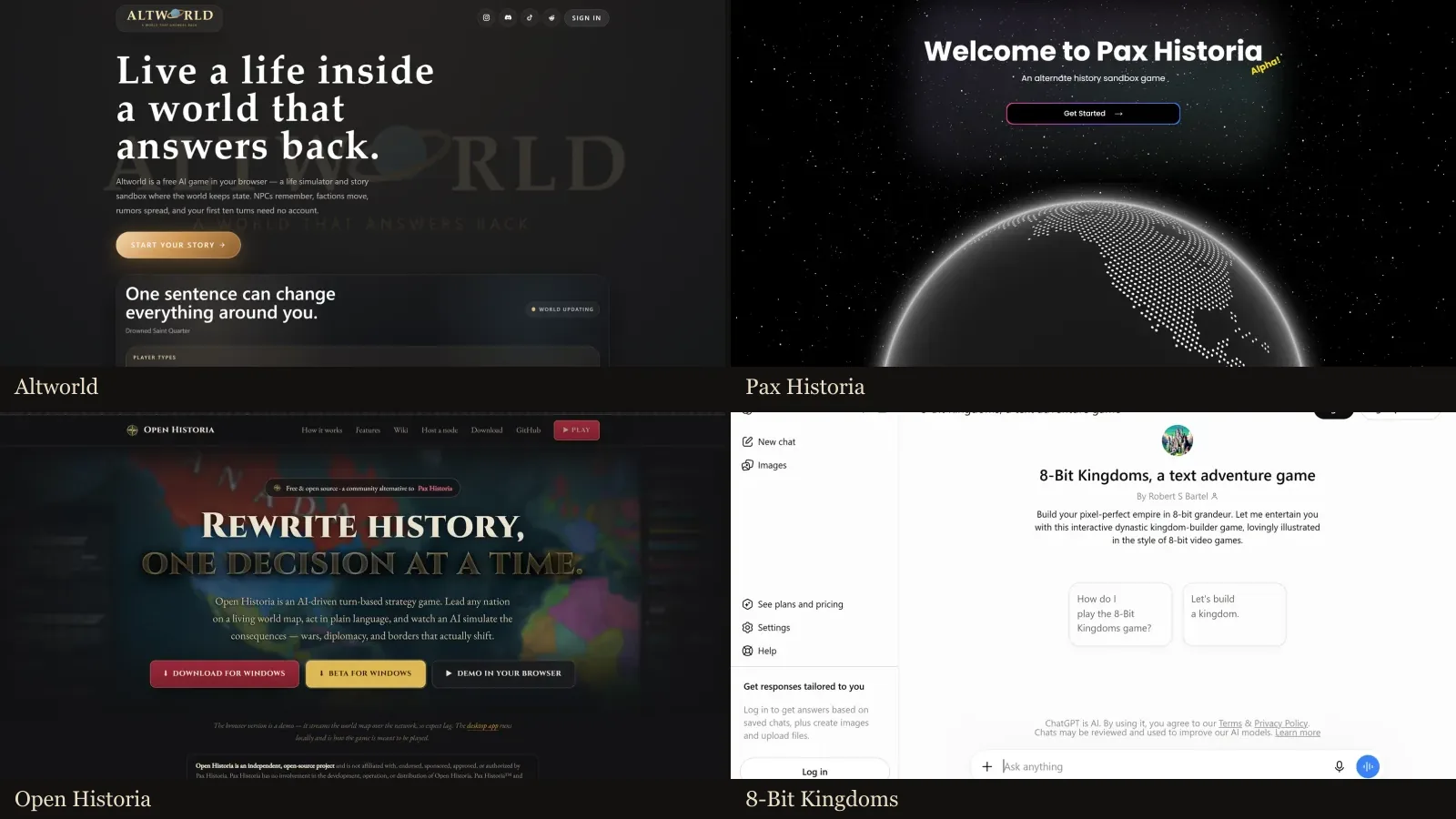
An AI simulation game is a game where a language model runs the world and you steer it: you give orders in plain words, choose how far to skip forward in time, and read what the AI says happened. You manage a country, a life or a kingdom, not one character in a conversation.
That is a different shape from the AI RPGs most of this site covers, and the choice is thinner. We found six games you can play today, plus two research projects that explain where the idea comes from. Four of the six we have not played, and this page says which ones.
Disclosure: Altworld gave us free Candles for our review. No conditions were attached to our coverage, and this page is independent and unpaid. Aevum Realm Architect is made by Arcanum, so we describe it and do not rank it. This page carries no scores. Scores belong to the benchmark, and a genre page would only repeat our taste.
The Short Version
| Game | Kind | What the AI does | Cost | How we know it |
|---|---|---|---|---|
| Altworld | Turn-based world and life simulator | Resolves your skipped time against a ledger of factions, holdings and rumours, then writes the report | Free to start; $3.99 a month for unlimited turns (checked 21 September 2026) | Played and reviewed |
| Pax Historia | Alternate-history strategy sandbox | Plays every other country and writes the events | Tokens; free allowance for a Google account | Read from its own pages, not played |
| Open Historia | Open-source strategy sandbox in the same style | Same, using an AI you connect yourself | Free game; you pay your AI provider, if anything | Read from its own documentation, not played |
| inZOI | Life simulation | Smart Zois: simulated people whose actions and thoughts the AI can influence | A Steam game; check the store page for the price | Read from the Steam disclosure and Krafton, not played |
| 8-Bit Kingdoms | Dynasty simulation, ChatGPT only | Runs five-year turns and your heirs | Free Custom GPT | Played and reviewed |
| Aevum Realm Architect | Kingdom-builder, made by Arcanum | Runs an economy and a class system from two files | Free download | Ours, not ranked |
If you read one line: Altworld is the simulator we have played, the two Historia games are the strategy sandboxes, and in all of them the cost that matters is every time you skip forward.
The Three Kinds of AI Simulation Game
Before the games, the shapes. Nearly everything in this genre is one of three things.
World and life simulators give you one person, or a small group, and a living world around them. You act, then let time pass. Altworld is the clearest example, and inZOI approaches it from the other side, as a traditional life sim with an AI layer.
Strategy sandboxes give you a country. You write orders, message the other countries and press the button that moves the calendar. Pax Historia and Open Historia work like this. Neither has a character sheet, dice or a build queue.
Agent simulations have no player in charge at all. Many AI characters live together and researchers watch what happens. These are not games you can buy yet, but every game above borrows from them, and we cover two below.
Across all three, the loop is the same: act, skip time, read what happened. That is why none of them feels like the games in our best AI roleplay platforms list, where the loop is a conversation.
World and Life Simulators
Altworld
Altworld is a browser game where you act, choose how far to skip, and read a report of what the world did while you were busy. You can start as a peasant before winter or a smuggler in a drowned city, or write your own world from a plain-language pitch. It runs on desktop and mobile with no download.
We played it and reviewed it. Two findings matter for this page.
First, it is the only game here where the world is a real ledger. The simulation resolves your skipped time against structured state: faction reputations, holdings, expenses, obligations and rumours. That is why the report reads like a history and not a story.
Second, a ledger can be wrong in a way a story cannot. In our test, one day of work earned 4 coins and a full month earned 6. That undercuts the central decision of the game, which is how long to skip. Read the full Altworld review for how that affected the verdict.
The pricing is easy to understand. A guest gets 10 full turns without an account. A free account gets 30 Candles and more each day, and turns cost 2 or 3 Candles. A Kindling Pass is $3.99 a month for unlimited turns. We checked these figures on 21 September 2026.
One update. On 15 October, Altworld said it would stop updating the game, then said it will be open sourced with a bring-your-own-key option, and that the game is not shutting down. There are no dates. Our news digest for 19 October has the details. If you play it, nothing stops working today, but do not expect regular updates.
inZOI
inZOI is Krafton’s life simulation, in early access on Steam from March 2025 when we last checked in September 2026. Its AI feature is the Smart Zoi: NVIDIA describes Smart Zois as AI-driven agents that plan, act and reflect on their decisions. Krafton’s own Steam disclosure is narrower. It says character actions and thoughts can be influenced with text using a small language model.
That difference is the thing to know. You do not talk to a character in inZOI. You nudge the minds of the people you are simulating. It is closer to The Sims with a reasoning layer than to a conversation game, and Krafton flagged the feature as experimental when it launched. We have not played it, and we did not re-check its current state for this page, so look at the store page before you buy.
For the other games with AI inside them, see games with AI NPCs you can actually talk to.
Strategy Sandboxes
Pax Historia
Pax Historia is a browser game where you play a country in a world run by AI. You type orders, talk to AI leaders, skip forward and read the events the AI writes. Its home page calls it Alpha.
Per its community wiki, a turn has four parts: write your actions, chat with other countries, ask an advisor, and jump forward. Jumping forward is the only way time moves, and every jump costs tokens. Its token system gives a Google account a small free allowance, and stronger AI models cost more per turn. The wiki estimates about $0.02 to $0.06 a turn on Gemini Flash Lite models and well over that on larger models. Those are community estimates, not Pax Historia prices.
We have not played it, and our guide says so. It covers what a turn costs on each model, what the Patron subscription adds and how multiplayer shares the bill.
Open Historia
Open Historia is a free, open-source game in the same style. It began on 1 March 2026, according to its repository, and its own site says it is independent and not affiliated with Pax Historia. You get a map, countries, orders in plain English, chats with AI leaders and a time-skip button.
The difference is who pays for the AI. Open Historia does not ship one. You connect a key from a provider, which can be a free Google AI Studio key, or a model on your own computer. It runs as a desktop app or an Android app. Its site calls the browser version a demo, which is easy to miss.
We have not played it either. The Open Historia guide covers setup, cost and what we could not confirm.
How the two compare
| Pax Historia | Open Historia | |
|---|---|---|
| Who provides the AI | The game, paid in tokens | You, with your own key or a local model |
| Price of the game | Free to start | Free, open source |
| Where to play | Browser | Desktop and Android; browser is a demo |
| Multiplayer | Yes, on its beta site | None mentioned in the documentation we read |
| Status | Labelled Alpha | Active development, started March 2026 |
Both are read, not played by us. If you want a strategy sandbox, try the one whose cost model suits you, and expect rough edges in both.
Kingdom-Builders on ChatGPT, Claude and Gemini
You do not need a platform to run a simulation. A prompt and a reference file can do it, and two games take that seriously. Our kingdom-builder list compares them in full.
8-Bit Kingdoms is a ChatGPT-only Custom GPT built around generations. You play in five-year turns, your ruler ages and dies, and an heir takes over. The weak point is the same mechanic: it generates history faster than a Custom GPT can hold it, so a long dynasty starts to contradict its own past. Read the review.
Aevum Realm Architect is our own, for ChatGPT, Claude or Gemini. You start as a serf with one copper piece and climb toward the throne through an economy tracked turn by turn. We never score our own work, so this is a description, not a pick. Read the write-up.
Where the Idea Comes From: Two Agent Simulations
If you want to know why AI simulation games exist at all, read these two papers. They are research, not products. We have a full explainer for each: Generative Agents and Project Sid.
Generative Agents (Park, O’Brien, Cai, Morris, Liang and Bernstein; arXiv:2304.03442, first submitted April 2023) put 25 AI agents in a small town inspired by The Sims. The agents keep a plain-language log of their experiences, condense it into higher-level reflections and use it to plan. In the paper, one agent is given only the goal of hosting a Valentine’s Day party, and the others spread invitations, form relationships and turn up together.
Project Sid (Altera.AL and co-authors; arXiv:2411.00114, submitted October 2024) ran groups of roughly 10 to over 1,000 agents in Minecraft. The authors report that agents took on specialised roles, followed and changed shared rules and passed on cultural and religious practices. They describe the results as preliminary.
We are summarising the abstracts, and we have not read the full papers closely enough to judge the evidence. The point for players is smaller: these are the designs that inZOI’s Smart Zois echo, and they show why a believable simulated person needs memory and reflection, not only a good prompt.
What the AI Is Actually Deciding
This is the question that separates one game here from another, and a quick way to size up any new one.
| Question | What it tells you |
|---|---|
| Is there a ledger under the story? | Altworld keeps structured state, so the report follows from numbers. The Historia games lean on the model to keep the world consistent. |
| What happens if you write many orders at once? | Pax Historia’s wiki warns that a very large number can overload the AI, which may ignore or forget some of them. |
| Who pays when you skip forward? | In Pax Historia, you pay in tokens. In Open Historia, your own provider bills you. In Altworld, Candles or a pass. |
| Can you undo a bad turn? | Altworld sells a re-roll of the last turn. Pax Historia has an Intervene button, with a warning about historical flaws. |
| Does the world keep going when you ignore a problem? | In our Altworld play, a famine we had solved on paper kept running for five in-game years. Check for this in any simulation. |
Which to Try First
| If you want | Try | Why |
|---|---|---|
| A life or a world in a browser, no setup | Altworld | Ten guest turns with no account; the one we have played |
| To run a country and talk to AI leaders | Pax Historia | Easiest to start for free; read how the tokens work first |
| The same, with no subscription and your own AI | Open Historia | Free and open source; needs a key or a local model |
| A reasoning layer inside a traditional life sim | inZOI | Early access on Steam; check the store page first |
| A dynasty or an economy inside ChatGPT, Claude or Gemini | Kingdom-builders | Free, and nothing to install |
| More free options | Best free AI roleplay | Free platforms and prompt games |
Want to keep up with new ones? Where to follow AI games lists the newsletters, podcasts and communities we checked.
What We Have Not Covered Yet
- AI People, from GoodAI. We found developer posts up to February 2025, and in October 2026 the game’s web address redirected to GoodAI’s home page, so we could not confirm it is still on offer and left it out of the list. What we did find is in AI People Explained.
- Any simulation we have not read or played. If you know a game that belongs here, tell us through the contact page.
- Adult simulations. This page does not cover them.
How to Check a Simulation Yourself
- Find what you are paying for. Look for the price of one skip of time, not only the price of the game.
- Do a short skip, then a long one. If a day and a year give you almost the same result, the central choice of the game is hollow.
- Solve something, then wait. Fix a problem and skip ahead. A good simulation shows the consequence; a thin one forgets it.
- Test a bad order. Ask for something impossible and see whether the world pushes back.
- Check where your save lives. Open Historia says saves stay in your browser or on your machine. Ask the same of any game.
Frequently Asked Questions
What is an AI simulation game?
A game where a language model runs the world and you steer it. You give orders in plain words, choose how far to skip forward in time, and read what the AI says happened. You manage a country, a life or a kingdom instead of playing one character in a conversation.
What are the best AI simulation games?
For a world simulator you can play in a browser, Altworld is the one we have played and scored. For a country-level strategy sandbox, Pax Historia and the free Open Historia are the two to look at, but we have only read about them. inZOI is the life simulation with an AI layer. We do not rank them against each other.
Are there free AI simulation games?
Yes. Altworld lets you play 10 turns as a guest without an account and gives free daily Candles to account holders. Pax Historia gives a Google account a small token allowance. Open Historia is free and open source, but you connect your own AI, which can be a free Google AI Studio key or a model on your own computer.
Is there an AI game like BitLife?
Altworld is the closest we have played. You live a life in a simulated world, take actions, then skip days or years and read what happened. It describes itself as a turn-based world simulator, not a text adventure.
Is there an AI game like Pax Historia?
Open Historia is an independent, open-source game in the same style, and says it is not affiliated with Pax Historia. Altworld is a different kind of game that is often compared with it.
Does inZOI use AI?
Yes, in part. Krafton’s Smart Zoi feature lets AI influence what simulated people think and do, and Krafton’s Steam disclosure says character actions and thoughts can be influenced with text using a small language model. It is a life simulation with an AI layer, not a conversation game.
Why do some of these games cost tokens?
Each time you skip forward, the AI writes new events, and that uses AI computing that someone pays for. Games that host the AI charge you in tokens or credits. Games that ask you to bring your own AI key pass the provider’s bill to you instead.