Generative Agents (Smallville) Explained: The 2023 Paper Behind AI Characters That Remember
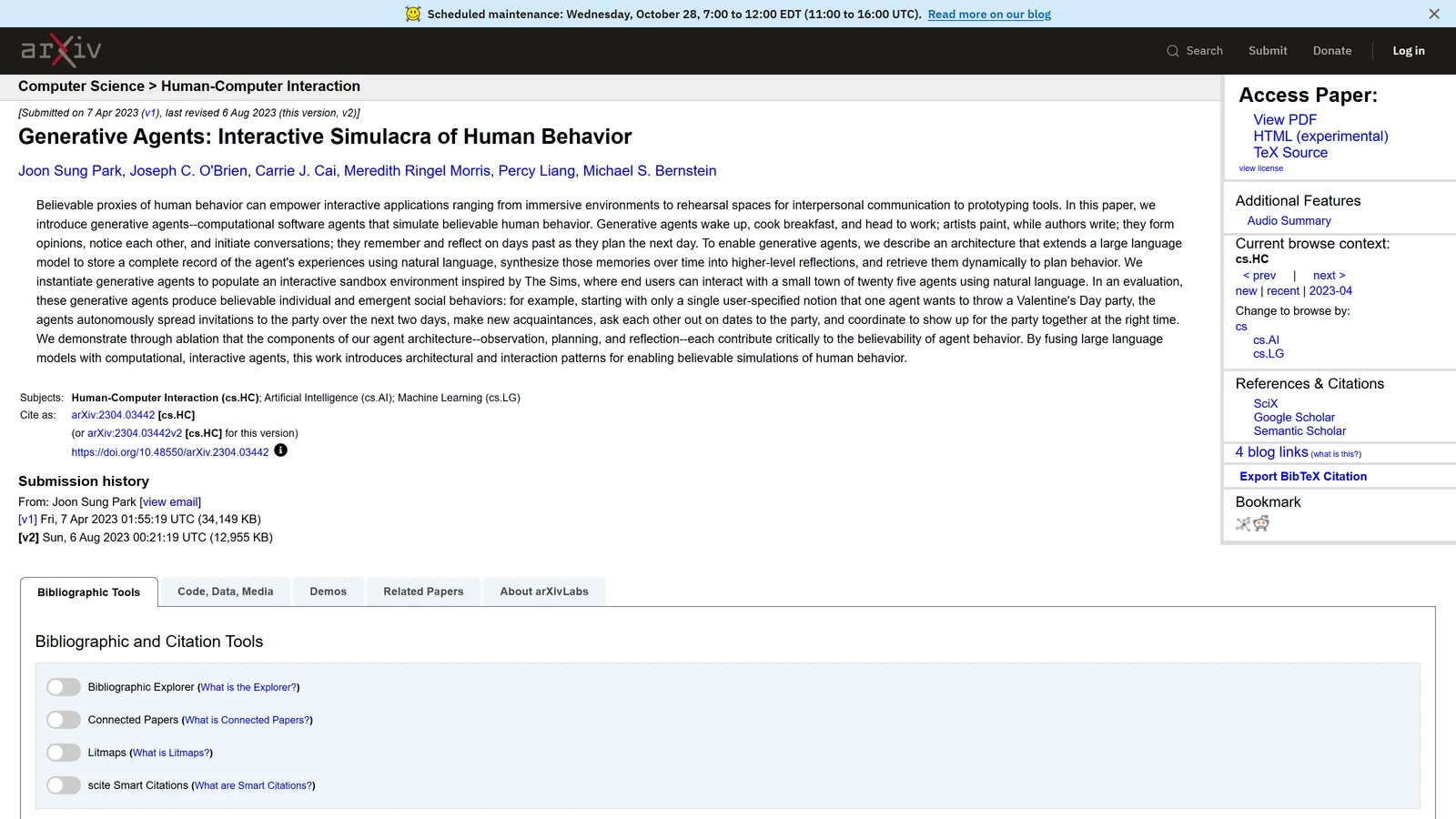
Generative Agents is a 2023 research paper in which 25 AI characters lived in a small simulated town called Smallville, remembered what happened to them, made plans for their days and, in one case, organised a Valentine’s Day party that nobody scripted. It is the most cited starting point for the idea that an AI character should have a memory of its own, not just a prompt.
If you have read about AI characters that “plan, act and reflect”, this is where the phrase comes from. NVIDIA uses it for inZOI’s Smart Zois, and Project Sid scaled the idea up to hundreds of agents. Most AI games do not work this way: the AI RPGs we review are conversations with one model that you steer. Generative Agents is a different design, and understanding it helps you judge any game that claims its characters “live their own lives”.
This page is built from the paper (arXiv:2304.03442) and the authors’ GitHub repository. We have not run the code, and nothing here is scored. It is read, not played, and it is a research system, not a game you can buy.
Arcanum is independent and unaffiliated with the authors, their institutions and every company named here.
The Short Answers
- What is it? A research paper and an open-source simulation. A language model plays 25 characters in a Sims-style town.
- Who made it? Joon Sung Park, Joseph O’Brien, Carrie Cai, Meredith Ringel Morris, Percy Liang and Michael Bernstein. The paper thanks Stanford’s Human-Centered AI Institute, Google Research, Microsoft Research and OpenAI, among others, for support.
- When? First posted on arXiv on 7 April 2023. A revised version followed in August 2023, and it was published at the UIST conference.
- Can I play it? No finished game. The code is on GitHub (Apache 2.0) and needs your own OpenAI API key.
- Why does it matter? It showed that three simple additions to a language model, memory, reflection and planning, made characters judged more believable than characters without them.
What the Researchers Built
The setting is Smallville, a sandbox town inspired by The Sims. Each of the 25 residents starts from a short biography written in plain language. The researchers ran the town for two full game days.
The model behind it was gpt-3.5-turbo, the ChatGPT model of early 2023. The authors note that GPT-4 was available by invitation only at the time.
A person can interact with the town in several ways, according to the paper: plant an idea in one agent’s head, talk to an agent while playing a character such as a reporter, speak as an agent’s “inner voice” to make it more likely to act on something, change the state of an object in plain words, or enter the town as an agent.
How the Memory Works
This is the part of the paper that matters most for anyone who plays AI games, because the commonest complaint about them is that the AI forgets. The authors’ answer has three pieces.
1. The memory stream
Each agent has a database of everything it perceives, written in natural language: “Isabella is setting out pastries”, “Klaus is reading at his desk”. Every entry has a creation time and a last-accessed time. Reflections and plans are stored in the same place.
2. Retrieval
A day produces far more memories than can fit in a prompt, so the system picks. When an agent needs to decide what to do, each memory is scored on three things, each scaled between 0 and 1 and weighted equally:
| Factor | What it measures | How |
|---|---|---|
| Recency | How recently the memory was used | Exponential decay, 0.995 per game hour since last access |
| Importance | How much it matters | The language model rates each memory from 1 (mundane) to 10 (poignant) when it is made |
| Relevance | How close it is to the situation now | Similarity between the memory and the current question |
The best-scoring memories go into the prompt. Everything else stays in the database.
3. Reflection and planning
An agent that only remembers events does not understand them. So when the importance scores of recent events add up past 150, which the paper says happens two or three times a day, the agent pauses and asks itself what the 100 most recent memories add up to. It writes conclusions that cite their evidence, and those conclusions are stored as new memories. Reflections can build on other reflections.
Planning works top-down. An agent starts the day with a rough outline of five to eight chunks, then breaks each into hour-long and then 5 to 15 minute actions. At every step it asks the model whether what it just saw should change the plan. If so, the plan is rewritten from that point.
What the Experiments Showed
The believability test
The authors recruited 100 participants, who watched replays and ranked five versions of the agents by how believable their answers to interview questions were. The versions were the full system, the system without reflection, without reflection and planning, without memory, reflection and planning, and answers written by human crowd workers.
| Version | Believability score |
|---|---|
| Full system | 29.89 |
| Without reflection | 26.88 |
| Without reflection and planning | 25.64 |
| Human crowd workers | 22.95 |
| Without memory, reflection and planning | 21.21 |
The paper reports every difference as significant except crowd workers against the fully stripped version. Two things stand out. Each of the three parts added something, and the full system ranked above the human-written answers. The authors are careful about the second point: they say the crowd worker condition is not the best a human could do.
The party
Researchers gave one agent, Isabella Rodriguez, the idea of hosting a Valentine’s Day party, and gave no further instruction. By the end of the two days, 13 of the 25 agents (52 percent) knew about the party, up from one. Of the 12 who were invited, five showed up. Of the seven who did not, three cited conflicts and four said they were interested but did not plan to come.
A second example: knowledge that Sam was running for mayor spread from one agent to eight (4 to 32 percent). Over the two days, the density of relationships between agents rose from 0.167 to 0.74. When agents were asked whether they knew each other, 6 of 453 answers (1.3 percent) were hallucinated.
Where It Falls Short
The authors list the failures themselves, which is the best reason to trust the rest of the paper.
- Missed or partial memories. Agents sometimes failed to retrieve something relevant, or remembered only a fragment.
- Embellishment. Agents sometimes added details that never happened, or pulled in what the model knew about the world, such as attributing a famous book to a character with the same name as the author.
- Misread norms. Agents misunderstood physical rules, such as a bathroom meant for one person or a shop’s closing time.
- Too polite, too cooperative. The authors link this to how the model was tuned. One agent rarely refused suggestions and absorbed other people’s interests.
- Short run, soft baseline. The test covered two game days. The crowd worker comparison is not a ceiling.
- Cost. Running 25 agents for two game days cost thousands of dollars in token credits and took multiple days.
- Robustness. The authors say agents are open to prompt hacking, to “memory hacking” (convincing an agent that something happened) and to hallucination.
The README for the released code repeats the cost warning and adds that the OpenAI API can hang when it hits its hourly rate limit, so you should save often.
What the Authors Warn About
The paper’s ethics section raises four risks, paraphrased here: people may form emotional attachments to agents, so agents should disclose that they are computational and should not reciprocate declarations of love; errors in guessing a user’s goals could cause harm; the technology could make deepfakes, misinformation and tailored persuasion worse, so platforms should keep audit logs; and designers should not use agents to replace real people in design research.
Why It Matters for AI Games
Three ideas from the paper show up in games today.
- Memory as a retrieval problem. Many AI RPGs cope with forgetting by compressing history into a summary. This paper treats memory as a search over a large store, scored by recency, importance and relevance. Our guide to why AI forgets explains how memory fails in practice.
- Reflection. Writing down a conclusion about what happened, and treating it as a memory, is how a character can seem to have learned something about you. Convai’s long-term memory, which stores facts about each player between sessions, works on a similar principle.
- Characters who act without you. In a chat-style AI RPG nothing happens until you type. In Smallville, the town moves on its own. That is the idea behind Altworld’s end-of-turn reports and behind the AI layer in inZOI, both covered in our AI simulation games guide.
It also shows what the idea costs. A game that ran 25 characters this way for a paying player would need a much cheaper model or heavy simplification.
What We Could Not Confirm
- We have not run the code, so we cannot say how well it works today. The README does not say whether the project is actively maintained.
- We have not read every page of the paper’s appendices. The numbers above come from its main text.
- Which of today’s games use the full design. Several describe agents that plan and reflect. None that we found publish a description detailed enough to compare with this paper.
If You Want to Try the Idea Now
-
Run the original. Developers can follow the GitHub README. Expect to pay for API use.
-
Play a simulation that borrows from it. See AI simulation games for what we have played and what we have only read about.
-
See what academic research says about AI characters. Our research index lists the papers we have checked against their sources, including this one.
-
For the people behind this work and others like it, see The People Shaping AI RPGs.
Frequently Asked Questions
What is Generative Agents (Smallville)?
Generative Agents is a 2023 research paper by Joon Sung Park and five co-authors. It describes software characters, driven by a language model, that keep a memory of their experiences, reflect on it and plan their days. The authors put 25 of them in a Sims-inspired sandbox town called Smallville and watched what they did.
Can I play Smallville?
Not as a finished game. The authors released the simulation code and the Smallville environment on GitHub under the Apache 2.0 licence. To run it you need your own OpenAI API key, and the README warns that simulations can be costly. There is no download for players.
How did the Valentine’s Day party work in Generative Agents?
The researchers gave one agent, Isabella, the intention to host a Valentine’s Day party. Without further instructions from them, the agents spread the invitation, and 12 agents were invited. Five came. Of the seven who did not, three cited conflicts and four said they were interested but did not plan to come.
How do generative agents remember things?
Each agent keeps a memory stream, a log of what it perceives written in plain language. When it needs to decide something, the system scores memories by how recent, how important and how relevant they are, and feeds the best ones to the language model. Higher-level reflections are written back into the same stream.
What are the limits of generative agents?
The authors list agents that miss relevant memories, add details that never happened, misread physical norms such as a one-person bathroom, and are overly polite and cooperative. They also say the run cost thousands of dollars in token credits, and that the evaluation covered only two game days.
Is Generative Agents the same as AI Town?
No. This page covers the paper itself and its released code, not other projects that use a similar name. We have not reviewed those.
Does any game I can play use this?
Several borrow the idea. inZOI’s Smart Zois are AI agents that plan, act and reflect, according to NVIDIA, and Altera’s Project Sid scaled the idea up in Minecraft. We list what can be played in our AI simulation games guide.
Sources
Checked 26 October 2026. Park, O’Brien, Cai, Morris, Liang and Bernstein, Generative Agents: Interactive Simulacra of Human Behavior (arXiv:2304.03442, submitted 7 April 2023, revised 6 August 2023); the authors’ GitHub repository (README and licence). Our own research index records the paper’s venue and citation count. The statement about NVIDIA’s description of Smart Zois comes from our games with AI NPCs guide.