The People Shaping AI RPGs (2026): Founders, Researchers and the Writers Behind AI Characters
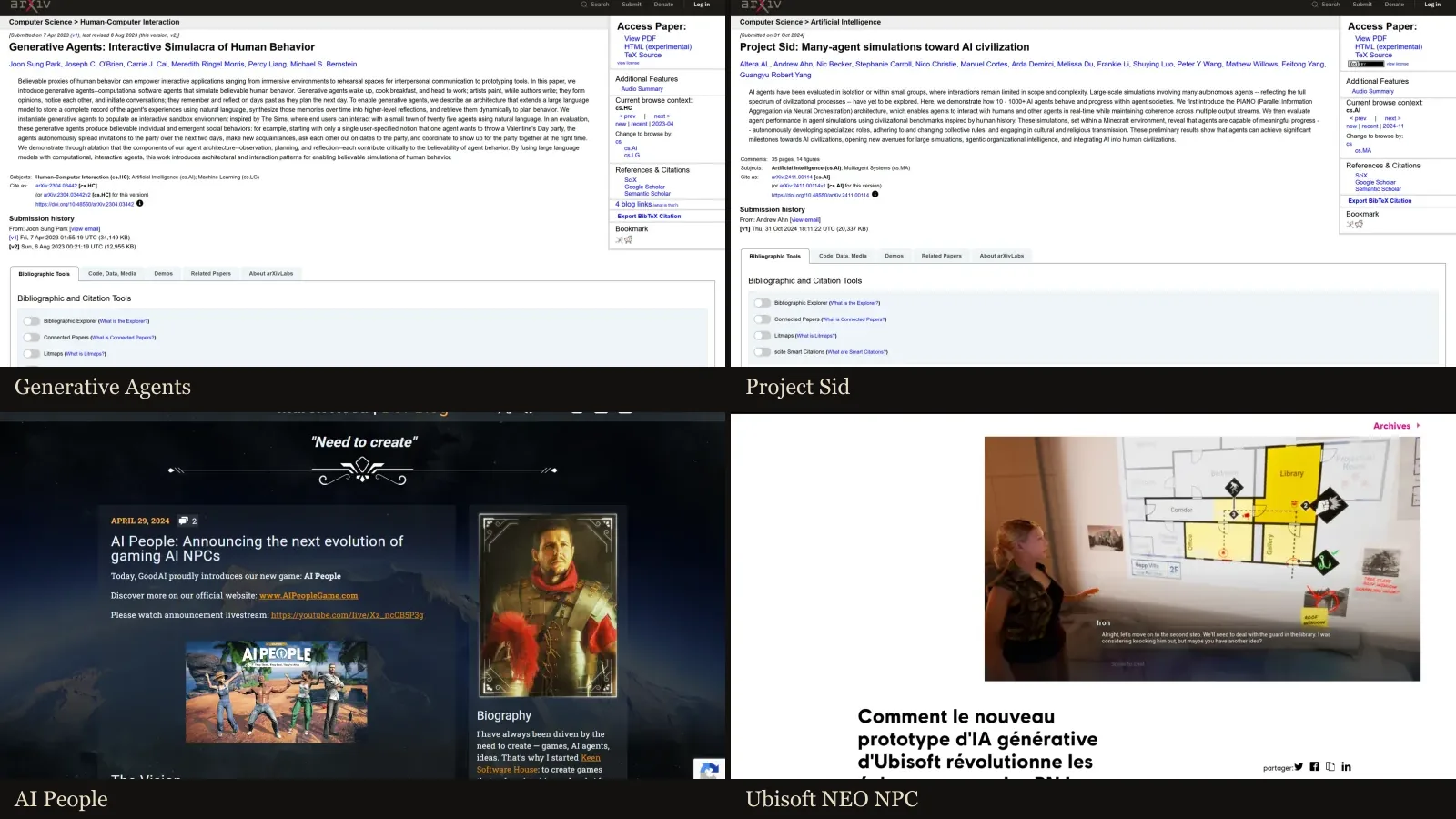
This page names twelve people with a clear, sourced part in how AI RPGs and AI game characters are made. They are founders of AI RPG platforms, people behind game-character technology, authors of the research that games borrow from, and two academics who study AI in games. It is not a ranking, and “influential” is a judgement we do not claim to measure.
We built it from the people’s own pages, their companies’ pages and their published work, all checked on 26 October 2026. If we could not confirm a role from a source like that, the person is not here. The last section lists who we left out and why.
Arcanum is independent. We have interviewed two of these people and used comped access to products from some of their companies, and each profile says so. Nobody on this page paid for a place, and none was offered one. Names and trademarks belong to their owners.
The Short Version
| Group | Who | Known for |
|---|---|---|
| Platform founders | Nick Walton, Hilary Mason, Eric, Louis Muk | Latitude (AI Dungeon, Voyage), Hidden Door, MythEngyn, Isekai Zero |
| NPC technology | Purnendu Mukherjee, Virginie Mosser, Mélanie Lopez Malet | Convai, Ubisoft’s NEO NPC prototype |
| Agents and simulation | Joon Sung Park, Guangyu Robert Yang, Marek Rosa | Generative Agents, Project Sid, AI People |
| Academia | Julian Togelius, Mike Cook | Research on AI and game design |
Platform Founders
Nick Walton, Latitude
What he did. Walton is the CEO of Latitude, the company that made AI Dungeon in 2019 and is building its structured successor, Voyage. We interviewed him in August 2026.
Why it matters. AI Dungeon is one of the best-known AI RPGs, and Voyage is Latitude’s attempt to rebuild the idea with a structured engine. In the interview Walton set out the Voyage timeline: an open beta in weeks and a full release in early 2027, as he told us on 10 August 2026. Check Latitude’s own pages for the current dates.
Read. Our interview with Nick Walton; Voyage; AI Dungeon.
Sources. Our interview, published 10 August 2026. Latitude gave us beta access to Voyage with no conditions.
Hilary Mason, Hidden Door
What she did. Hidden Door’s team page lists Mason as co-founder and CEO, and Matt Brandwein as co-founder for product. The company describes itself as making narrative technology for creative teams in entertainment. Its consumer platform lets people explore licensed worlds from film and publishing partners, talk to characters and return to stories that remember their choices. It also offers a studio called Atlas for building a world, and an API and an MCP connection for partners and creators.
Why it matters. Hidden Door takes the opposite route to a free-form chatbot. Its stories are assembled from authored material inside licensed worlds. That makes it a useful comparison point for anyone deciding how much an AI should invent.
Read. Our Hidden Door review.
Sources. Hidden Door’s own team and about pages, checked 26 October 2026. The page gives no career history for her, so we do not give one.
Eric, MythEngyn
What he did. Eric is the founder and engineer of MythEngyn, which he builds under Mutiny Labs with his brother. In our August 2026 interview he said the longest campaign on the platform had run to 4,288 turns, and set a target of November 2026 for version 1.0.
Why it matters. He narrowed a marketing phrase, “infinite memory”, to a claim that can be checked: unbounded retention, not an unlimited context window. That is the kind of precision our readers can use.
Read. Our interview with Eric; MythEngyn.
Sources. Our interview, published 11 August 2026. MythEngyn’s developer gave us an account with unlimited messages; MythEngyn carries no rating from us.
Louis Muk, Isekai Zero
What he did. Muk is named as CEO of Isekai Zero in Inworld’s own materials, where he is quoted praising Inworld’s voice model.
Why it matters. Isekai Zero is a platform on our benchmark. Neither the quote nor our sources say which of its features use Inworld, so we do not say.
Read. Our Isekai Zero review and our Inworld AI guide.
Sources. Inworld’s TTS-2 launch post and homepage, as recorded in our Inworld AI guide.
NPC Technology
Purnendu Mukherjee, Convai
What he did. Convai’s own account, published in September 2023, names Mukherjee as its chief executive and says he was on the NVIDIA team that built the NeMo language-model framework and the Jarvis conversational-AI framework. NVIDIA’s announcement of ACE for Games in 2023 says Convai integrated ACE modules into its avatar platform for the Kairos ramen-shop demo.
Why it matters. Convai still sells a platform for building AI characters that talk, see and act in 3D worlds. It still sells that platform, while its best-known rival, Inworld, retired its Character Studio in 2025, as our guide explains.
Read. Convai Explained and NVIDIA ACE.
Sources. Convai’s own account and NVIDIA’s announcement, both quoted in our Convai guide. The NVIDIA team claim is Convai’s, and we have not verified it elsewhere.
Virginie Mosser and Mélanie Lopez Malet, Ubisoft
What they did. Ubisoft’s article about its NEO NPC prototype says narrative director Mosser spent more than a year writing the characters: their backstories, hopes, personalities and ways of speaking. It says data expert Lopez Malet trains the model to act like them, using guardrails, text instructions and analysis of how players behave.
Why it matters. Their work is a public example of a split many AI character projects use: people write who the character is, and the model improvises what they say. Ubisoft’s article is also open about the problems, including stereotyped behaviour and nonsensical player input.
Read. Ubisoft NEO NPC Explained.
Sources. Ubisoft News, 19 March 2024, French edition, read in translation.
Agents and Simulation
Joon Sung Park and co-authors
What he did. Park is the first author of Generative Agents: Interactive Simulacra of Human Behavior, with Joseph O’Brien, Carrie Cai, Meredith Ringel Morris, Percy Liang and Michael Bernstein. It put 25 AI characters in a Sims-style town for two game days. The paper credits a Microsoft Research PhD fellowship to Park and thanks Stanford’s Human-Centered AI Institute, Google Research and OpenAI, among others, for support.
Why it matters. It is the paper behind the idea of an AI character with a memory it searches, reflects on and plans from. Our research index records more than 5,600 citations for it, as of 25 September 2026.
Read. Generative Agents Explained and our research index.
Sources. The paper (arXiv:2304.03442). We give no employer or title for Park because the paper’s arXiv page does not show one.
Guangyu Robert Yang and Altera
What he did. Yang is one of the authors of Project Sid: Many-agent simulations toward AI civilization, credited with Altera.AL and 12 other co-authors. The paper reports AI agents in Minecraft forming roles, following and changing rules, and spreading a parody religion.
Why it matters. It tested a question the earlier paper could not: what happens with hundreds of agents, not 25.
Read. Project Sid Explained.
Sources. The paper (arXiv:2411.00114). We could not load Altera’s own site, so we give no company role for Yang.
Marek Rosa, GoodAI
What he did. Rosa’s own blog biography says he started Keen Software House to make games that existed only in his imagination, and that Space Engineers came from that. After Space Engineers took off he founded GoodAI, to pursue artificial general intelligence. It says he now focuses on Space Engineers 2, the VRAGE3 engine, AI People and autonomous agents, including NPCs and drone swarms. He is creative director of AI People.
Why it matters. AI People is a game built around AI characters with goals and memory, and Rosa’s February 2025 diary is a frank account of how far it was from that aim at the time.
Read. AI People Explained.
Sources. His blog and its biography, checked 26 October 2026. The status of the game itself is unclear, as that page explains.
Academia
Julian Togelius, NYU
What he does. NYU’s faculty page lists Togelius as a Professor in Computer Science and Engineering, and says he directs the Game Innovation Lab. His listed interests include AI for games, player modelling, procedural content generation, automatic game design and believable bot behaviour.
Why it matters. Procedural content generation and automatic game design are the research fields that AI RPGs descend from. His page is a good map of that work.
Sources. NYU’s faculty page, checked 26 October 2026. A third-party bio describes him as a co-founder of the game-testing company modl.ai. NYU’s page does not, so we do not rely on it.
Mike Cook, King’s College London
What he does. King’s College London lists Cook as a Senior Lecturer in the Department of Informatics and Deputy Head of the Human Centred Computing Group. His research interests include computational creativity and automated game design. His page lists the game-designing AI systems ANGELINA, Puck, Bluecap and Pixie, and a book, Next Level, about creative technology and games.
Why it matters. Cook has spent years building AI systems that design games, which makes him a useful voice on what AI can and cannot do in design. A 2023 event blurb on his page says he examines AI’s control by corporations.
Sources. King’s College London’s staff page, checked 26 October 2026. We do not call him a critic of AI in games, because his page does not say so, and we have not read enough of his work to say it for him.
Who We Left Out, and Why
This list is shorter than the one we first drafted. We cut anyone whose role we could not confirm from a primary source on 26 October 2026.
- Inworld’s founders. Inworld’s own about page names no leadership, and the people-and-title details we found came from secondary sites. We would rather link the company’s guide than state titles we could not confirm at the source.
- Emily Short. She is a respected interactive-fiction author, but her blog’s most recent post we found is dated November 2023 and nothing on it ties her work to AI RPGs. We will add her if that changes.
- Investors and journalists. We have no primary-source way to measure influence for them, so we left them out.
- Critics of AI NPCs. We started with the idea of a section for critics. We could not source a position for anyone on the day we checked, so there is no such section.
- Players, modders and community builders. Many of the most useful people in this field are not founders or authors. We have no way to name them fairly yet.
How We Chose
- A role we can source. A title, a paper or a product, from the person’s own pages, their company’s pages or their published work.
- A connection to AI RPGs. The person builds, studies or supplies the technology for AI role-playing games or AI game characters.
- Facts only. Roles, projects and dates. Nothing about private life, and no opinions we cannot source to the person.
- Dated. Each profile carries its source check date, and we re-check every quarter.
If you think someone belongs here and can point us to a primary source for their role, tell us through the contact page.
Frequently Asked Questions
Who are the most influential people in AI RPGs?
There is no agreed list and this page is not a ranking. It names twelve people with a clear, sourced role: Nick Walton of Latitude, Hilary Mason of Hidden Door, Eric of MythEngyn, Louis Muk of Isekai Zero, Purnendu Mukherjee of Convai, Virginie Mosser and Mélanie Lopez Malet of Ubisoft, Joon Sung Park, Guangyu Robert Yang, Marek Rosa, Julian Togelius and Mike Cook.
Who created AI Dungeon?
Latitude, the company led by CEO Nick Walton, made AI Dungeon in 2019, according to our interview with him. Latitude is now building Voyage, which it describes as AI Dungeon’s structured successor.
Who wrote the Generative Agents paper?
Joon Sung Park, Joseph O’Brien, Carrie Cai, Meredith Ringel Morris, Percy Liang and Michael Bernstein. It was first posted on arXiv in April 2023 and describes 25 AI characters living in a simulated town.
Who is behind Hidden Door?
Hidden Door’s own team page lists Hilary Mason as co-founder and CEO and Matt Brandwein as co-founder for product. The company makes narrative technology and a platform where audiences explore licensed worlds from film and publishing partners.
Who made Ubisoft’s NEO NPC?
A small research and development team at Ubisoft’s Paris studio. Ubisoft’s article credits narrative director Virginie Mosser with creating the characters and data expert Mélanie Lopez Malet with training the model to act like them.
Why are some well-known names not on this page?
We only list people whose role we could confirm from their own pages, their company’s pages or their published work. Several well-known names did not meet that standard on the day we checked, and the page says which and why.
How often is this page updated?
Quarterly. Each profile carries the date its sources were checked.
Sources
Checked 26 October 2026. Hidden Door team page; Marek Rosa’s blog; NYU Tandon faculty page for Julian Togelius; King’s College London staff page for Michael Cook; Generative Agents and Project Sid on arXiv. The Ubisoft, Convai, Inworld and Latitude details come from our own guides and interviews, which cite their sources: Ubisoft NEO NPC, Convai, Inworld AI, Nick Walton and Eric of MythEngyn.