Project Sid Explained: Altera's AI Civilization Experiment in Minecraft, and What It Shows
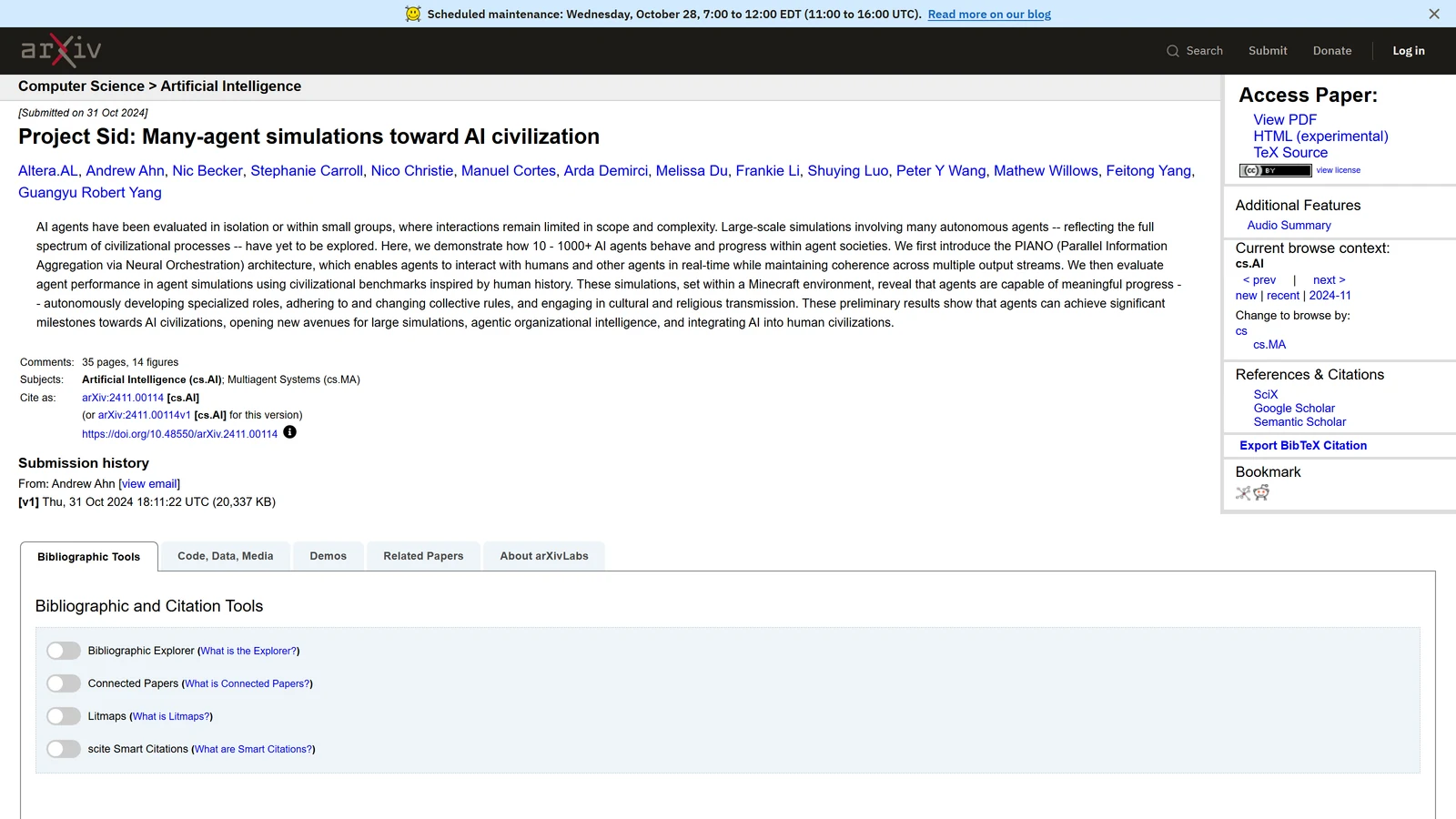
Project Sid is a 2024 research paper from the company Altera in which hundreds of AI agents lived together in Minecraft, took on jobs, paid taxes, voted on changes to their rules and spread a parody religion. The authors call it a preliminary step toward AI civilizations. It is not a game, and you cannot play it, but it is one of the larger attempts we have read to see what happens when many AI characters share a world.
It follows Generative Agents, which put 25 agents in a small town for two game days. Project Sid asks what changes when the group is twenty times larger and the world is Minecraft. If you have wondered where ideas like “a world that keeps going without you” in an AI simulation game come from, papers like this are the source.
This page is built from the paper (arXiv:2411.00114) as published. We have not run anything from it, and nothing here is scored. It is read, not played, and we have not checked the authors’ results independently.
Arcanum is independent and unaffiliated with Altera and every company named here.
The Short Answers
- What is it? A research paper and the experiments it reports. Groups of AI agents live in Minecraft.
- Who wrote it? Altera.AL and 13 named co-authors, including Guangyu Robert Yang.
- When? Submitted to arXiv on 31 October 2024.
- Can I play it? No. There is nothing to download.
- How big? Experiments ranged from about 3 agents to a 500-agent run. Runs above 1,000 agents exceeded the server’s limits, according to the paper.
- Why does it matter? It is a test of whether AI agents can sustain a society for hours, not minutes.
The Problem the Paper Is Trying to Solve
An AI agent that works alone is one thing. Put dozens in a shared world and new problems appear: each agent has to talk, move, plan and remember at the same time, and what an agent says has to match what it is doing. If an agent announces it is going mining while it walks toward a farm, the other agents are reacting to nonsense.
The authors’ answer is an architecture called PIANO. The paper expands the name two different ways, as “Parallel Information Aggregation via Neural Orchestration” in the abstract and introduction and as “Parallel Input Aggregation” in a later section, so we use the short name.
How PIANO Works
The idea is to stop treating an agent as one prompt that thinks, then acts, then thinks again. Instead, several modules run at once at different speeds, all reading from and writing to one shared state.
| Piece | What it does |
|---|---|
| Concurrent modules | Cognition, planning, motor control and speech run in parallel at different timescales. The paper says there are ten core modules, including memory, action awareness, goal generation, social awareness, talking and skill execution |
| Fast reflexes | Quick responses use small, fast networks, not a large language model |
| Slow reasoning | Goal setting uses deliberate, slower reasoning |
| Cognitive Controller | One module makes the high-level decisions and sees only a filtered view of the shared state. Its decisions are broadcast to the other modules, especially the ones that handle speech, so words and actions stay consistent |
The authors describe the controller as their coherence mechanism. They also report that removing parts changed the results, which is how they argue each one matters.
What They Ran
| Experiment | Agents | Length | What was measured |
|---|---|---|---|
| Exploring | 25, spawned far apart | Not stated in the parts we read | Items collected |
| Long single-agent run | 49 | 4 hours | Items collected over time |
| Societies | 50 | 4 hours or more (about 12 in-game days) | Relationships and roles |
| Specialisation | 30 in one village | 20 minutes, repeated 3 times | Which roles formed |
| Tax and voting | 29 (25 constituents, 3 influencers, 1 election manager) | 20 minutes | Tax payments and constitution changes |
| Cultural spread | One 500-agent run | 9,000 seconds | Memes and religious conversion |
The authors say runs above 1,000 agents exceeded the server’s limits, so the cultural results come from the 500-agent run. They also say the discussion section’s mention of “a thousand agents” is stronger than the methods support, and one of the paper’s numbers (the rural population) is given as both 300 and 302. Read the headline range, “10 to over 1,000”, with that in mind.
What They Found
Gathering items
With the full design, agents collected about 17 unique items on average after 30 minutes. Top performers reached 30 to 40, and some got fewer than five. Across 49 agents over four hours, the group’s total saturated around 320 unique items, roughly a third of all items in Minecraft. Taking away the module that tracks what the agent is doing slowed progress.
Reading each other
Agents tracked how others felt about them from conversation. In the 50-agent societies, how likeable an agent seemed matched how likeable it really was, and the match improved with more observers and longer interaction. Without the social modules, relationships stayed flat and neutral. Introverted agents ended up with fewer incoming ties than extroverts.
Jobs
Agents formed roles such as farmer, miner, engineer, guard, explorer and blacksmith, and kept them over time. Without the social module, roles did not stick and were more alike. Societies given a martial goal produced scouts and strategists, and artistic ones produced curators and collectors. The paper says GPT-4o was used to label the roles.
Taxes and votes
Under a constitution that required it, constituents put about 20 percent of their inventory into a shared pool. When the constitution was amended to lower the rate to 5 to 10 percent, payments fell to about 9 percent. Agents designated as influencers pushed opinion for or against the tax, and payments moved with them. When the constitution was frozen, the rate stayed the same.
Memes and religion
In the 500-agent run, agents invented memes, and rural areas produced significantly fewer than towns. Each town had a different dominant theme, such as ecology in one and pranks in another. For religion, the researchers seeded 20 priests of the parody religion Pastafarianism. Converts kept growing for two hours without saturating, and the area of influence spread as converts travelled.
What the Authors Say They Could Not Do
This is the section to read before repeating any headline about “AI civilizations”.
- No vision or spatial reasoning. Agents cannot see the world properly, which limits navigation and building together.
- No real drives. The agents lack deep motives such as survival, curiosity or loyalty to a community that could push a society to develop on its own.
- Nothing new. Because the models were trained on human knowledge, the authors say the agents cannot yet show a society inventing new institutions, such as a democratic system or an economy, from scratch.
- Preliminary. The abstract calls the results “preliminary”.
- Hard to compare. The authors say comparing item-collecting results with an earlier system, Voyager, is difficult because the conditions differ.
- Models. The best item results used GPT-4o, and older base models did not reach them. The paper does not clearly say which model drove the full agents in each experiment.
Why It Matters for Games
- It shows the shape of a real AI society. Agents with roles, rules and shared beliefs are the picture behind the idea of a game whose world runs without you.
- It shows the cost of scale. The authors hit server limits at 1,000 agents. A game that sold a world with that many reasoning characters would face the same wall.
- It shows what is still missing. Agents that copy human institutions from their training are not yet agents that build new ones. A game built on this today would feel like a world of capable imitators.
We did not find a game that publishes an architecture like PIANO, so we do not claim any of them uses it. inZOI describes its Smart Zois as agents that plan, act and reflect, which is the same family of idea at a much smaller scale.
What We Could Not Confirm
- We have not reproduced any result. Everything here is what the authors report.
- The length of the 25-agent exploring run. We did not find it in the parts of the paper we read, so the table says so.
- Anything after the paper. We did not check what Altera has released since October 2024.
If You Want to Play With the Idea Now
-
Read the AI simulation games guide for what you can play today.
-
Read Generative Agents Explained for the smaller, earlier version of the same idea.
-
Our research index lists the academic papers we have checked against their sources.
-
For the people behind this work and others like it, see The People Shaping AI RPGs.
Frequently Asked Questions
What is Project Sid?
Project Sid is a research paper by Altera.AL and co-authors, submitted to arXiv on 31 October 2024. It reports experiments in which groups of AI agents, from a handful up to about 500, lived together in Minecraft and developed roles, followed and changed shared rules, and passed on cultural habits. The authors call the results preliminary.
Can I play Project Sid?
No. It is a research report, not a game or a product you can download. The only way to see what it did is to read the paper.
What is PIANO?
PIANO is the architecture the authors built so one agent can do several things at once, such as talk while walking and planning. Its parts run at the same time and share one state, and a single cognitive controller makes the high-level decisions so that what the agent says and does stay consistent. The paper expands the name two different ways.
Did the AI agents really form a society?
The paper reports agents taking on specialised roles such as farmers, miners and guards, paying about 20 percent of their inventory under a constitution and changing the rate when it was amended, and spreading memes and a made-up religion. These are results from the authors’ own experiments. The authors say the agents still lack vision and spatial reasoning and cannot yet invent new institutions.
How many agents did Project Sid use?
The experiments used between about 3 and 500 agents, depending on the test. The abstract describes groups from 10 to over 1,000, but the paper says runs above 1,000 exceeded the server’s limits, and the cultural results come from a 500-agent run.
Is Project Sid an AI game?
No. It is research on how AI agents behave in groups. It matters to games because it is the kind of system that AI simulation games borrow ideas from, but nothing in the paper is a product.
How is Project Sid different from Generative Agents?
Generative Agents put 25 agents in a small town for two game days. Project Sid ran many more agents inside Minecraft, where they could gather items and build, and it measured roles, taxes and cultural spread.
Sources
Checked 26 October 2026. Altera.AL and co-authors (Andrew Ahn, Nic Becker, Stephanie Carroll, Nico Christie, Manuel Cortes, Arda Demirci, Melissa Du, Frankie Li, Shuying Luo, Peter Y. Wang, Mathew Willows, Feitong Yang and Guangyu Robert Yang), Project Sid: Many-agent simulations toward AI civilization (arXiv:2411.00114, submitted 31 October 2024). We read the paper’s text as published; we did not read every appendix.