RPBuddy Review: Build the Town, Time the Strike, Then Write the Shop Yourself
Access disclosure: RPBuddy gave us free access to its Hero plan for this review. No conditions were attached to our coverage. This review is independent and unpaid.
RPBuddy is an AI RPG sandbox in which you build the world first — the map, the towns, the buildings and the people in them — and then play a character inside it, talking to anyone you meet. It runs in a browser, on a computer or a phone.
It scores 3.4 out of 5, seventh of the thirty-one platforms on our benchmark, level with Isekai Zero. That number is an average of two very different games. One is a world-builder with ideas nobody else in this category has, and it earns the highest score we give for Signature Design. The other is an RPG whose shops and quests are not finished yet, and it earns a 2 for fairness.
We ran our Extended tier against it — the long test, carried well past turn 50 — on the Hero plan, the most expensive one. Hero includes what RPBuddy calls enhanced NPC memory, so a player on a cheaper plan should expect the memory to be, if anything, a little weaker than what we describe below.
What It Is
RPBuddy’s own name for itself is “The Ultimate AI RPG Sandbox”, and the word that matters there is sandbox.
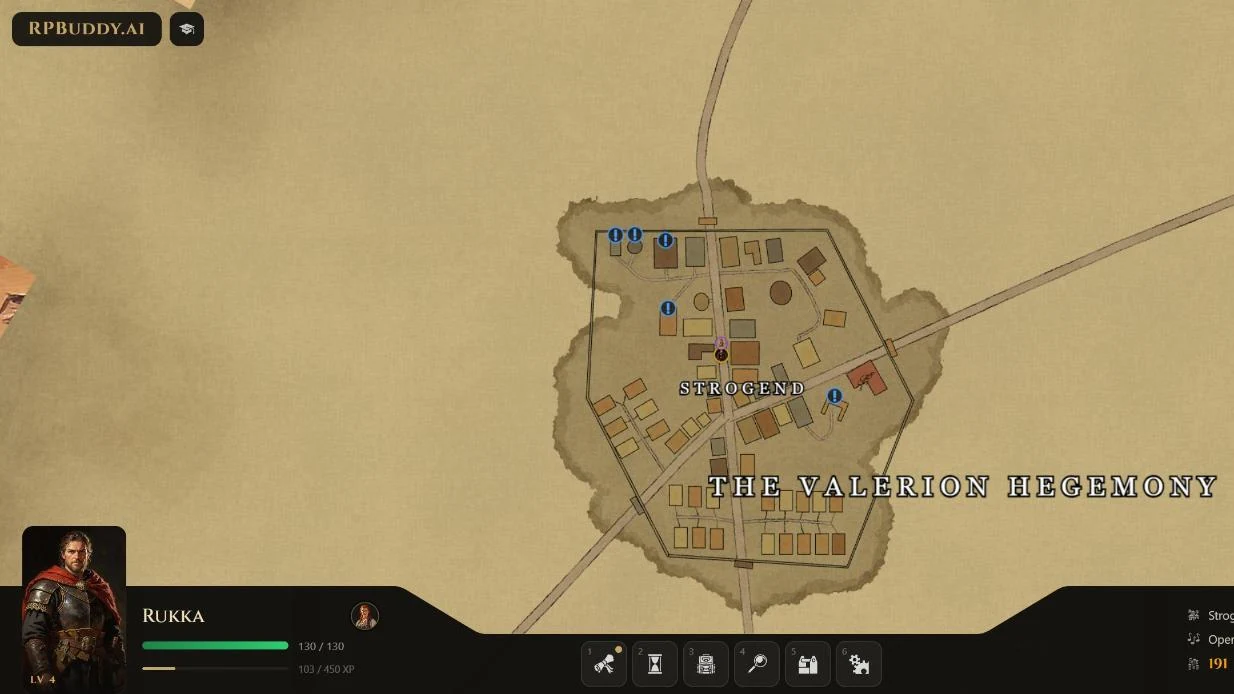
You start by creating a world: a name, a setting and a map made of hexes. There are four settings — Medieval Fantasy, Modern Day, Neon Future and Sci-Fi Colony — each with its own buildings, currency, music and culture, and five art styles for the pictures the game paints. Then you build. You draw settlements on the map, place buildings, lay roads, rivers and walls, and fill the buildings with characters. You can do every part of that by hand, describe what you want and let the AI write it, or drop in a ready-made town from a template.
Then you play. You have one character of your own. You walk into a building and talk to whoever is there, in free text, and they answer as themselves. Out on the map you meet enemies and fight them. Each town has a Bounty Board with jobs: kill a number of monsters, go and talk to someone, or carry a package from one person to another.
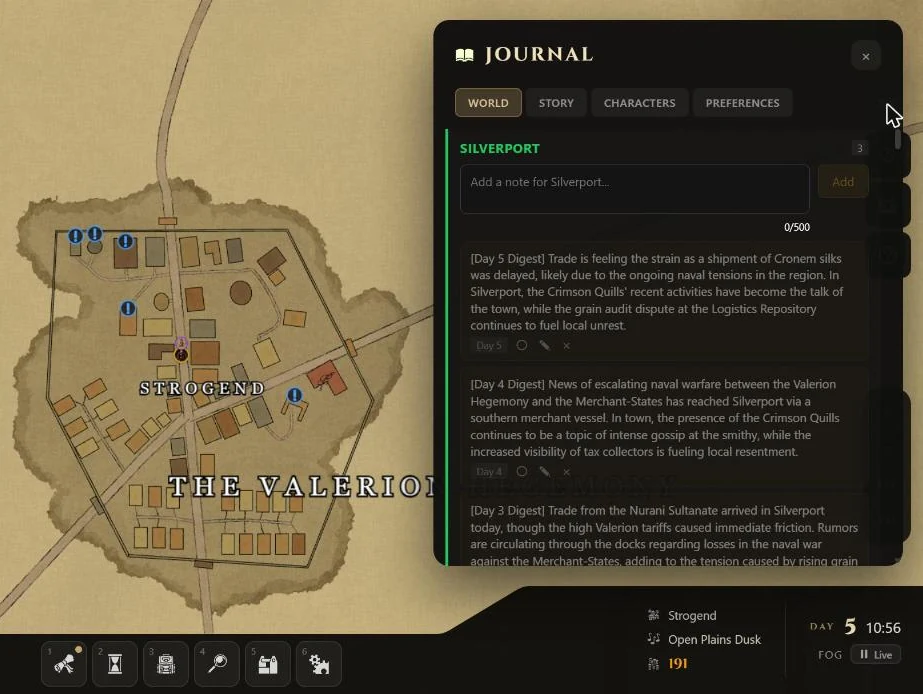
The world does not stop when you look away. Characters have daily routines and move between buildings. When they share a room they talk, and they pass on what they know about you — the docs say a story can travel two people from whoever saw it, and no further. Each night the game writes a digest for every settlement, and the Journal keeps those digests, the story so far, and everything each character remembers.
It is single-player. It works on a phone, and can be installed to the home screen, but there are no apps in the App Store or Google Play, and RPBuddy’s own FAQ says desktop is still the best way to build maps. It is for adults only; mature scenes are available on the paid plans.
Signature Design — 5
This is the highest score we give. Seven of the thirty-one platforms on our board hold it, and RPBuddy earns it for four things.
You design the buildings. A building is not a name in a list. You place it on the map, shape its footprint, set how many floors it has and pick its roof. You give it a type — an inn, a thieves’ guild, a barracks — and then its rooms, its floors and its hallways. Its appearance is yours to decide. The Location Wizard can fill it for you from a sentence (“a tavern run by an elderly couple”), from a ready-made option, or from a blank form.
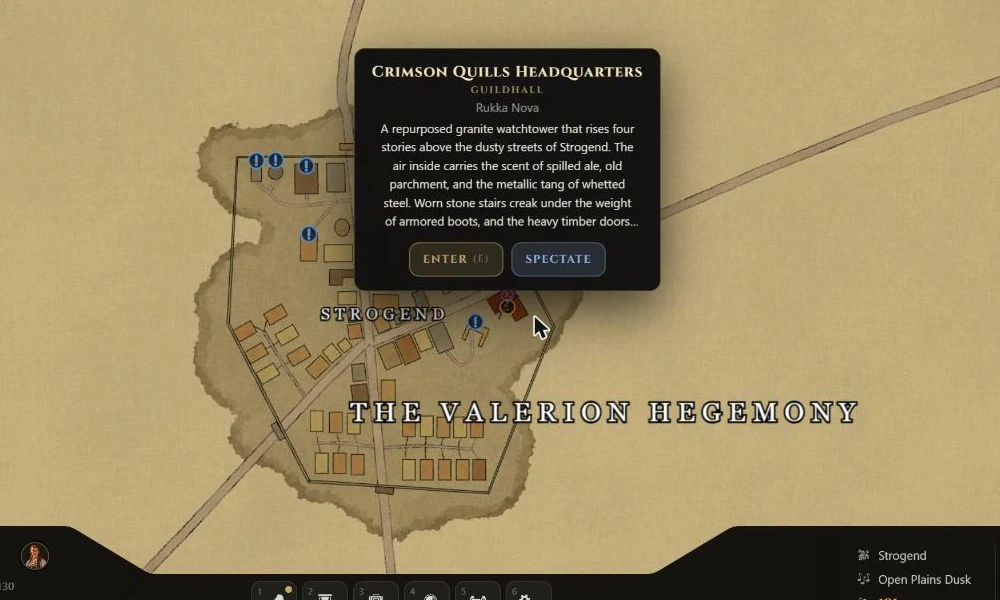
You can found a settlement. Draw a boundary on the map, call it a village, a town, a city or something of your own (“free city”, “mining camp”), and the game gives you a whole place: buildings, streets and the people who live and work there. Every settlement gets a short briefing that all of its residents know, and its own Bounty Board. We have not seen this anywhere else in this category. It is really unique.
The world map, and how much you can change it. Most AI RPGs give you a world described in text. RPBuddy gives you a map you can see, built hex by hex, and nearly all of it is yours to change. Its FAQ is honest about the other direction: if a character mentions a city that is not on your map, the game does not create it. The map changes only when you change it.
Combat you can be good at. RPBuddy offers two kinds of combat. One is the usual: the game rolls, and you hit, miss or land a critical at random. The other is a timing system. When you attack, a marker sweeps across a bar; stop it inside the marked zone and you hit, stop it in the small zone inside that and you land a critical, and miss the zone and you miss. Time it right for a critical, well for a hit, badly for a miss. That turns a fight from luck into skill, which is rare in a category where combat is usually a dice roll described in prose.
NPC Fidelity — 4
Characters are where the “you get what you put in” rule first shows.
Out of the box, they can feel bland, and alike. A character made quickly, by a template or a one-line description, speaks well enough, but many of them sound like the same person in different clothes.
Give them a personality and they keep it — and keep it very well. Every character has a profile you can edit, with a goal, a fear and a secret, and you can add instructions they follow above their usual nature. When we wrote a personality into a character’s profile, they held to it, and held to it in a great way.
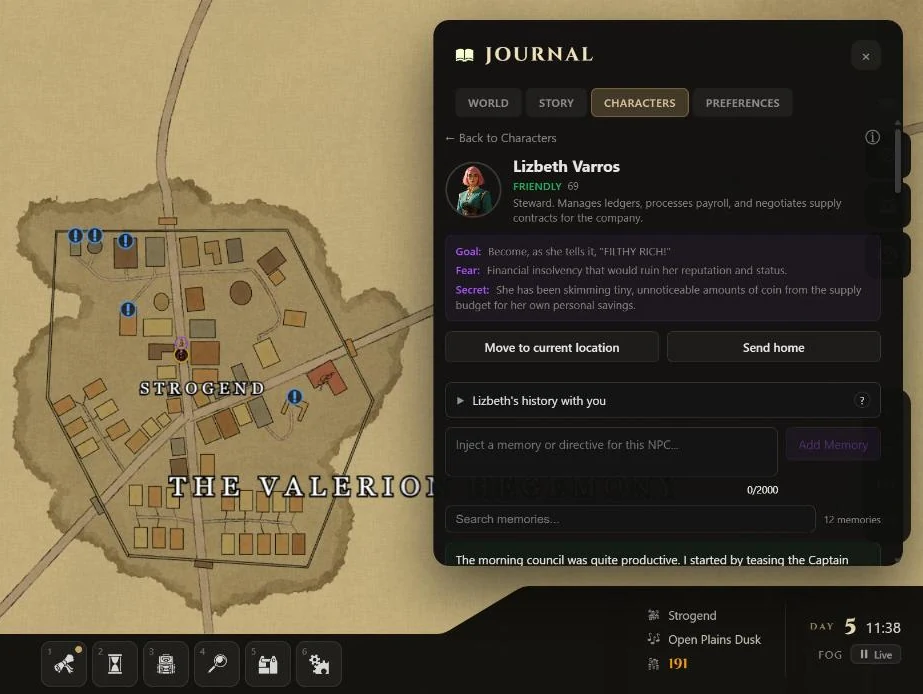
That is why this is a 4 and not a 5. Worked on properly, these characters could earn the top score. But that means hours of tweaking each character you care about, and a world can hold thousands of them — ours had 6,791. A score has to describe what a player gets, not what they could build.
Longevity — 3.5
Still a little bare to be a game you play for months, but not bad.
Everything that makes RPBuddy special pulls this up: a world you made, that keeps moving, with characters who remember you and gossip about you. Everything that is unfinished pulls it down. When there is nothing much to buy, quests do not work and money means little (see below), the long-term goals an RPG usually gives you are missing. What is left is the world itself, and how much you enjoy building and living in it. For the right player that is a lot.
Player Agency — 3.5
There was no puppeting. RPBuddy never wrote our character’s actions or words for us.
There was railroading, but of an unusual kind. Most games that railroad you steer the story back to the path they wanted. RPBuddy leaves the story alone and limits what you can interact with. We could not, for example, choose to kill a citizen, or start a fight in an inn.
That limit is partly by design. RPBuddy’s documentation says a fight with a character starts when a conversation turns physically violent, and that it is the character who takes it to the battle screen; characters can also be set never to fight, and fights with characters can be switched off for a whole world. So in a conversation, the game, not you, decides when words become a fight. A player who wants to choose violence, rather than ask for it, will feel the wall.
Memory & Continuity — 3
RPBuddy has one of the more thought-through memory systems we have read about. Its docs say every character forms a memory of each conversation from their own point of view, and on every message they bring to mind their pinned memories, a summary of their history with you, a few recent memories, a few that match what you just said, the story threads you share and a little gossip. Nothing fades on its own. You can read all of it in the Journal, and you can add memories, edit them, delete them, and pin them.
In play, the problem was not that RPBuddy forgot. It was that it chose badly what to remember in the moment.
- The memory is selective, and it often failed to bring up what was pertinent. The right memory existed, but the character did not recall it when the scene needed it. That gave us odd turns in the story and in conversations, and goals were lost along the way.
- Automatic memories were sometimes skipped on the places and characters that needed them, so a scene that should have left a mark did not.
You can fix a lot of this yourself. Pin the facts that matter, inject the memories you want a character to have, and they will use them. Done for hours, that would raise this score. Done by the game, out of the box, it is a 3.
Mechanical Depth — 3
This is an average of parts that score very differently.
- Combat and moving around the world would score a 5. The timing gauge, the turn options (strike, brace, use an item, flee), enemies whose cards show what they are about to do and what they are weak to, and a party who fight alongside you, all on a map you can see and travel.
- Commerce and quests did not work in our testing. We return to commerce under fairness, below.
- How much you can interact with the world varies hugely. In some places there is a ton to do. In others, close to nothing.
We expect this score to climb in later updates, because the parts that pull it down are the parts still being built.
Determinism & Fairness — 2
The fair half is real. Combat is fair, and so are relationships: characters warm to you or cool on you for reasons you can follow.
The other half is money. Money was almost meaningless, because commerce was close to non-existent when we played. We could not really sell our loot, and we could not find things to buy. To get better gear, we had to roleplay the whole trade and then do the bookkeeping ourselves: ask a blacksmith for a quote in conversation, then go into the inventory, delete our sword by hand and create a better one.
An economy where the player writes their own rewards cannot be fair or unfair. It is not there. That is why this is a 2.
One thing to know before you take that at face value. RPBuddy’s documentation now describes a shop panel in conversations with shopkeepers, with Buy and Sell, prices that change with how the shopkeeper feels about you, and haggling. That is not what we found when we played. The docs may describe changes made after our testing, and we have not tested them. We will look again in November, and if commerce works, this score, and Mechanical Depth with it, will move.
Pricing
RPBuddy is free to start, with no card. Its plans, from its own pricing section on 19 October 2026:
| Plan | Price | What you get |
|---|---|---|
| Traveler | Free | 50 image credits, 50 AI actions a day, unlimited worlds, unlimited manual building |
| Adventurer | $10/month or $100/year | 200 image credits a month, unlimited NPC chats, unlimited worlds |
| Hero | $20/month or $200/year | 500 image credits a month, advanced image generation and premium image models, message editing and re-rolling, enhanced NPC memory, early access to beta features |
What the free plan really limits is talking. On Traveler, a chat message and an AI generation each count as one of your 50 actions a day, and they reset at midnight UTC. Building by hand is unlimited. For a game where most of play is conversation, 50 actions is a short evening.
Image credits are for pictures. One credit paints one image — a portrait, an interior, a settlement — and some advanced edits cost more. Conversations never cost credits. Extra credits come in packs: 50 for $5, 100 for $8 and 300 for $20, and packs never expire.
Yearly plans cost ten months’ price for twelve, and add a one-time bonus of 200 image credits on Adventurer or 500 on Hero.
Refunds. If you cancel within 48 hours of subscribing and have not used any of the credits the subscription gave you, you can ask for a full refund. After that, subscriptions are not refundable. Credit packs are never refundable.
Your chats. On the free plan, your prompts and the replies may be used to train RPBuddy’s AI. On paid plans they are not.
Where to Play
- In a browser, at rpbuddy.ai. Desktop is best for building.
- On a phone or tablet, in the browser, or installed to your home screen as an app from there. There are no apps in the App Store or Google Play.
RPBuddy is for adults only.
Verdict
RPBuddy has systems that could make it one of the strongest games we have reviewed. Nothing else we have reviewed lets you design a building room by room, found a settlement, and then walk into it and talk to the people you put there. Its characters hold a personality better than most. Its combat rewards skill.
But all of that is behind your own work. To get the best out of RPBuddy you have to invest dozens upon dozens of hours: in your world, then in your characters, then in your own character, pinning memories and writing personalities by hand. Out of the box, the characters are bland, the memory picks the wrong things, and the shops and quests are not there yet. It is the definition of “you get what you put in”.
At 3.4 it is sixth on our board, level with Isekai Zero. If you love building worlds as much as playing in them, it may be one of the most rewarding games on our board. If you want a finished RPG tonight, wait for the economy. We will be back to check on it.
Product names and trademarks are the property of their respective owners. Arcanum is not affiliated with RPBuddy.