NovelAI vs Sudowrite vs NovelCrafter (2026): Three Writing Tools, Three Ways to Pay for the AI
NovelAI, Sudowrite and NovelCrafter are three different answers to the question of who pays for the AI: NovelAI includes its own models in a flat monthly subscription, Sudowrite spends monthly credits, and NovelCrafter sells you the writing tool and makes you bring your own AI. That one difference explains most of their prices, their limits and who each one suits.
We read each product’s own pricing page, documentation and front page on 30 October 2026, and used our own dated NovelAI pricing page, read on 29 September 2026, for the NovelAI tier details. We did not run Sudowrite or NovelCrafter for this page, we did not test the quality of anyone’s writing, and we are not scoring any of the three. Nobody gave us access to any of them.
All three are third-party products and the names are used nominatively. Arcanum is not affiliated with any of them.
The Short Answer
| You want to… | Look at |
|---|---|
| Type a story and have the AI continue it, with a flat price | NovelAI |
| Draft and polish a novel with a bible, outline and editing tools, and let the tool include the AI | Sudowrite |
| Organise a book and series, and pick the AI model yourself | NovelCrafter |
| Run the AI on your own computer | NovelCrafter (its help page mentions local models) |
| Play a game with a game master, dice and a character | None of these. See AI RPG platforms |
Three Different Ideas
| NovelAI | Sudowrite | NovelCrafter | |
|---|---|---|---|
| What it is | A story-writing studio with its own text and image models | An AI writing assistant for fiction | A writing organiser for books, series and universes |
| Who supplies the AI | NovelAI | Sudowrite | You. You connect a provider or a local model |
| How the AI is paid for | Included in the subscription | Credits that come with the plan | Separately, through your provider |
| Free plan | No. A trial | No. A free trial, no card | No. A 21-day trial |
| Its own memory feature | Memory window plus Lorebook | Story Bible | Codex |
The easiest way to hold it in your head: NovelAI is a writing room with its own staff, Sudowrite is an editor you pay by the hour, and NovelCrafter is a desk and filing system where you hire the writer yourself.
What They Cost
| NovelAI | Sudowrite | NovelCrafter | |
|---|---|---|---|
| Entry price | $10 a month (“start at $10”, from its front page) | $10 a month (Hobby & Student) | $4 a month (Scribe, no AI features) |
| Middle | $15 (Scroll) | $22 (Professional) | $8 (Hobbyist), $14 (Artisan) |
| Top | $25 (Opus) | $44 (Max) | $20 (Specialist) |
| What the money buys | Text generation with no per-message limit, bigger memory and better models as you go up | A monthly credit pool, larger on higher plans | Features of the app, not the AI |
| Billing | Monthly prices on the page we read | Monthly prices on the page; advertises “up to 50% off” for yearly | Monthly; a “2 months off” label for annual; prices are localised to your region |
Three notes on the numbers.
NovelAI’s tier details are from our own page. On 30 October its front page said subscriptions start at $10 a month and that stories are powered by GLM 4.6, but it did not list the tiers. The $10, $15 and $25 tiers, the memory sizes and the trial come from the plan table we read on 29 September. Check its current pricing before you pay.
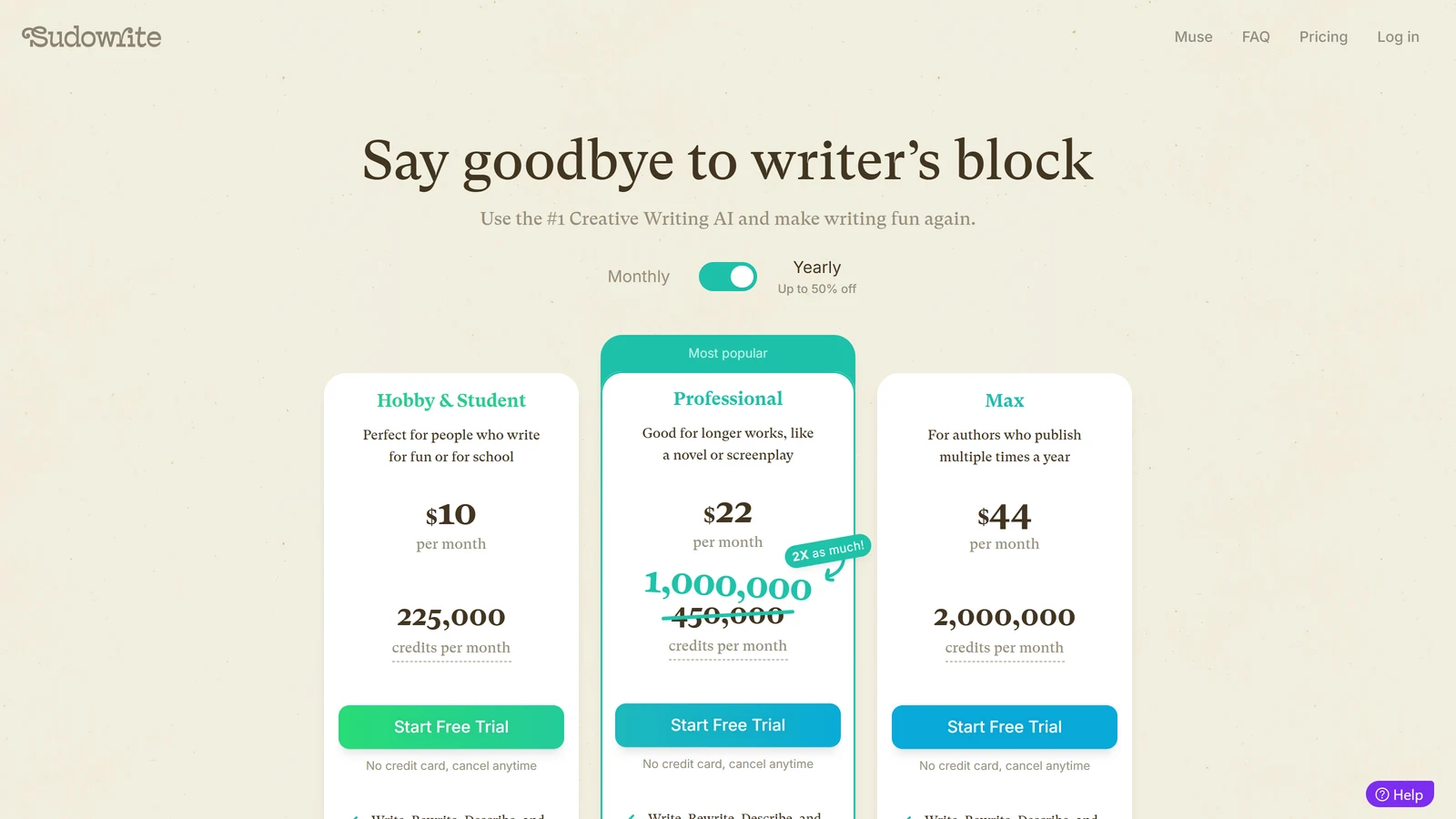
Sudowrite’s Professional plan shows a promotion. Its pricing page lists 225,000 credits for Hobby & Student and 2,000,000 for Max. For Professional it shows 1,000,000 credits with 450,000 struck through and a “2X as much!” tag, so the larger figure is what the page offers today, and we do not know how long that lasts. Its credits article also refers to “the 1 million credits of the Professional plan”. Its own help text says there is no one-to-one link between words and credits: it gives a range of 50,000 to 500,000 AI words a month for that plan, depending on how you use it.
NovelCrafter’s price is not the whole price. Its help page says a subscription “does not offer any AI credits or usage on its own”. The AI is billed by whoever you connect it to. Its FAQ links an article on AI cost, which we did not read, so we cannot tell you a typical monthly total.
How the AI Is Paid For
This is the row that decides the rest.
NovelAI: one subscription, AI included. Unlimited text generation is included on every tier, and your story is written by NovelAI’s own hosted models. In our September read of its plan table, Tablet and Scroll differ only in memory size, and Opus adds two more text models and unlimited images at normal sizes. Images are separate: pay as you go on the lower tiers, with a pool of bonus image credits called Anlas.
Sudowrite: credits. Each plan gives a monthly amount, and features spend it based on how many words the AI reads, how many it writes and which model does the work. The page does not say what happens when you run out, or whether credits roll over, apart from saying that Max credits roll over for 12 months. Its docs list separate articles on both questions, and we did not read them. It says its models include its own Muse and Ballad, Anthropic’s Claude, open-source models and OpenAI models, and it does not map specific models to specific plans.
NovelCrafter: bring your own. Its help page says that to use AI you need to connect to an external vendor or run a local model, and that most users connect through OpenRouter, naming OpenAI’s GPT, Anthropic’s Claude and Google’s Gemini as examples. BYOK appears from the Hobbyist plan up. This is the only one of the three where you pick the model and can change it whenever a better one appears.
| NovelAI | Sudowrite | NovelCrafter | |
|---|---|---|---|
| Which model writes | Its own, on the tier you buy | Its own plus others, chosen by the tool | Your choice |
| Can you swap models freely | Only among what the tier gives you | Within what Sudowrite offers | Yes |
| Can you run it locally | No | No | Yes, according to its help page |
| Surprise bills | No. The price is the price | Unlikely, because credits are capped | Possible, since provider costs vary with use |
How Each One Remembers Your Story
This is the question that matters most if you want a long story to hold together. It is also where we have to be most careful, because we only know what each product says.
NovelAI gives the AI a fixed window of your story: 8,192 tokens on Tablet, 12,288 on Scroll and 28,672 on Opus, about four characters per token. Anything outside it is not seen unless you put it in the Lorebook. Our pricing page explains the numbers, and its conclusion is that for playing an AI RPG the window is small next to general AI models that handle far more.
Sudowrite keeps a Story Bible for each project. Its docs describe it as “a source of truth that both you and the AI can refer back to”. It has sections in a suggested order: Braindump, Genre, Style, Synopsis, Characters, Worldbuilding, Outline, Scenes and Draft, and each one feeds the next. One sentence in the docs is the one that matters for long stories: scene and prose generation “will only look at explicitly mentioned Characters and Worldbuilding elements”. If something is not in the Bible and not mentioned, the AI is not looking at it.
NovelCrafter has a Codex, which its features page describes as a way to “organize characters, locations, and more with automatic tracking and progressions.” We did not read an article on how the Codex is passed to the AI, so we will not say how much of it the AI sees at once.
| NovelAI | Sudowrite | NovelCrafter | |
|---|---|---|---|
| Fixed memory window | Yes, 8,192 / 12,288 / 28,672 tokens | Not stated on the pages we read | Depends on the model you connect |
| Notes the AI can use | Lorebook | Story Bible | Codex |
| Stated limit | Window size | Only explicitly mentioned characters and worldbuilding are used for scenes and prose | Not read |
The honest reading is that none of the three is built around the problem of an AI that forgets what happened forty turns ago in a game. They are built around an author who decides what the AI should know. If you want to understand why long AI stories drift, why LLMs forget explains it.
Trials and Free Plans
| NovelAI | Sudowrite | NovelCrafter | |
|---|---|---|---|
| Free plan | No | No. Without a paid plan you can open projects but not use AI features | No. “We currently do not offer a free plan” |
| Trial | 30 image and 50 text generations (from our September read; its front page now says “Start Generating for Free” without details) | A free trial on each plan, “no credit card”; length not stated | 21 days, all features unlocked, no credit card |
| After you cancel | Check its terms | Your projects stay accessible | Read-only access to your data |
Which Suits Which Reader
You want to play a story, not write a book. Start with NovelAI, because it is closest to typing a story and having it written back. Our NovelAI review and AI Dungeon vs NovelAI go further, and DreamGen vs NovelAI and SillyTavern vs NovelAI cover the closest alternatives. None of these three has a game master, dice or a character sheet.
You are drafting a novel and want the tool to include the AI. Sudowrite is built for this: a Story Bible, outline, scenes and a draft, with credits that cover the AI. Its price per month is higher than NovelAI’s, and what you actually get depends on how fast you spend credits.
You want to choose the model and keep control of the files. NovelCrafter. It is the cheapest subscription, you can change which AI writes at any time, and the help page mentions a local model. The cost is that you assemble it yourself and pay a second bill.
You want a game. None of these. An AI RPG platform adds the things these tools lack: a game master that runs the world, memory built for play and, in some cases, dice and a sheet. See the best AI RPG platforms and AI RPG alternatives to NovelAI.
What We Have Not Checked
| Claim | Status |
|---|---|
| Quality of the writing from any of the three | Not tested |
| Sudowrite and NovelCrafter in use | Not run |
| NovelAI’s current tier prices | Read on 29 September; its front page confirms only “from $10” |
| What happens when Sudowrite credits run out | Not read |
| How long Sudowrite’s doubled Professional credits last | Not stated on the page |
| How much of the Codex NovelCrafter gives the AI | Not read |
| What NovelCrafter’s AI costs in practice | Not tested |
Frequently Asked Questions
What is the difference between NovelAI, Sudowrite and NovelCrafter?
They pay for the AI in three different ways. NovelAI includes its own text models in a flat monthly subscription. Sudowrite gives each plan a monthly pool of credits that its AI features spend. NovelCrafter is a writing organiser whose subscription includes no AI at all, so you connect your own provider, such as OpenRouter, or run a local model.
Which is cheapest, NovelAI, Sudowrite or NovelCrafter?
On subscription price alone, NovelCrafter, from $4 a month. But its page says a subscription does not include any AI usage, so you also pay an AI provider. NovelAI’s front page says subscriptions start at $10 a month, and Sudowrite’s plans are $10, $22 and $44 a month. The total cost of NovelCrafter depends on which AI you connect and how much you use it.
Is there a free plan for NovelAI, Sudowrite or NovelCrafter?
None has a permanent free plan with AI. NovelCrafter says it offers no free plan and gives a 21-day trial with every feature unlocked. Sudowrite offers a free trial with no credit card, and without a paid plan you can open your projects but not use the AI features. NovelAI has offered a trial of 30 image and 50 text generations.
Which one is best for playing a story rather than writing a novel?
NovelAI is the closest, because you type and it writes back in the same space. Sudowrite and NovelCrafter are built for an author drafting and editing a manuscript, with outlines, scenes and a story bible or codex. None of the three is an AI RPG platform with a game master, dice or a character sheet. For that, look at an AI RPG platform or SillyTavern.
How does each one remember a long story?
NovelAI gives the AI a fixed memory window of 8,192, 12,288 or 28,672 tokens depending on the tier, plus a Lorebook. Sudowrite uses a Story Bible per project, and its docs say scene and prose generation looks only at characters and worldbuilding that are explicitly mentioned. NovelCrafter has a Codex that tracks characters and locations, and the AI can only see what you connect it to.
Can I use my own AI model in these tools?
In NovelCrafter, yes. Its help page says you need to connect to an external vendor or run a local model, and that most users connect through OpenRouter. In NovelAI and Sudowrite you use the models they provide. Sudowrite names its own Muse and Ballad models plus Claude, open-source and OpenAI models. NovelAI’s front page says its stories are powered by GLM 4.6.
Prices and features were read from NovelAI’s front page, Sudowrite’s pricing page and documentation, and NovelCrafter’s pricing and help pages on 30 October 2026, and from our NovelAI pricing page read on 29 September 2026. Some prices are localised or change often, so check each site before you pay. We have not tested any of the three for this page and we have not scored them. NovelAI, Sudowrite and NovelCrafter are third-party products and all names are used nominatively. Arcanum is not affiliated with any of them.