AI for Tabletop RPGs (2026): How to Play, Run and Prep a TTRPG With AI
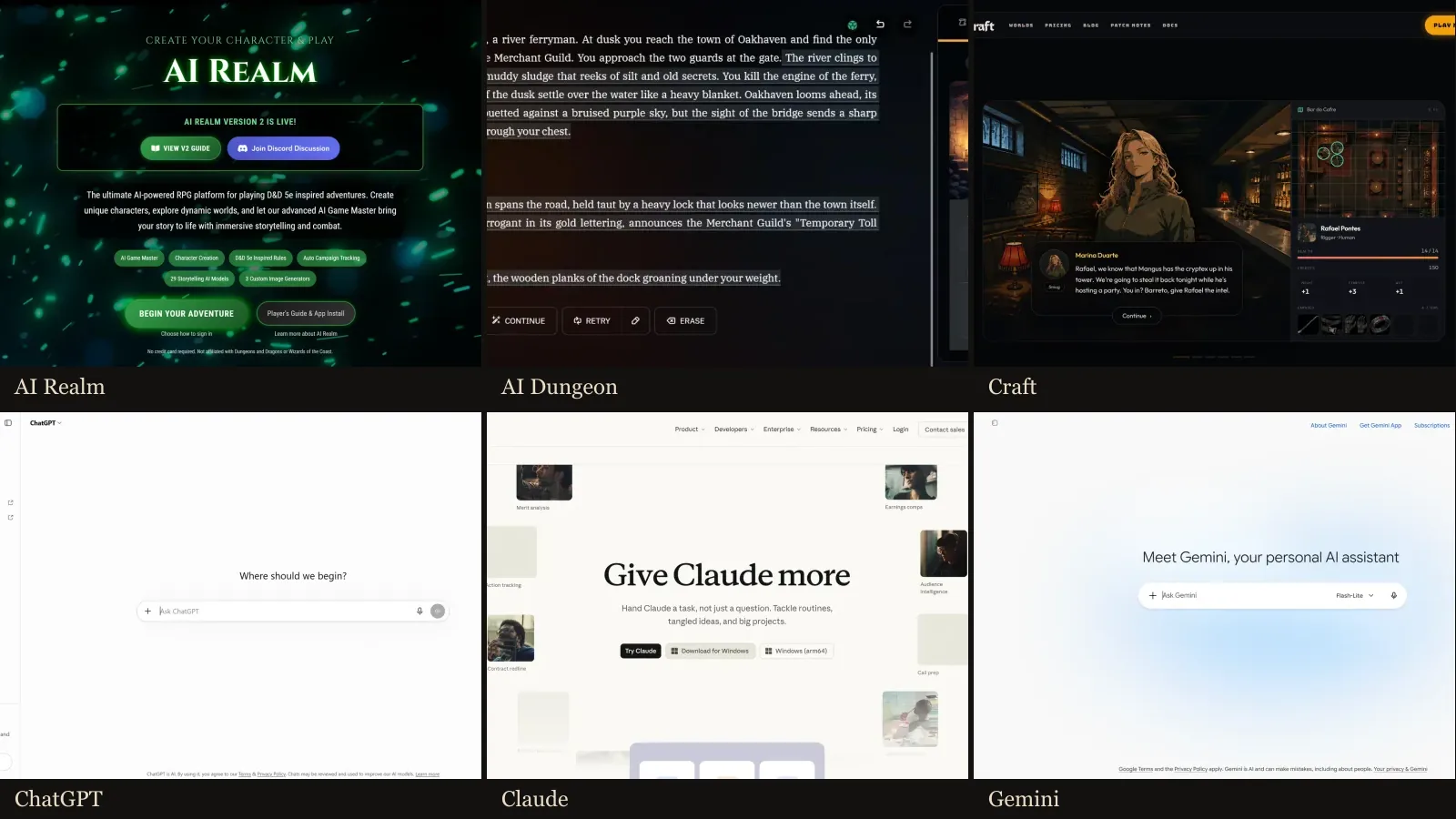
AI in tabletop roleplaying means using a language model as the game master, as a player, or as a prep tool for a human game master, in games like Dungeons & Dragons, Pathfinder or any other system you play around a table or online. It covers three very different activities, and most confusion comes from mixing them up. Playing a campaign with an AI as your game master is one hobby. Using AI to write NPCs for the game you run on Friday is another. Building your own rules engine around a model is a third.
This page is a map. It sorts every guide we have on AI and tabletop games by what you actually want to do tonight, and says in a few lines what each one answers. It does not rank platforms; our directory and the reviews linked from it do that, on the same seven measures for every platform.
Start Here: What Do You Want to Do?
| You want to | Start with | Then read |
|---|---|---|
| Play a campaign alone, with an AI as the game master | Solo RPG with AI | How to play D&D solo with AI |
| Play D&D specifically, with an AI DM | AI D&D | AI Dungeon Master |
| Play with friends | AI RPG with friends | AI D&D on Discord |
| Play at your own pace with a group | Play-by-post D&D | AI RPG with friends |
| Get help as the human GM | AI tools for dungeon masters | AI D&D generators |
| Use ChatGPT, Claude or Gemini as your GM for free | ChatGPT D&D prompt generator | Claude RPG guide |
| Run your own system’s rules | Claude Skills for tabletop RPGs | MCP for AI RPGs |
| Keep a long campaign together | Why AI campaigns fall apart at turn 50 | Best AI RPG for a long campaign |
The Words, in Plain Terms
Tabletop players and AI players use different words for the same things. Here is a short glossary, so the guides below read the same way to both.
| Term | Meaning |
|---|---|
| TTRPG | Tabletop roleplaying game: a game where players describe what their characters do and a game master decides what happens, usually with dice and a rulebook. |
| GM / DM | Game master. In Dungeons & Dragons the GM is called the Dungeon Master. An AI GM or AI DM is a language model in that role. |
| System | The rules: D&D 5th edition, Pathfinder, Call of Cthulhu and so on. |
| Session / campaign | One sitting / a story that runs across many sittings. |
| Context | How much recent text an AI can see at once. Anything older is invisible to it unless something brings it back. |
| Platform | A service built for AI roleplay, with its own memory and rules around the model. Our directory lists the ones we track. |
| General model | ChatGPT, Claude or Gemini used directly, with your own prompt. |
Playing With an AI Game Master
This is what most people mean by “AI TTRPG”: you play a character, and the AI runs the world.
Alone
Solo play is where AI changed the hobby most. Before it, solo roleplay meant oracle tables and journaling games; now a model can answer anything you try. Two guides cover it:
- Solo RPG with AI explains the two ways to play (a dedicated platform or a general model with a good prompt), how to start, and how to stop the story falling apart.
- How to play D&D solo with AI is the step-by-step version: session zero, character creation, the first scene, combat and long-term notes.
Dungeons & Dragons specifically
Most AI GM products are built around D&D-style fantasy, and many players search for D&D by name.
- AI D&D answers whether an AI can run a real 5e campaign, what it does well, where it breaks, and which AI DMs fit solo, group and Discord play.
- AI Dungeon Master explains how an AI DM works under the surface and where it beats, and loses to, a human.
With friends
A group is harder for an AI than one player. It has to share attention between several people, track several characters, and keep everyone’s choices from contradicting each other. Our analysis of AI RPG NPCs shows why characters that hold up one-on-one start to fail once a second character walks in.
- AI RPG with friends compares the three ways to play together: everyone at once, taking turns over days, and inside Discord, with player limits and prices.
- AI D&D on Discord covers the bots that live in your server, the platforms with a Discord front end, and the build-your-own route.
- Play-by-post D&D explains asynchronous play, where each player posts when they can, and what an AI game master changes about the format’s oldest problem: people stop taking their turn.
With a general model, for free
You do not need a dedicated platform to try this. ChatGPT, Claude and Gemini can all run a game if you give them a clear setup.
- ChatGPT D&D prompt generator builds a structured game master prompt in under a minute, and explains why a one-line prompt copied from a forum breaks by session two.
- Claude RPG guide covers running a campaign in Claude.
The trade-off is memory. A general model has no campaign notes unless you keep them, which is the subject of the long-campaign section below.
When You Are the Game Master
If you run games for people, AI is a tool, not a replacement, and this is where it is most reliable today. A first draft that you edit is much safer than a ruling made at the table.
- AI tools for dungeon masters starts from what prep actually costs a GM and which parts an AI can take: names, NPCs, rumours, item text, recaps. It also lists what not to hand over.
- AI D&D generators explains why an AI gives you the same “hooded stranger with a mysterious past” every time, what a usable NPC, backstory, encounter or magic item needs, and offers a free generator that rolls all five.
- How to summarize a long campaign is written for AI play, but the method works for session recaps at a human table too.
Two jobs people ask AI to do that it does less well: maps and live rules calls. Image models can draw a pretty battle map, but grid accuracy and consistent scale are still weak spots; our DM tools guide answers whether AI can generate battle maps. And a rules question answered by a model at the table is a guess presented as a fact, so check anything that decides whether a character lives.
Systems Other Than D&D
People who say “TTRPG” rather than “D&D” often play something else: Pathfinder, Call of Cthulhu, a Powered by the Apocalypse game, a sci-fi system. Here is the honest picture.
Dedicated platforms lean on D&D. Several of the AI GM platforms we cover are built on D&D 5th edition rules; AI Realm is one, and our comparison of AI Dungeon and AI Realm sets free-form play against 5e rules. Others, like AI Dungeon, are free-form story engines with no fixed system. A few let you write your own rules; our guide to building a world in Craft shows one way. Check a platform’s rules before you commit a campaign to it.
General models know many systems, but drift. ChatGPT, Claude and Gemini know the broad shape of most popular systems, and they will happily run one. The problem is precision: over a long session they mix in D&D habits, misremember a rule, or let a check slide. The fix is to keep the rules in front of the model:
- Claude Skills for tabletop RPGs shows how to package a system’s rules, dice conventions and GM behaviour into a module Claude loads when it needs it.
- MCP for AI RPGs goes further: the rules and the world state live in a separate program, and the model asks it what happens, instead of remembering.
Either way, you supply the rules text. Use your own books, an official free reference document where the publisher offers one, or your own summary.
Keeping a Long Campaign Together
Every AI campaign meets the same wall sooner or later. The first sessions are great, then names slip, a dead villain comes back, a promise is forgotten. That is not a bug in one product; it is how language models work.
- Why AI campaigns fall apart at turn 50 explains the cause, context limits and memory drift, and the fixes for ChatGPT, Claude and Gemini.
- How to summarize a long campaign is the most useful single habit.
- Best AI RPG for a long campaign shows which platforms actually remember, measured.
- How to move a campaign between platforms and what happens to your campaign when you leave matter more than people expect: this autumn one of the largest AI character platforms filed for bankruptcy.
There is a second, quieter problem: an AI game master that never lets you fail. Models tend to agree with the player, and a campaign where every plan works stops feeling like a game. Our piece on why your AI Dungeon Master is too generous explains it and what helps.
AI GM or Human GM?
People in the tabletop hobby argue about AI, and some tables and communities do not want it anywhere near their games. That is their call. This section is for players deciding what to use for themselves.
| AI game master | Human game master | |
|---|---|---|
| Available | Any hour, no scheduling | When the group can meet |
| Memory | Weak without notes or a memory system | Remembers your campaign |
| Rules | Drifts unless the rules are kept in front of it | Makes consistent rulings |
| Stakes | Tends to say yes too often | Can let you fail, and make it matter |
| Reading the table | Responds only to what you type | Reads people’s mood |
| Cost | Free to a monthly fee, or per token | Free among friends, or a paid GM |
| Best for | Solo play, practice, no group nearby, odd hours | The weekly table with friends |
Many players use both: AI for solo sessions between games, and a human GM for the group. Our AI Dungeon Master guide goes deeper into where each one wins.
How We Cover This
Arcanum reviews AI RPG platforms and guides players to them. When we rate a platform, we play it ourselves and score it on seven published measures in our methodology: memory, player agency, NPCs, depth, fairness, longevity and signature. Guides like the ones linked here are built from the platforms’ own documentation and our play, and each one says which. This hub itself does not rate anything; it sends you to the page that answers your question.
Frequently Asked Questions
Can AI run a tabletop RPG?
Yes, with limits. An AI game master can describe scenes, voice characters, call for rolls and keep a story moving, alone or for a group. Where it struggles is the long game: remembering events from many sessions ago, holding the rules steady and letting you fail. Dedicated AI GM platforms add memory and rules systems around the model to fix that, with different degrees of success.
What is the best AI for tabletop RPGs?
It depends on what you want to do. To play alone, start with our guides to solo RPG with AI and AI D&D. To play with friends, see AI RPG with friends and AI D&D on Discord. If you are the GM and want help with prep, see AI tools for dungeon masters. Our directory of AI RPG platforms compares the dedicated services on the same seven measures.
Can I play a TTRPG with AI with my friends?
Yes. Some AI game master platforms host a whole party in one shared story, some run inside a Discord server, and play-by-post lets a group take turns at their own pace. Groups are harder for an AI than one player: it has to share attention, track several characters and keep everyone’s choices consistent. Our AI RPG with friends guide compares the options.
Can AI run systems other than D&D?
Partly. Several dedicated AI GM platforms are built around Dungeons and Dragons fifth edition. Others are free-form or let you write your own rules. A general AI model such as Claude, ChatGPT or Gemini can run almost any system if you give it the rules, but it will drift from them unless they stay in its context or are packaged in a reusable form, such as a Claude Skill.
Can AI help me as a game master?
Yes, and this is where it is most reliable today. AI is good at first drafts of NPCs, names, rumours, item descriptions and session summaries, which you then edit. It is weaker at anything that needs your campaign’s whole history or a consistent rules judgment. Our AI tools for dungeon masters guide covers what saves real prep time and what to keep for yourself.
Is AI a replacement for a human game master?
Not yet. A human GM remembers your campaign, reads the table and makes rulings with stakes. An AI GM is available at any hour and never cancels, which is why solo players and people without a group use it. Many players treat the two as different hobbies: AI play for solo sessions, a human GM for the weekly table.
Why does my AI game master forget things?
Because a language model only sees a limited amount of recent text, and older events fall out of it. Long campaigns need a memory system: summaries, notes the model reads every turn, or a platform that stores facts outside the chat. Our guide to why AI campaigns fall apart at turn 50 explains the cause and the fixes.
This hub summarises Arcanum’s own guides and reviews; each linked page lists its own sources and test dates. It contains no ratings of its own.
Dungeons & Dragons is a trademark of Wizards of the Coast. Pathfinder is a trademark of Paizo Inc. Call of Cthulhu is a trademark of Chaosium Inc. Arcanum is independent and not affiliated with any of them. Nominative use only.