Terminal Adventures First Look: A Hardcore Survival Text Adventure Whose Meters Would Not Refill
Access disclosure: the developer emailed us and invited us to try the game. It is free and open to anyone with a username, and we played on an ordinary account. No extra access came with the invitation, and nothing was arranged in return. This first look is independent and unpaid.
This is a hands-on first look at a game its developer describes as a work in progress, not a rated review. We don’t score pre-release software, and he told us he was not looking for a review. A rated review, against our public methodology, would only follow if the game reaches a public launch.
Terminal Adventures is a survival text adventure that plays inside a terminal-style web page, built by Anthony Muro, a software developer from the Bay Area. You create a username, define the world you want to play in, and then survive in it: health, hunger, thirst, money, gear and property are all tracked, and time passes as you act.
It is a concept-stage game, and that is how we judged it. It has a lot of design in it, a lot of modularity, and a developer who clearly cares. The part we could not get past was the survival loop itself: the meters fell the way they should, but they would not come back up when we fed them.
What It Actually Is
There is no app and no sign-up form. The page is the game. It opens on an amber-on-black terminal screen that tells you that by logging in you accept the terms, asks you to enter a username or type “register” to create an account, and lists a few more words you can type: settings, terms, privacy, aup, refund and contact.
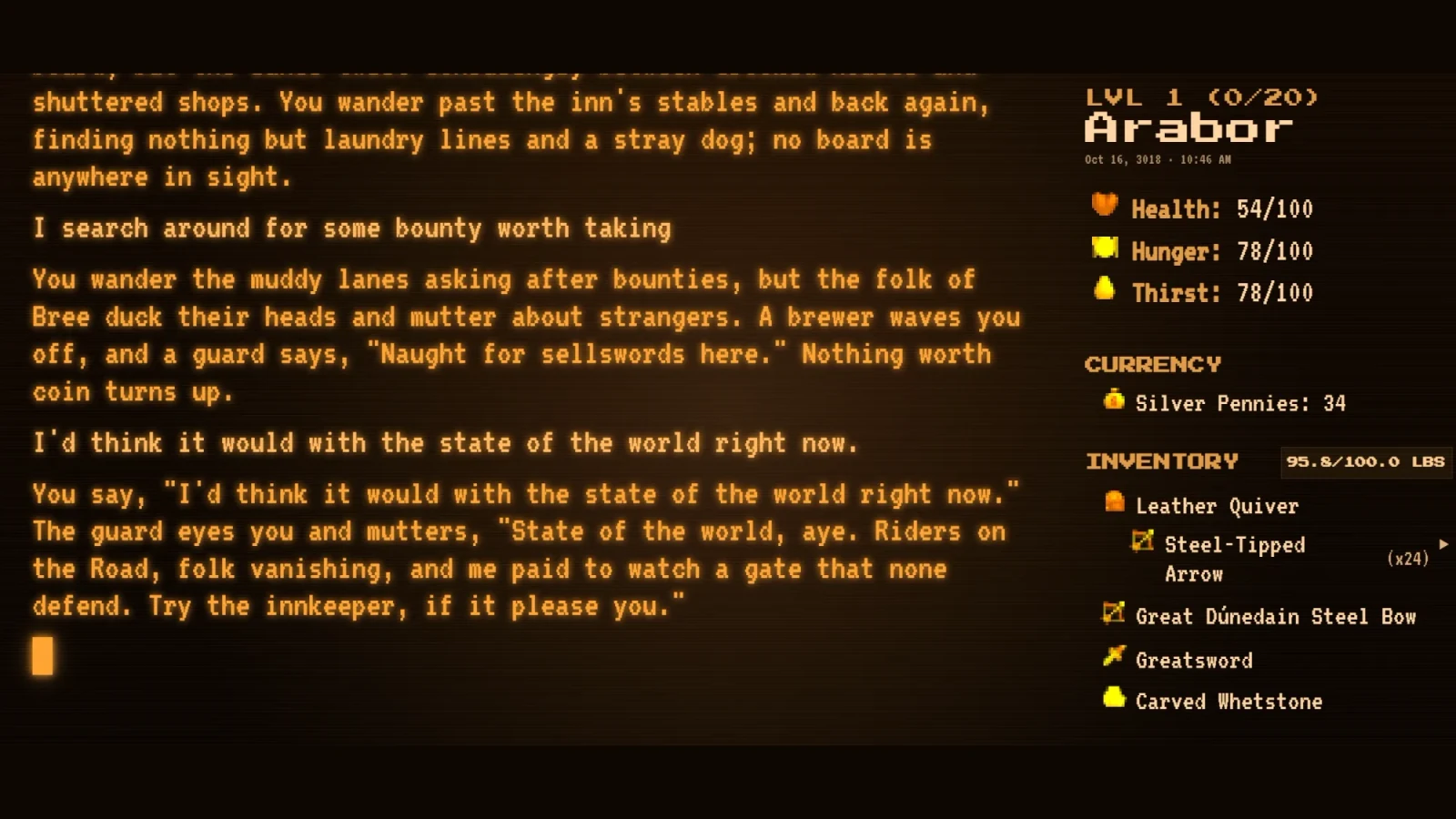
Once in, you describe the setting you want. We chose a setting borrowed from Tolkien’s Middle-earth, and the game ran with it: our character, Arabor, was level 1 in the town of Bree, carrying a bow and a greatsword and looking for bounty work. The screen is split into the story on the left, in the same amber text, and a status panel on the right.
That panel is where the game shows how much it keeps track of. In our screenshot it lists:
- A level and experience bar — level 1, 0 of 20.
- The in-game date and time.
- Three survival meters — health at 54 of 100, hunger at 78 of 100, thirst at 78 of 100.
- Currency — 34 silver pennies.
- An inventory with a weight limit — 95.8 of 100.0 pounds, with a leather quiver holding 24 steel-tipped arrows, a bow, a greatsword and a whetstone.
The developer’s own description is longer. In an email to us he listed health, hunger and thirst, items, containers and bags, currency, equipment, functional weapons, vehicles, properties, party members, creature collection, “unlimited” memory and NPC personalities. We saw the first group in play, along with objects and equipment. We did not test vehicles, party members or creature collection, so we report them only as his claims.
It also has a deliberate brake on cheating and endless retries. You can undo twice, and the allowance recharges after two turns, so you are quickly stuck with what you did. Settings let you change things like voices, radio and sound, the font and colour, and how long the replies are.
Models. The game’s pages do not say which AI model is behind the narration, so we cannot name one.
Price. Free for now. See below.
The Good News: It Is Modular, and the World Remembers
The concept is the draw, and it holds up. You can feel how much game sits under the text. The systems are separate pieces — a body with meters, a pack with weight, a purse, a place you can own — and they connect. Owning property, objects and equipment is supported. That modularity is charming in a way that few AI text adventures at this stage are, because most of them are one chat window with a prompt behind it.
The NPCs remember. They recall what you have done and they do their jobs well: the brewer waves you off, the guard answers in character, and the town reacts to what you say. In the screenshot, a guard at the gate sourly tells the player there is nothing for sellswords in Bree and points us toward the innkeeper. That is a small scene, and it is competent.
Where it falls short is individuality. Character information and character pages do not exist, so there is nowhere to look up who someone is, and the NPCs are not very unique. They remember and they work, but they are not yet people you want to find again. Don’t expect much on that front yet.
The Problem: The Meters Would Not Refill
This is what we most want you to know, and it is the reason the rest of our time was hard.
The depletion is right. Hunger, thirst and health fall according to how much time your actions take, which is how a survival game should work: a long journey costs more than a short walk. We spent a lot of time travelling, and the meters ran down to zero. We had expected that. We were prepared for it.
What we were not prepared for was the recovery.
We went to an inn, bought a full dinner and mead, and ate and drank until we could not hold more. Hunger rose only slightly, and thirst did not move at all. We then tried to rule out our own mistake. We thought the mead might not be hydrating enough, so we put our purse on the table and kept buying: jugs of water, then dish after dish. Hunger never filled again. Our record was 80. After travelling for a little while, we were back at 0.
That changed how we played. We could not properly worry about the rest of the game, the property, the equipment and the people, because we were constantly watching the survival meters. A survival game wants the meters to be a pressure, something you manage. Here they became a wall.
We tried to get an answer in the game. We typed “OOC:”, the usual way to step out of the story and ask a question, and out-of-character talk is not supported, so we could not ask. That left us to guess. It might be an overshoot, or a handicap bug that stopped hunger from rising any further. We cannot say which it is, and we are not claiming to know the cause. We are reporting what happened: meals bought and eaten, and a meter that stayed low.
That is a balance problem, not a concept problem. The design is sound, depletion tied to time is the right call, and the fix is probably a matter of numbers or one bug. But it sits in front of everything else, and it is the first thing a new player will hit.
What a Listing Changes
We want to be fair about where this game is. The developer told us it is not perfect, that it lacks some polish, and that he has plans for it. He is not promoting it, and there is no public launch date.
Listing it here changes that a little. We cover it now, and some players will arrive because of it, curious about the concept. That is good for a project this early: those players will find things, and he will get the feedback he asked for. It also means a few practical things are worth having ready for newcomers:
- A clear first hour. Newcomers will hit the survival meters straight away. A short note on how recovery is meant to work, or a visible way to ask, would help.
- Out-of-character questions. When a rule seems wrong, players need a way to ask about it without breaking the story.
- A published price. The game is free for now. The developer said in an email he expects it to be very cheap, at roughly a dollar for a hundred messages at most. That is an estimate, not a published rate, and we have not verified it. A page that says so would let curious players decide.
Who Should Try It Now
Try it if you are curious about a hardcore survival text adventure with a lot of systems under it, you like the amber terminal look, and you are happy to test an early concept and report what you find. It is free, and the developer asked for feedback.
Wait if you want a game that is balanced already, with characters you can look up and a clear price. The meters, the character depth and the information around them are the parts that still need work.
What Happens Next
Terminal Adventures is a good concept with real modularity and a passionate developer, and it currently has balance problems, mainly in recovery from hunger and thirst. We will check in again if the developer makes changes, and our directory of AI RPG platforms covers everything you can play today.
This is a first look at a concept-stage game, not a definitive review.
Disclaimer: Terminal Adventures is an independent game by Anthony Muro. Arcanum is an independent publication and is not affiliated with, endorsed by, or sponsored by Terminal Adventures or its developer. Bree and the other names in our test campaign belong to J.R.R. Tolkien’s works; they appeared because we chose that setting, and Arcanum is unaffiliated with the Tolkien Estate. Features and prices described are those of a concept-stage game and may change.