Isentroth First Look: 24 Hours in a Norse Text RPG Where the Dice Keep Writing the Story
Access disclosure: we played the free Isentroth demo that anyone can download from Steam today. Nothing was arranged with the developer beforehand, and no extra access, keys or credits came with it. This first look is independent and unpaid.
This is a hands-on first look at a pre-release build, not a rated review. We don’t score pre-release software. A full rated review, against our public methodology, follows at launch.
Isentroth is a solo text RPG set on the Isenmarch, a cold Norse frontier, in which an AI “Machine Game Master” narrates your story while a dice ruleset decides how your actions turn out. It comes from the studio Schedule 3 Wizards, it has a free demo on Steam, and the full game is planned for November 2026.
We spent 24 hours in the demo. The short version: it makes a strong first impression, and it is a better-written and better-looking game than most we test at this stage. It also has a problem at its centre, which is that almost every action ends in a dice roll, and the roll can feel like it is writing the story instead of you. The developer read our transcript and took the feedback seriously, which is why we think this one is worth watching.
What It Actually Is
The pitch is on the game’s own Steam page: a text-based RPG on a cold Norse frontier, where a Machine Game Master narrates the story and responds to your choices, and a dice ruleset runs beneath the narrative. You create a character, swear vows, and manage momentum, supplies and companions. The page describes the world in one line we can confirm after 24 hours: it “has teeth and does not explain itself.”
The rules are adapted from the tabletop game Ironsworn, used under a Creative Commons Attribution 4.0 licence and modified for solo play. The game’s listing says it is not affiliated with or endorsed by Tomkin Press, and neither are we.
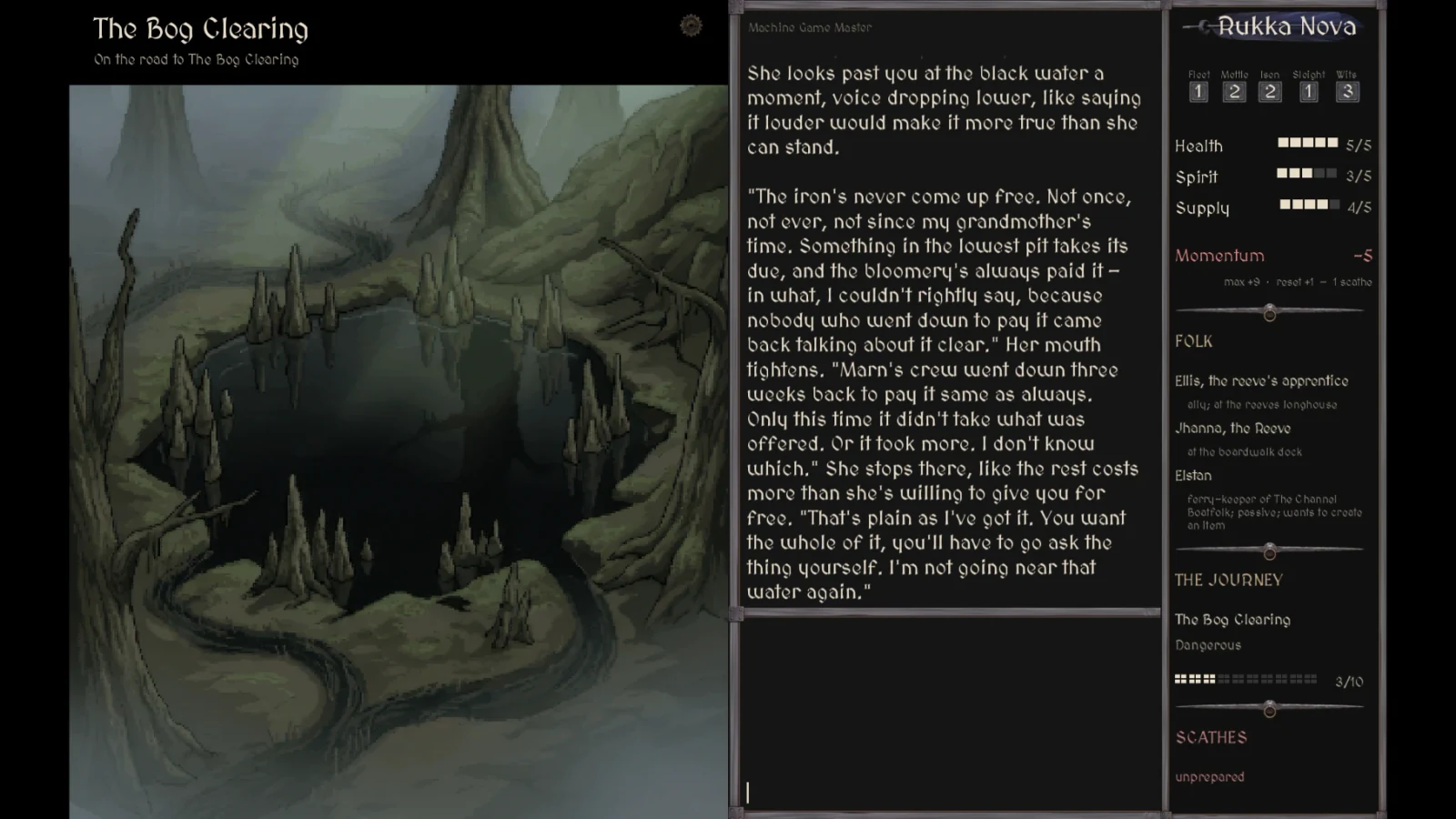
The screen is split in three. On the left is a pixel-art scene for wherever you are standing, with its name and where you are heading on top. In the middle is the Machine Game Master’s text, and below it the line where you type what you do. On the right is your sheet:
- Five stats — Fleet, Mettle, Iron, Sleight and Wits — each a small number.
- Three meters: Health, Spirit and Supply.
- Momentum, which can go negative, with its maximum and reset value shown beside it.
- A list of the folk you have met, each with a note on who they are to you and where they are.
- A journey track for the place you are travelling to, with a danger label and a progress bar out of ten.
- A section for scathes, which are lasting injuries and burdens.
The game needs an internet connection, because the narration is generated live. The Steam page says the game connects to a third-party AI service, Anthropic; it does not name a model version, so we do not either. It also says the scene art, music and ambient audio were generated during development and then art-directed by the team, while the ruleset adaptation, world systems, location descriptions, interface design and the Machine Game Master’s voice are human-made.
Price. The Steam page does not list one yet. The demo is free.
Age rating. The developer rates Isentroth 18+. By its own description it contains frequent narrated violence, injury and death, including the death of companions. At an intensity the player chooses it can also include material such as torture, cruelty to animals, body horror, plague, starvation and captivity, and those can be switched off in the game’s “Terms of the Tale” menu. The page says sexual content, harm to children and self-harm are excluded at every setting.
The Good News First: The First Hour Is Excellent
The presentation is the first thing you notice. The pixel scenes are moody, the soundtrack fits them, and the Machine Game Master’s writing is better than the usual run of AI narration: restrained, specific, willing to leave a question unanswered.
The scene in our screenshot is a good example. We were on the road to a bog clearing, and an NPC was telling us about an iron bloomery that had never once produced free iron: “Something in the lowest pit takes its due, and the bloomery’s always paid it.” She said a crew had gone down three weeks earlier to pay it as always, and this time it “didn’t take what was offered. Or it took more.” She would not say which, and she would not go near the water again. The scene gives you a rumour, a cost, a refusal and an open question in a few lines, and it never explains the thing at the bottom of the pit.
The worldbuilding behind it is thoughtful. The names, the folk on your sheet and the way the frontier is described feel like one place rather than a list of fantasy nouns. If you pick games for atmosphere, Isentroth already delivers it in the demo.
The Dice: Almost Every Action Is a Roll
Our main criticism is about the loop, not the writing. Almost every action we took triggered a dice roll. After a few hours the loop felt repetitive, and outcomes felt overly random. It is the same shape of problem as the one we described in WorldAI’s first look, where the game rolled for actions that were not in doubt, except that here the rolls are the whole game.
We want to be fair about the numbers. We counted 40 rolls in the session we sent the developer, and 13 of them were misses, about 32%. The developer checked and confirmed that the luck was statistically normal. So this is not bad RNG. The dice were honest. The problem is in how the game uses them.
That matters because a roll should only come when the outcome is in doubt and a failure would change something. When every action is a roll, nothing feels like one. Rolls that should be tense become routine, and rolls that should be rare turn up on the way to doing anything at all.
Player Agency: Who Decides What Happens?
The second problem follows from the first. In our run, it felt as though the dice determined the story instead of our decisions meaningfully shaping it. We would choose something we thought was clever, the roll would come back, and the result would carry us along whatever the choice was. A miss at the wrong moment did more to steer the scene than the plan behind it.
This is a design question, not a bug. Ironsworn’s own rules are built around moves that you trigger when the fiction calls for them; it is the game master’s judgement that makes a roll worth making. A Machine Game Master that calls for a roll on almost every action is, in effect, giving up that judgement. Player agency is the question of whether the world has already decided what your choice means. Here the world is not deciding in advance; the dice are deciding afterwards, and the effect on the player is much the same.
The Inn That Counted as Wilderness
The clearest example of the mechanics and the story disagreeing came in a place that should have been safe. We went into an inn to rest, and the game kept charging us wilderness-style resource penalties anyway. We were sitting indoors, in a tavern, by a fire, and the game was treating us as if we were sleeping in the snow. It undermined the immersion, and it undermined recovery, which is the point of stopping at an inn.
This is where the developer’s response mattered. We reported it, and the developer, who goes by Mattlock, told us the game had detected the inn as “Wilderness.” He then worked on it promptly. We want to underline that, because it is the useful result of a first look: we found something real, and it got fixed.
Two Confirmed Bugs
The developer identified two problems after reading our transcript:
- Missing settlement-rest mechanics. The game did not yet have a proper way to rest in a settlement, which is what the inn problem was a symptom of.
- A vow progression issue. One of our vows did not progress the way it should.
Both were slated for fixes. We have not re-tested either one, and we will report on them in the full review.
The Developer Was the Best Part of the Story
We don’t usually spend a section on how a developer answers feedback, but here it is part of the finding. Mattlock read the transcript, acknowledged the problems, explained what had gone wrong with the inn, confirmed that our luck had been statistically normal, and discussed tuning options with us. He did not argue that the dice loop was fine, and he did not blame the player.
For a game at such an early stage, that is encouraging. A rough demo with a developer who listens is a much better bet than a polished one that doesn’t, and the problems we found are specific and fixable: fewer rolls, better rest rules, and a stronger sense that your choices count.
Who Should Try It Now
Try it if you want a moody, well-written solo text RPG with a real ruleset under it, and you are happy to play a pre-release demo. It costs nothing, and the writing and art are worth seeing for themselves.
Wait if the thing you care about is feeling that your decisions, not the dice, shape the story, or if you want a rest-and-recover loop that works. Those are the parts that still need tuning.
Update, 4 November 2026: after this first look, Isentroth’s host was breached and the developer moved the game in one morning. For what players should do when a game’s host is hit, see the Railway breach and AI RPGs.
What Happens Next
Isentroth has a strong creative foundation and needs better mechanical balance and a stronger sense of player agency. The demo’s gameplay does not yet match the quality of its atmosphere and writing. We will reassess after the fixes, and publish a full, rated review at launch, scored on the same seven axes as everything else in our directory. Until then, our directory of AI RPG platforms covers everything you can play today.
This is a 24-hour first look at a pre-release build, not a definitive review of the finished game.
Disclaimer: Isentroth is an independent game by Schedule 3 Wizards. Arcanum is an independent publication and is not affiliated with, endorsed by, or sponsored by Schedule 3 Wizards. Ironsworn is by Shawn Tomkin; Isentroth’s ruleset is adapted from it under the Creative Commons Attribution 4.0 International licence, and Arcanum is unaffiliated with Tomkin Press. Anthropic is a trademark of Anthropic, PBC. Features and prices described are those of a pre-release demo and may change.