Metaware First Look: A Visual-Novel AI RPG That Looks the Part — and Only Takes ADA
Access disclosure: we played Metaware as an ordinary free player, on the same free account anyone can open. No extra credits or special access came with it, and nothing was arranged with the developer. This first look is independent and unpaid.
This is a hands-on first look at an early game, not a rated review. We don’t score pre-release software, and two hours of play is too little to score anything. A full rated review, against our public methodology, follows once we can test it properly.
Metaware is a browser RPG with an AI game master, made by Ofir Geller, in which you play a story set on a painted map at the western edge of a crumbling empire. It feels more like a visual novel than a game board. It also has a payment rule you should know about before you sign up: once the free credits run out, you can only buy more with Cardano’s ADA.
A note on the numbers, because we want to be exact. Our first looks run over a 24-hour window. In Metaware, credit limits meant our total play time in Metaware was two hours, spread over two different days. Everything below comes from those two hours.
What It Actually Is
The game’s front page is short. It calls Metaware “an RPG with an AI game master,” and it gives you the setup in one line: you have no idea who you are or what brought you to the western edge of the crumbling empire. A free account gets you in.
Once inside, the world is a painted map. Our screenshot shows a walled town on a bend of a river, red-roofed houses in rings around a central building with a pool, vineyards and olive groves around the walls, and an old bridge leading out. A red pin marks where you stand. Along the bottom is a clock that shows the hour, the date in the game’s own calendar and a speed control; along the right are four round buttons for images, quests, your inventory and chat.
The story is a mix. Some events and quests are scripted, so you get a proper thread and a story to follow. For most of what you do, you are in control. The result is a game that feels like a visual novel — you are playing more of a story than a game — though it does have an inventory menu, a quests menu and a heads-up display.
Models. The game’s public pages do not say which AI model runs the game master, so we cannot name one.
Price. Free to start, then prepaid credits. See the payment section below.
The Good News First: The Look and the Theme Work
Aesthetically and thematically, Metaware works. The beginning of the game keeps its look consistent, and the painted map is a good choice: it tells you what kind of world this is before a word of narration. The setup line is a good hook, because it puts you in the position of the character: you do not know who you are either.
That consistency matters more than it sounds. Plenty of AI RPGs open strongly and then drift between styles. In our two hours the opening kept its tone.
Where the Polish Thins Out: Loot and Equipment
The polish does not last through the inventory. When you start looting things, the game loses some of its finish, because looted items have no images. When you start equipping your character it gets worse: equipping an item takes off the imaged asset, and you are left with a blank square that carries only the equipment’s name.
It is a small thing in each case, and it is exactly the thing that makes you notice the rest. The map and the opening scenes promise a finished picture book; the gear screen is a list of names in boxes. This looks like content not yet made, rather than a fault in how the game works, and it is the kind of gap that early games close over time. We will look again when we do the full review.
The Roll Shows Its Working
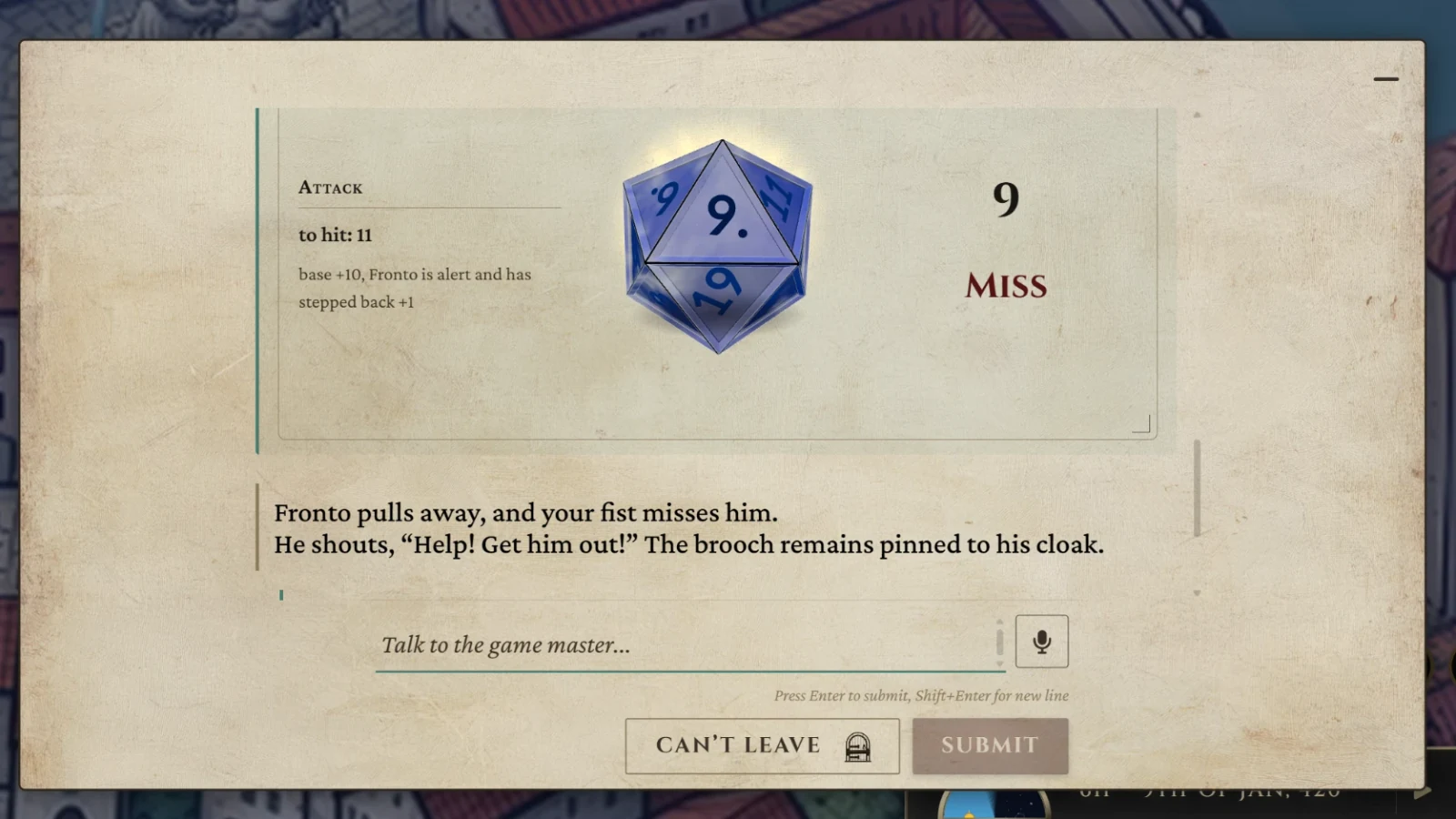
One thing Metaware does well is show you the maths. Our second screenshot is a fight. The player swung at a character named Fronto, who had a brooch pinned to his cloak. The game put a roll on screen, a twenty-sided die, and next to it it explained the target in plain words:
- To hit: 11
- “base +10, Fronto is alert and has stepped back +1”
We rolled a 9, and the game stamped it MISS. Then the narration took over: Fronto pulls away, our fist misses him, he shouts “Help! Get him out!”, and the brooch stays pinned to his cloak.
That is a good design. The roll is visible, the number you needed is visible, and so are the reasons the number is what it is — a base of 10, plus one because Fronto was alert and had stepped back. You can see that the miss was the dice and the odds, and not the narrator’s mood. A system that shows its working is easier to trust, and easier to complain about when it is wrong, and both are good for the player. We saw this once. Two hours is not enough to say how often it calls for a roll, or how consistently it explains itself; that is a question for the full review.
Payment: ADA Only
This is the thing we most want you to know before you start, and it is something we found odd. Metaware runs on prepaid credits, and the only way the game takes payment is Cardano’s ADA.
The game’s own payment page says, in the developer’s words, to pick an amount and then send ADA to the address, or scan the QR code, from any Cardano wallet. The rules it lists are:
- Payments confirm automatically, usually within minutes.
- A purchase is between $10 and $1000 USD.
- Credits match your quote 1:1 while ADA’s price stays within 5% of it. Larger moves are credited within 5% of the market rate instead.
- Requests expire after 3 hours. A payment that arrives late is still credited, at the market rate when it confirms.
- If a confirmed payment has not appeared after 5 minutes, you contact support.
- Credits are prepaid service credit: non-refundable, non-transferable, and not convertible back to ADA.
In practice, that means three things. You need a Cardano wallet, and some ADA in it, before you can buy a single credit. The smallest purchase is $10, so there is no small top-up. And what you buy is gone: it cannot be refunded or turned back into ADA.
We are not telling you whether that is good or bad. Some players will like paying this way, and for others it will be the end of the road before they begin. We are telling you because it is not what most readers expect from an AI RPG, and because the first you hear of it should not be when your free credits run out in the middle of a story.
That is also how our own play ended. As free players, credit limits cut us off, which is why we got two hours over two days and not a longer run. We have not seen what a credit buys, in turns or in hours, so we cannot tell you what a session costs.
Who Should Try It Now
Try it if you want a story-first RPG with a painted map, a quest log and an inventory, if you like seeing the dice and the odds, and if you are happy to explore on the free credits and decide later whether to pay.
Wait if you only want to pay by card, if you want a game with a finished inventory and gear screen, or if you want to know the cost of a session before you start. None of those is answered yet.
What Happens Next
Metaware makes a good first impression and gives up some of it in the inventory. The theme and the opening work. The gear screen has gaps, the payment method is unusual, and two hours is not enough to tell you about memory, long campaigns or how the game master copes when you go off the scripted threads.
We will go back for a longer session and publish a full, rated review, scored on the same seven axes as everything else in our directory. Until then, our directory of AI RPG platforms covers everything you can play today.
This is a first look at an early build, based on about two hours of play over two days. It is not a definitive review.
Disclaimer: Metaware is an independent project by Ofir Geller. Arcanum is an independent publication and is not affiliated with, endorsed by, or sponsored by Metaware or its developer. Cardano and ADA are named only to describe the game’s payment method. Features and prices described are those of an early game and may change.