Stories Terminal First Look: A Detective Text Adventure Where the Hard Case Is the Wording
Access disclosure: we played the free Stories Terminal demo that anyone can download from Steam. Nothing was arranged with the developer, and no extra access came with it. This first look is independent and unpaid.
This is a hands-on first look at a pre-release demo, not a rated review. We don’t score pre-release software. A full rated review, against our public methodology, follows at launch.
Stories Terminal is a detective text adventure from the studio OddlyGames in which you type your own commands to investigate a death on a university campus at midnight. The idea is old and good: no menu of choices, just you, a command line and a case. The execution is where our 24 hours got interesting, because the hard case to crack was not the murder. It was how to word what we wanted to do.
What It Actually Is
The Steam page describes a detective text adventure inspired by classic parser games, where you type your own commands instead of choosing from fixed options. The first case, “KAD-43: The Marek Nowak Case,” is set on the campus of Vilnius University at midnight, and you investigate the death of a biology teacher. The page promises evidence-driven investigation, pixel-art locations, several endings depending on what you discover, and an interface in English and Polish. The demo is the first scenario; the full game has no release date yet.
Before you start, the game shows you a wall of old television sets in a cluttered, dim study. One set glows green and plays the case: a rainy courtyard at night, a clock tower, a covered body on the paving stones, a small cylinder lying beside it. The four other sets show static with a clock icon: they are other crimes, which are not in the demo. Under the glowing set is the case’s name, “KAD-43: The Marek Nowak Case,” a line reading “best 0/24 / unspent 0 pts,” and the choices New Game, Continue and Back.
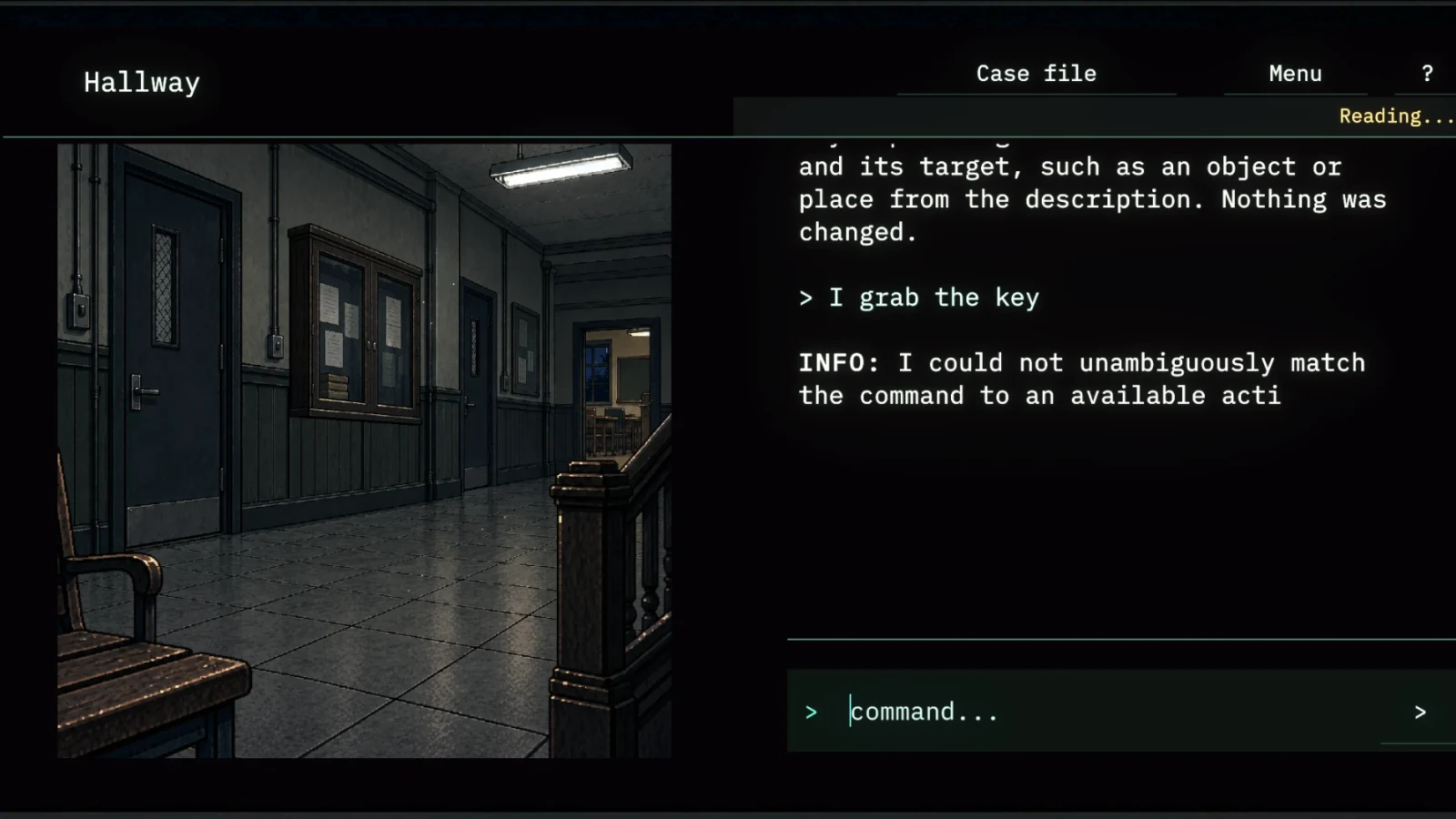
In play, the screen looks like an old computer terminal. On the left is a pixel-art picture of where you are, with the place name above it — in our screenshot, a school corridor labelled “Hallway,” with doors, a noticeboard behind glass, a ceiling light, a bench and a staircase. On the right is the story text, and below it a line that starts with a prompt and the word “command.” The top bar has a case file, a menu and a help button, and a small status line that reads “Reading…” while the game works on your command.
Models. The developer told us the game uses AI. The Steam page does not say so, or say how: it describes “flexible command recognition” and “contextual hints,” and Steam users tag the game “Artificial Intelligence” and “Dynamic Narration,” but it never explains what is behind them. We do not know which model it is, or what the AI does in the game, so we do not name one.
Price. The Steam page does not list one. The demo is free.
Age rating. Steam lists none. The story is a murder investigation in a noir mood.
The Good News First: It Feels Like the Old Games
Stories Terminal took us straight back to the great games of old, like Carmen Sandiego and the like. The feeling is the best thing about it.
It is atmospheric. The pixel art is on point, and the hallway in our screenshot is a good example of it. The soundtrack is lo-fi, and it is adequate and unobtrusive, which in a game like this is exactly right. It gives you room to think, and it does not push you along.
The Problem: Finding a Command That Works
Our main criticism is about the command line, and it is a big one: it is painfully difficult to find a command that works.
Three moments show it.
- The object on the floor. We could see a vial-like object lying on the ground and wanted to inspect it. We tried many different wordings before one worked. It got there in the end, but only after many attempts.
- The lab. The game pointed us to a lab, and we could not get there. We typed that we would go into the lab, and that we would go to the porter. The game did not let us, and it gave no clue at all about what the options were. After a lot of different sentences and word combinations we managed to get in.
- The lab again. In the hall we heard about the lab once more, and again we could not go there. We spent a lot of time on this as well.
Our screenshot catches the same thing. We typed “I grab the key,” and the game answered with a line starting “INFO:”, saying it could not unambiguously match the command to an available action. Above it, the earlier message explained that a command needs an action and its target, such as an object or place from the description, and ended with “Nothing was changed.” That message is honest and clear about what went wrong. What it does not do is tell you what to try.
That is the heart of it. This is a detective game, and the case we struggled with was not the murder. It was how to word things in a way that gets the game to do what we want. Detective work is supposed to be hard because the clues are hard to read. Here, the clues were fine, and the interface was the puzzle.
The Fix We Would Ask For
The remedy is a small one, and the Steam page already hints at it. The page lists “contextual hints.” In our play, a failed command returned the general message each time, and we did not get a hint of the kind we would have wanted.
What we would ask for is simple: when a player fails twice in a row, nudge them. Name some objects or places that are in the scene, or suggest what to do instead, so that the second failure is a step toward the answer and not a repeat of the first. A general message that the game could not understand you is fair once. Twice is the point where the game should start helping.
A game with the word “terminal” in its title and a case file in its menu has the right setting to do that in character.
Who Should Try It Now
Try it if you love the look and feel of classic detective adventures, if you want a moody case on a free demo, and if trial and error with your wording is a game you enjoy. It costs nothing, and the art and the soundtrack are worth the download on their own.
Wait if a failed command is the kind of thing that ends your evening, or if you want the game to guide you toward what it can understand. That is the part that still needs work.
What Happens Next
Stories Terminal has the right mood, art and sound for the genre it loves. It needs a friendlier way to tell a stuck player what the game will accept, and a better way to recover from a wrong command. We will go back to the demo after updates, and publish a full, rated review at launch, scored on the same seven axes as everything else in our directory. Until then, our directory of AI RPG platforms covers everything you can play today.
This is a first look at a pre-release demo, not a definitive review of the finished game.
Disclaimer: Stories Terminal is an independent game by OddlyGames. Arcanum is an independent publication and is not affiliated with, endorsed by, or sponsored by OddlyGames. Carmen Sandiego is named only to describe the kind of game this one recalls; Arcanum is unaffiliated with its owners. Features and prices described are those of a pre-release demo and may change.