Astara Infina First Look: A Space RPG With a Standout Design and Characters That All Sound Alike
Access disclosure: the developer asked us to review Astara Infina. We played it at its public address, the same way anyone can, and nothing was given to us. No extra access or credits came with the request, and nothing was arranged in return. This first look is independent and unpaid.
This is a first look at an open alpha, not a rated review. We ran the game through our seven-axis rubric informally, because the developer asked for the feedback, and we are publishing what we found in words, with no scores. Our methodology keeps scores for finished products, because it isn’t fair to grade an unfinished build, or to let an early score outlive the build it described. We will score the game at its public release.
Astara Infina is a free, browser-based AI RPG in which you choose a faction, build a crew and take missions to small worlds, then return to your station with the rewards and the stories before taking another. It is built by one developer, Michał Kowalkowski, and he calls it an open alpha.
The short version: it is one of the most distinctive designs we have tried, with real depth in its systems. It is also held back by characters who share one voice and by a memory that did not hold up. Both are things an alpha can fix, and he asked us to say where they are.
What It Actually Is
The game is a web app with a row of tabs along the top: Station, Campaign, Party, Ship, Fabricator, Chart and Databank. You start at the station. From there you make a character, put together a party, and take missions to planets. Each mission is a small storyline of its own. When it is over you come home with the rewards and what happened, and pick the next one.
Character creation opens with a screen titled “Find your crew.” It asks you to choose the people and principles you want to fly with, because your crew shapes your companions, the missions you are offered and how you approach each world, and it says species and class come next. In our run there were three factions:
- Coalition — “Explorers with principles”: professional officers in a civilization built on science and cooperation, who survey unknown worlds, study anomalies and build diplomatic ties.
- Alliance — “Freedom through action”: volunteers and idealists who stand against oppression, delivering relief and evacuating civilians.
- Confederation — “Independent, not indifferent”: independent spacers who treat their crew like family, running supplies and repaying favours for frontier communities.
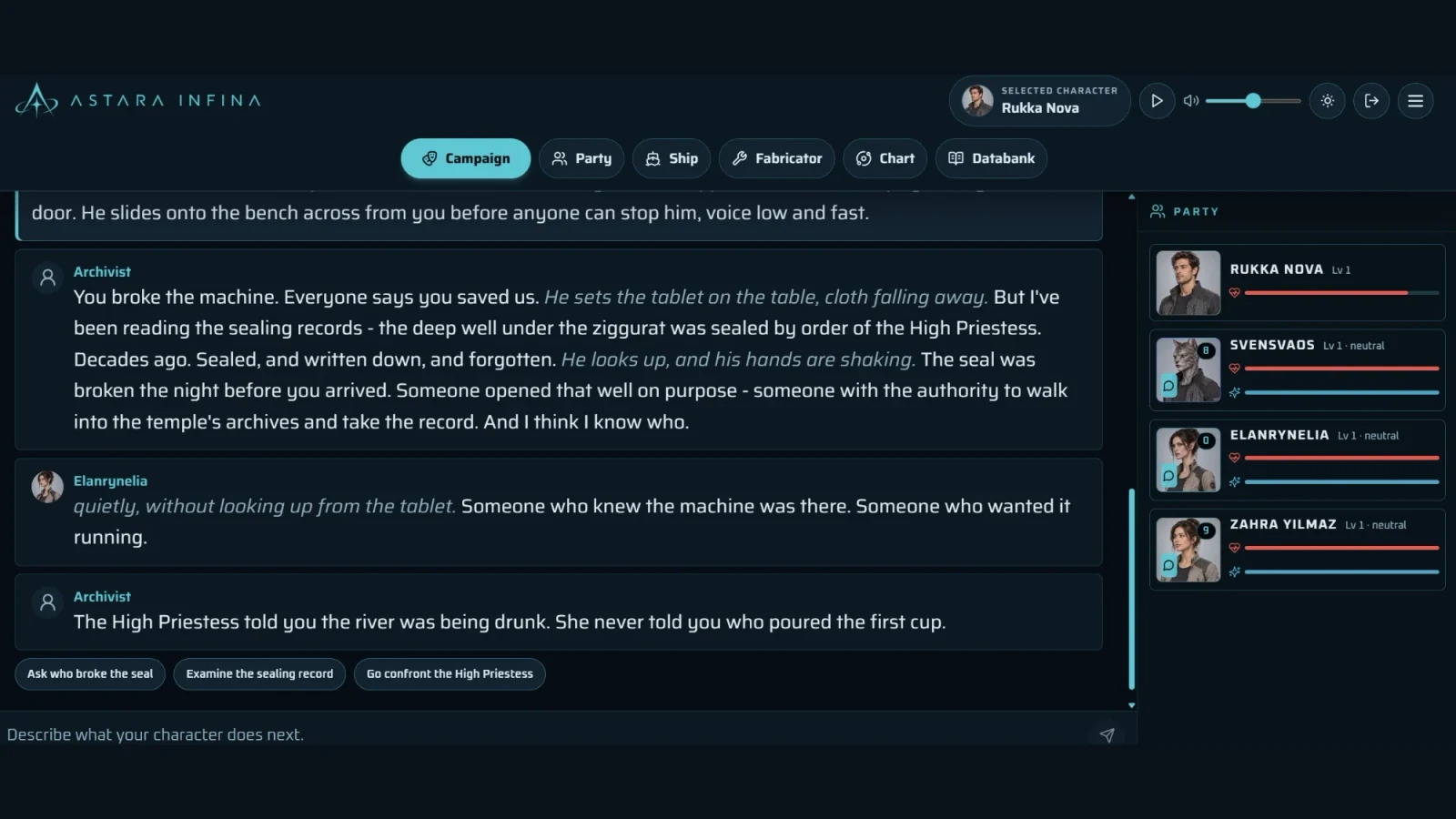
Each card lists the missions you might take and “the hard choices” you may face. Once you are in a campaign, the story fills the main panel and a party list sits at the side with a portrait for each crew member. Below the story there are a few suggested actions you can click, and a box that says “Describe what your character does next.” The chart is a star map labelled “Known universe,” with 26 known worlds; selecting one, such as Aster, opens a short description of it and says which faction it comes from. A music player, a volume slider and a light and dark switch sit in the top bar.
Models. You can switch models in the Profile settings. The developer told us the two he uses right now are GLM 5.3 Flash and DeepSeek V4 Flash.
Price. Free. See the section on cost below.
We went through the seven axes of the rubric in turn. What follows runs roughly from the game’s strongest axis to its weakest, not in the rubric’s own order.
Signature Design: Very Few Games Do This
This is the standout, and it is the reason to try the game. It does something that very few other games do.
Character creation is fun and full of meaningful options. The way you get party members is its own system. The core loop is unusual: you take missions to planets that act as small storylines, come home with the rewards and stories, and then take another. And there are small, clever details. You can see the crewmates who are left behind on the ship in the rooms of the ship. A lot of little cool, unique touches add up. On the question the rubric asks here, whether it does something nobody else does, the answer is yes, and by some distance.
Mechanical Depth: Deep and Charming
The game is really deep and well thought out, and it lets you do a lot with interesting mechanics. We liked the ship’s fabricator, the station news, and the different jobs you can take. It has quite a charm. There is more going on under the story than in most games we test, and it does not feel like narration wearing dice.
Player Agency: Strong, With One Structural Limit
There is almost no puppeting: the game does not write your character’s words and actions for you. There is a degree of railroading, in the sense that you always have a mission objective, but that is the point of the gameplay, not a fault.
The limit is built into the loop. You get the full agency experience only when you are inside a world on a mission. Between worlds, you cannot really experience the galaxy, its politics and so on. That is a small gap in a good result, and we can see room to improve it.
Determinism and Fairness: Rewards That Did Not Feel Earned
In our play, the rewards never felt like they were worth something. We never had the sense of getting a reward that mattered. This was the thinnest part of our evidence. We did not see enough to say more, and we are sure a longer test would give a fuller picture. We did not see enough to tell us the game was ready for an extended review.
Longevity: A Structure That Helps It
Longevity is tricky. The weak memory and the flat characters would normally count against a game here. But the game is designed as a series of contained episodes in worlds, so the problems matter less than they would in a single long campaign. A mission can start and finish without needing the whole history. That structure is a real help, and we credit it.
NPC Fidelity: One Voice, Many Names
Characters are not the strongest point. They are all the same voice wearing different names and specs. A warrior speaks like a warrior because the “voice” knows it has to be a warrior, and a spy speaks like a spy for the same reason. But the character, the personality and the quirks do not change: it is the same flavour for all of them.
This is the failure we describe in why AI RPG characters collapse in a party: a character is more than a role label. Here the role is carried well. The person is missing. Whether it comes from the model, the prompt or the way the party is generated, we cannot tell from the outside.
Memory and Continuity: Not in the Right Place
The game failed our fact-plant test, which is the only memory test we disclose, so that developers can’t optimise for it along with the rest. It failed some of the others as well. For some reason, memory is not in the right place.
We could not find out why. In this interface you cannot see the memories the game keeps, or open character pages, so we had nothing to inspect. That is a reasonable thing to leave out of an alpha, but it is also what a developer would need to debug the problem, and what a player would need to trust it. Showing the player what the game remembers would help both.
What It Costs, and Where It Is Going
Astara Infina is free. The developer told us he does not sell anything and does not really plan to, unless usage grows to the point where he can no longer pay for the models out of his own pocket. Even then, he wants a free way to play, with power users paying for usage, or a way to sell something that does not affect gameplay, such as cosmetics. He told us he does not know yet. It is a side project, and it began on a dare: a friend who likes AI RPGs knew he works with AI in his professional software-as-a-service work, and wondered whether he could build a better one than the game his friend was playing.
That story fits what we saw. It is the work of someone who built a distinctive design for himself, and is still working out the rest.
Who Should Try It Now
Try it if you like simulation and space-age games, you want a free and unusually structured AI RPG, and you are happy to try an alpha. The design is worth seeing for itself.
Wait if you care most about characters who feel like individuals, or a memory you can trust over many missions. Those are the parts that still need work.
What Happens Next
The developer asked to be reviewed, and we ran the rubric to give him real feedback. We will look again at the public release and publish a formal review, with scores, on the same seven axes as everything else in our directory. We are looking forward to seeing how it develops. Until then, our directory of AI RPG platforms covers everything you can play today.
This is a first look at an open alpha, not a rated review. No score is given or implied.
Disclaimer: Astara Infina is an independent project by Michał Kowalkowski. Arcanum is an independent publication and is not affiliated with, endorsed by, or sponsored by Astara Infina or its developer. GLM and DeepSeek are named only to describe the models the developer says he uses. Features and prices described are those of an alpha build and may change.