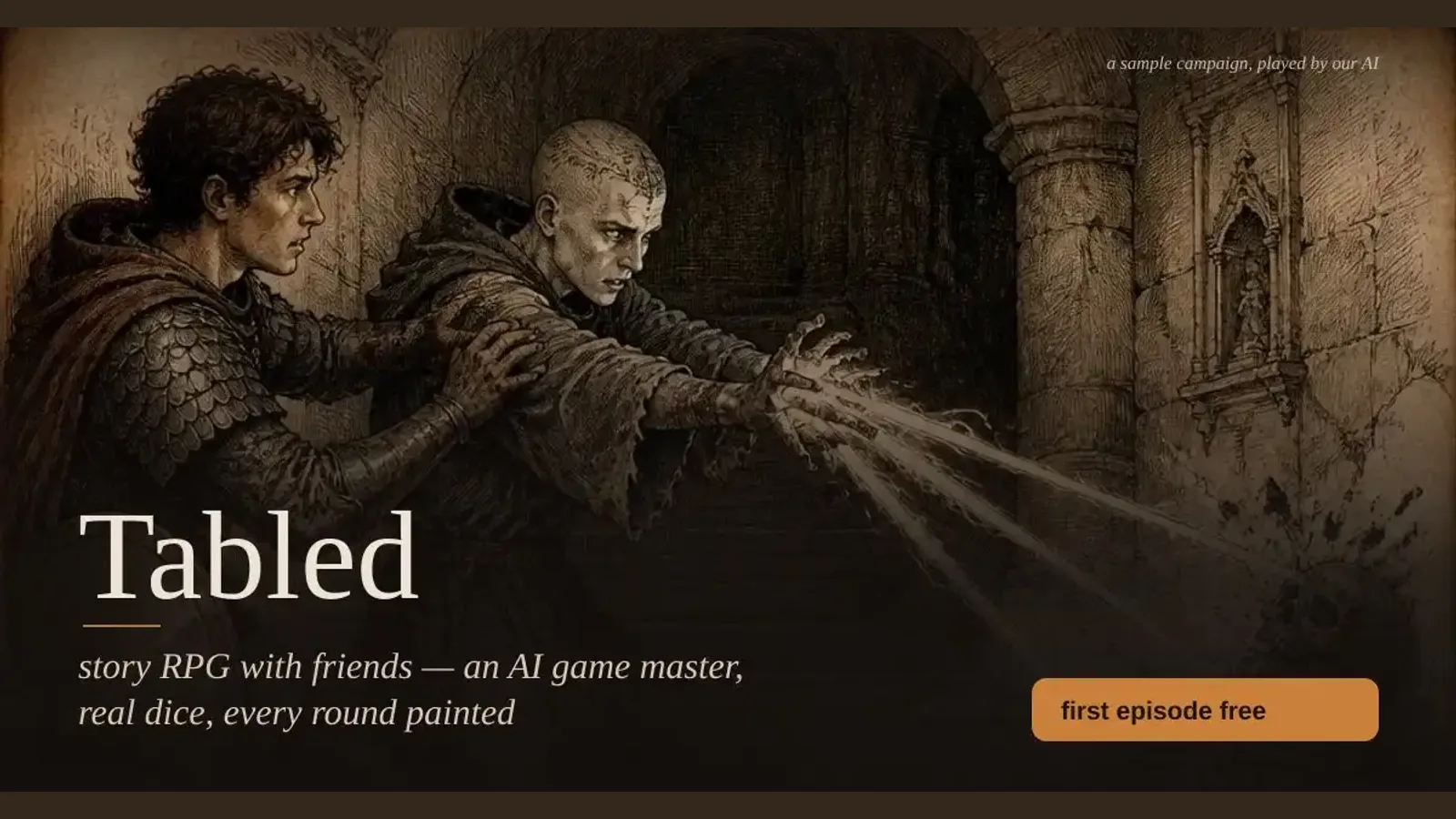
Tabled
The most trustworthy dice in the category, wrapped around a story that runs on its own schedule whether you show up or not — and pays you experience for fights you walked away from.
this platform · field average of 25 rated platforms
- Memory & Continuity4
- Player Agency4
- NPC Fidelity3
- Mechanical Depth3
- Determinism & Fairness2
- Longevity3
- Signature Design3
Tabled is a 5e-compatible campaign game with an AI game master, built for tables that cannot get six people into the same room on the same night. Up to six players share one invite code, rounds resolve asynchronously — “a thoughtful move a day, or five rounds in a lively evening” — and every turn is painted, so the campaign accumulates into an illustrated chronicle the table keeps. It is made by Short Hill Labs LLC, a small studio in Virginia, and it is live on the web, on Google Play, and on the App Store since 15 August 2026.
It also does something almost nothing else in this directory does: it takes the dice out of the model’s hands entirely.
How It Works
You found a party, name it, set its tone and write the seed of a story. Friends join with a code, or AI companions fill the empty seats — the configuration we tested. Then you say what your hero does, in your own words, and the game master weaves everyone’s declared action into a single scene, illustrates it, and ends on the question that starts tomorrow.
Underneath that is a deterministic rules engine. Every roll is made and audited server-side and handed to the game master already committed, so the narration is written around a result the model did not choose. Experience is granted only by the server. Character death is real. The published rules page is unusually candid about where it diverges from the System Reference Document and why: spell charges instead of slots, a breather-and-camp cycle instead of short and long rests, no grid, no initiative and no opportunity attacks, and a list of spells excluded by name — Wish, Time Stop, Simulacrum, Animate Dead — because, in the studio’s own framing, they are “argue with the referee” magic that no server can honestly enforce.
What It Does Best
Player Agency — 4 is the second-highest score any platform has earned on this axis, shared with AI Dungeon and Tales RPG and beaten only by NOPOTIONS at 5. Two chapters into our campaign we decided the party’s quest was not our character’s problem, and we left — physically, to a different part of the map, to quest alone. Tabled let us go. It did not fold the plot around to meet us, invent a reason to drag us back, or quietly narrate our character reconsidering. Most of this category fails that test, and it passed cleanly.
Memory & Continuity — 4 ties the ceiling too, held otherwise only by Hidden Door and WyrdTale. Across a full campaign of normal play we never caught it losing the thread. The architecture is the reason: the numbers that usually rot — charges, conditions, experience, inventory — are not being remembered by a language model at all, they are being read out of a database.
NPC Fidelity — 3 understates something worth naming, because the shortfall is narrow and the strength is rare. Tabled’s characters have their own morals and their own initiative. They will not take the option you are steering them toward if they think it is the wrong one, and they act without being prompted. Our own party carried on with a quest we had abandoned, for reasons of their own that we never shared. That is free will rendered legibly, and most platforms in this directory cannot do it. What holds the score at 3 is voice: the party had distinct convictions and one shared speaking style, so talking to one member felt much like talking to the next.
Where It Breaks
Determinism & Fairness — 2 is the score that will look strangest on a platform whose headline promise is that the dice cannot be fudged, so it is worth being exact. The dice are not the problem. The dice are the best in the category. The problem is one layer up: the story is not ours to change.
In the first chapter we rescued a hostage from a gang, and we did it only because his sister asked. The second chapter required us to save one of that gang from hanging, because he alone knew the others’ names. We had no stake in those people and no reason to risk our neck for a list of them — so we left. The plot proceeded anyway. For the rest of the campaign two stories ran in parallel: ours, and the one we had walked out of, each rationed to a line or two per turn. Neither had room to be good. We continued receiving reports on a quest we had declined, and we continued collecting experience for kills our party made in our absence.
That is what a 2 measures here. Our fairness axis asks whether outcomes are earned and consistent, and being paid for a battle you were not at is an unearned outcome — the exact thing the server-side dice were built to prevent, happening in the fiction instead of in the maths. It is also why this entry scores 4 on agency and 2 on fairness at the same time: the game genuinely let us leave, and then the world did not notice we had gone.
Longevity — 3 is really two numbers. Play the story Tabled brought and this is a game we would expect to hold for a long campaign. Push against it and the experience thins out into the split-attention problem above, which is closer to a 1. The score is the average of a game that works and a game that does not, depending entirely on how agreeable you are.
Memory & Continuity earned its 4 but not a clean one. Three turns from the end of our campaign we called back to a fact we had planted in the opening chapters. The game did not have it — and rather than say so, the game master invented an answer and delivered it with confidence. Forgetting is the category’s universal failure and we grade it gently. Filling the gap with fiction is a different and worse thing, because it is unfalsifiable from inside the story.
Mechanical Depth — 3 is solid rather than deep. The rolls resolve, the rules hold, the game master calls for the right attribute, the between-session shop works, and rewards land where they should. There is simply less of it than the most systems-heavy platforms we have scored.
Pricing
Verified on tabled.gg, August 2026. Every campaign’s first episode is free and complete. After that, $14.99 once — paid by the host, covering the entire table of up to six — opens every season of that campaign and funds a season or two of typical play. Long campaigns top up with $4.99 refills, which the studio calls a flask of lamp oil and expects a steady table to need every season or two.
There is no subscription, no per-turn credit, no daily cap and no expiry, and friends never pay. In a category that has largely settled on metered turns, that is a genuinely different bet, and one worth noting even where the score is not.
Verdict
Tabled has built the honest half of the problem and left the other half undone. The engine underneath is the most trustworthy in this directory — real dice nobody can lean on, a rules layer a server enforces, experience the narrator cannot hand out as a favour, and a published account of exactly what was cut and why. Its NPCs have wills of their own, its memory is joint-second on our board behind Voyage alone, and it will let you walk away from the plot.
What it will not do is care that you did. The campaign it wants to tell proceeds on schedule, in parallel, thinner, still paying you for it — so the freedom to leave arrives without the consequence that would make leaving mean anything. Go along with the story and this is a strong 5e campaign that will genuinely survive your group’s calendar. Refuse it and you get two half-told tales and a stack of experience you did not earn. 3.1 out of 5.
Full write-up in our Tabled review.
Tabled is an independent work compatible with fifth edition, built on the System Reference Document under CC BY 4.0. It is not affiliated with or endorsed by Wizards of the Coast, and neither is Arcanum.
Building an AI RPG platform, or part of the team behind Tabled? See how to work with Arcanum.