Luminarc Review: Worlds That Remember, When They Do
Access disclosure: Luminarc’s developer gave us free credits, through a 2,000-credit code, to play the game for this review. This review is independent and unpaid.
Luminarc is a browser AI RPG where you enter a world as your own character and play a story that is supposed to remember what you did. It scores 2.8 out of 5. So far it is an average game. It can sometimes play better than average, but at the cost of very long waits.
What It Is
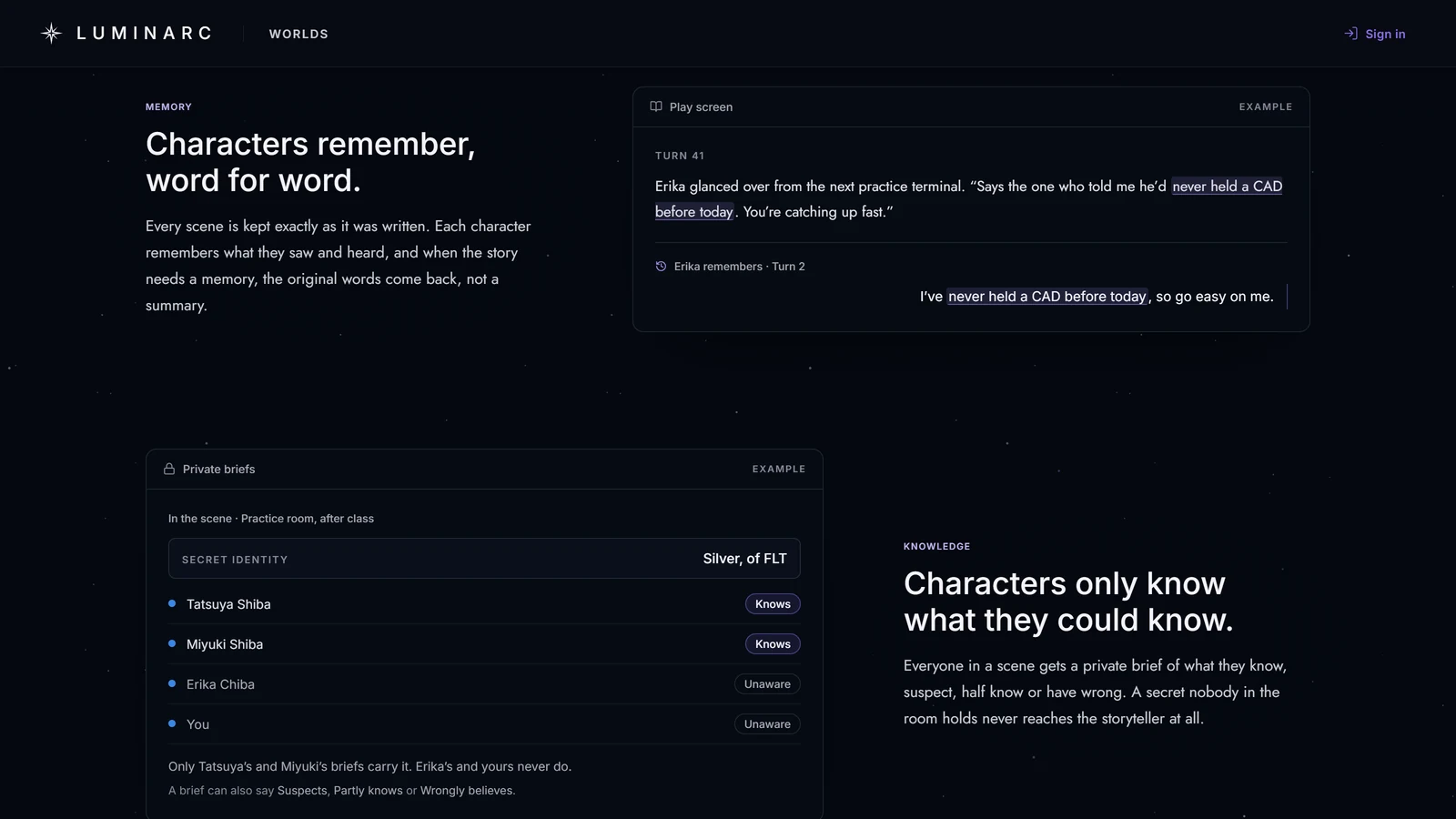
The developer builds the pitch around memory. According to Luminarc, each turn goes into a running record, every fact is marked by who knows it, and a check reads each scene for lore and continuity mistakes before you see it. Those are the developer’s descriptions of how it works. What follows is how it played.
You can play a published world or build one on a world map of characters, places and factions. This review does not assess the world builder. When we looked, signed out, on 27 November 2026, we saw one public world, based on the anime The Irregular at Magic High School and listed as made by Luminarc. Sign-in is through Discord or Google. The model menu offers Luminarc Auto, which it recommends, along with GLM and DeepSeek options.
Memory & Continuity — 3.5
Memory is the headline feature, and it did not impress us as much as the pitch suggests.
It is picky about what it remembers, and it is unreliable. It can surprise you by bringing back something that happened long before. It can also forget something on the very next turn. The good moments are real, but you cannot count on them, and in a long story that is what matters.
Gender Mistakes
The game got our character’s gender wrong often, and it was annoying. It was clearly going by the name rather than the character’s gender. Rukka can be a male or a female name.
We have seen this before: it is the same kind of mistake we described in our Altworld review. In a game where you play as your own character, getting that character right is basic.
Player Agency — 3.5 and Fairness — 3
There is puppeting: the game plays your character for you in places, when that should be your job.
It also gives the player too much in the other direction. It let us make things up and went along with them. That can feel like freedom for a moment, but a world that accepts whatever you declare has weak limits, and limits are what make success mean something.
NPC Fidelity — 3 and Mechanical Depth — 2.5
The characters are average. Nothing about them stood out either way.
There is not much depth mechanically. If you want systems to learn and master, this is not where you will find them.
Latency and Longevity — 2
The latency is a big problem. If you are happy to take a turn, go and do something else and come back later, you may not mind. If you want to sit down and play, it can really hurt.
It is also why Longevity is so low. We do not see many people sticking with a campaign while the waits are like this.
Signature Design — 2
Luminarc attempts nothing new. Persistent worlds, characters with their own knowledge and a record of past events are goals other AI RPGs share.
Pricing
Verified on Luminarc’s membership page on 27 November 2026. The sign-in page offers new accounts 200 free credits, valid for 7 days.
| Monthly plan | Price | Credits each month |
|---|---|---|
| Key Keeper | $5 | 200 |
| Adventurer | $15 | 650 |
| Rising Hero | $25 | 1,100 |
| Elite | $40 | 1,800 |
| S-Rank | $65 | 3,000 |
Monthly credits reset each month, and each plan is marked as supporting your own API key. Credit packs never expire and run from 200 credits for $5 to 4,000 for $100. Luminarc’s terms say credit use depends on the feature, the options and actual usage, so a balance does not guarantee a number of turns. Purchases are non-refundable, except where the law or the payment provider requires a refund.
If you plan to build a world, read section 5 of the terms first. You keep ownership of your original work, but submitting a world gives Luminarc a permanent, irrevocable licence to your original contributions for use in its service.
Verdict
2.8 out of 5. Luminarc is an average game that can sometimes do better, and it asks you to pay for those moments with long waits. Memory, the thing it is built around, is too uneven to carry it.
It is clearly a fresh launch with quite a few rough edges. We hope it improves.
Full axis scores and the pricing detail are on the Luminarc directory entry. How we arrive at these numbers is on our methodology page, and the benchmark shows how it compares with the rest of the field.
Luminarc’s developer gave us free credits to play the game for this review. Arcanum is independent and unpaid. Product names and trademarks are the property of their respective owners. Arcanum is not affiliated with Luminarc or with the owners of The Irregular at Magic High School.