NovelFarer Review: Real Dice, a Danger Clock, and a Door That Opened Itself
Access disclosure: NovelFarer gave us free access to its Legend plan for this review. No conditions were attached to our coverage. This review is independent and unpaid.
NovelFarer is a text RPG in which an AI storyteller writes each scene and a ruleset kept by plain code decides what is true: you roll a d20 for risky actions, and the game tracks your health, gear, money, trust and a clock of rising danger. It runs in a browser. Its own line is “A novel you play yourself”.
It scores 2.5 out of 5, twenty-fourth of the thirty-one platforms on our benchmark. The number is flat because the axes are flat: nothing here scores above a 3. The exception is memory, which is far below the rest. At 1.5 it is close to game-breaking, and it made the game act strangely almost every turn.
We tested it at the standard tier of our methodology, on the Legend plan, for nearly 50 turns.
What It Is
You pick a world from seven genres: fantasy, science fiction, mystery, horror, cyberpunk, post-apocalyptic and pirates. There are dozens of ready-made starting points, or you can describe your own world in one sentence. You choose one of five roles, write your own past, and play on to level 10. You can play in English or Dutch.
Then you type what you do. The storyteller writes the next scene. When an action is risky, the game first shows you the number you need and what is at stake, and you roll the d20 yourself. There are four outcomes, from success to setback. Your items and money are kept by the game, not by the storyteller, and so is your health. Every story has a main goal with steps, people offer jobs, and a map grows as you explore, with areas marked calm, dangerous or deadly. A danger clock fills as time passes and when you fail, and when it is full the consequence stays. In mysteries the solution is fixed before you start, and you can accuse someone once.
The game paints pictures of scenes and characters, and lets you choose the look of the art.
It is made by Xquissive AI, a company in Maassluis, in the Netherlands, trading as NovelFarer. You must be 16 or older. Love scenes are not described, and explicit content is not allowed.
Memory & Continuity — 1.5
This is the axis that decides the review.
Our expectation was simple. NovelFarer has an engine that tracks the world, and an engine should remember better than a prompt pasted into a chatbot. It does not. All twelve of the prompt-only games we score have a better memory than this one, and only two platforms on our board score lower.
Two things happened in our play.
We lost a companion. We ran away on a wyvern with a woman, travelled with her, and arrived at the destination. She was gone. The game said that if we had been with someone, they were not there now.
A door opened itself. At the start we knocked on a door. The person inside did not open it, but spoke to us through the wood. The game even offered us the option of breaking in. We chose to keep talking from outside, and the person did not let us in. Then an enemy arrived, and the narration suddenly put us inside the house with the enemy trying to get in. We asked how we had got in when nobody had opened the door. The woman inside said she had not opened it. The man outside said he would have to talk to us through the wood.
A door nobody opened, a player who is suddenly inside, and two characters whose lines no longer fit the scene. It was not a one-off: this kind of fault made the game act strangely almost every turn.
Player Agency — 3
Puppeting is when the game writes your character’s actions or words for you. NovelFarer does very little of it, so little that it is extremely rare. That is well done.
Railroading is the other half, and it exists. The game wants you on a certain path, and when you leave it, it pulls you back. If you want to run from a contract, or solve a quest in a way its designers did not plan, it makes that very hard.
A second problem is characters who will not go away. When you meet a new character it can be hard to unstick them from you. A woman we had no interest in followed us around until we left the area flying. The reverse also happens, as the companion we wanted vanished. Characters you want leave, and characters you do not want stay.
It lets you do a lot, and lets you do it your own way, but it also makes some things impossible. That keeps it at a 3, and it is not what we would promote the game for.
NPC Fidelity — 2
Characters were flat. They all talk the same way, and their voices blend together. In nearly 50 turns we met about six of them and did not find one with a clear personality trait.
The site says everyone has “a name, a voice and a fixed look”, and that trust counts when you try to win someone over. We did not find the voice. A person you cannot tell from the last person is not much of a character.
Mechanical Depth — 3
NovelFarer has real mechanics: a map, a danger meter and a progress meter that move, the usual action rolls with a d20, and combat. None of it is unusual, and nothing pushes the bar up. It stays level with the industry standard, which is why it is a 3.
The site says the game system is plain code that guards what you own and how you are doing. The weakness is the memory, not the rules: the story around the rules loses track of who is with you.
Signature Design — 3
The game is well designed, but not much of it is new. Rolling a d20 with the number shown first, a map, a clock and a main goal exist in other games on our board.
Two things stood out. First, you can pick a look for the artwork the game generates, so the pictures match the story you want. Second, progress toward a goal is logged, and so is danger, so you can see progress and tension building side by side. That makes a story feel like it is going somewhere.
It is not a soulless game by any means. It simply does not break the mold.
Determinism & Fairness — 2.5
This was hard to judge, because a memory that makes turns wobble also makes it hard to tell what the game decided and what it forgot. If we set the inconsistencies aside, it is not very deterministic, and it is not very unfair.
It does not reward smart play and push back, so it sits close to the industry average. It is a little above, because its rules stop you from doing what other games allow. You cannot attack without a weapon, and you cannot make a weapon appear by typing that you draw a dagger from your belt in a pinch. The rules push back, where other games let you say anything.
Longevity — 2.5
Nearly 50 turns showed the shape of a story: a goal with steps, a danger clock and a map that gets more dangerous as you go further. That is a good frame for a long game. What holds it back is the memory. A campaign needs people and places to still be there, and here they were not.
Pricing
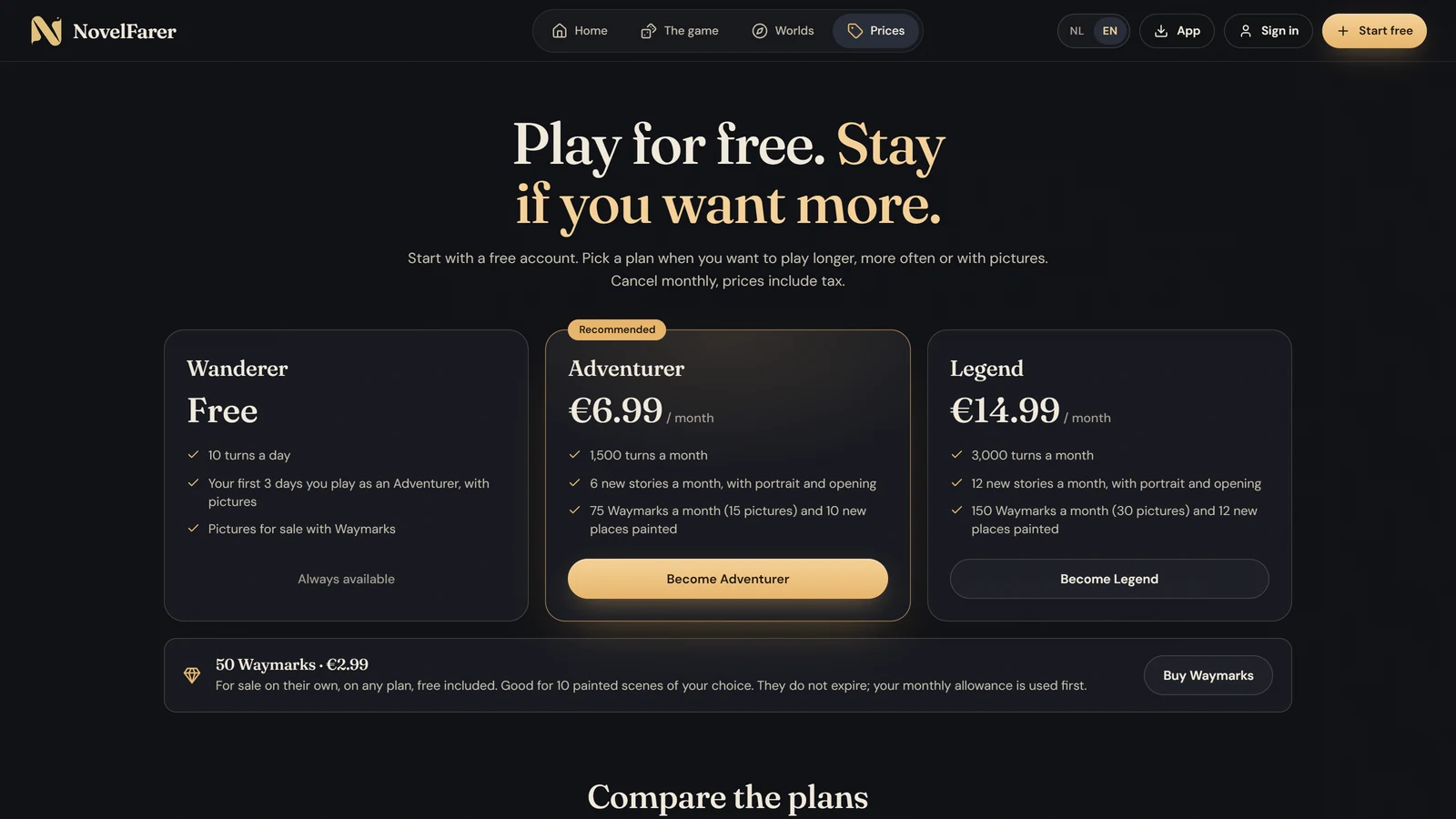
NovelFarer is free to start. It needs no card. The figures below are from its own pricing page on 20 October 2026, shown in euros. The terms say prices are in US dollars outside Europe, and that they include VAT or sales tax.
| Plan | Price | Turns | Pictures |
|---|---|---|---|
| Wanderer | Free | 10 a day | None included; pictures can be bought with Waymarks |
| Adventurer | €6.99 a month | 1,500 a month | 75 Waymarks a month (15 pictures) and 10 new places painted |
| Legend | €14.99 a month | 3,000 a month | 150 Waymarks a month (30 pictures) and 12 new places painted |
A turn is every time you do or say something and the story continues, and starting a new story counts as three turns. Waymarks are the credit for pictures: a picture on request costs 5 Waymarks, and a pack of 50 costs €2.99, which is our arithmetic of about 30 cents a picture. Bought Waymarks do not expire, and your monthly allowance is used first. New accounts play their first three days as an Adventurer, with pictures.
On the turn count, that is our arithmetic too: Adventurer works out at under half a cent a turn, and Legend at half a cent.
Cancelling. Plans renew monthly, and you can cancel at any time. The plan then runs to the end of the paid month and goes back to free, and your adventures are kept. At checkout you agree to immediate access and give up the 14-day right of withdrawal; the terms say that if something is wrong afterwards, the studio looks fairly at every request.
Your data. The privacy policy says that to write each turn it sends what you type and the story so far to a language model from OpenAI, and a short description of the scene to KIE.ai for pictures. The terms say your stories are yours, and are not sold or used for advertising.
Where to Play
- In a browser, on a computer or a phone, at novelfarer.com. A free account is enough to start.
- As a home-screen app. The site ships a web app manifest, so a browser can install it. We found no App Store or Google Play listing linked from the site.
Verdict
NovelFarer feels like the work of a team that has good ideas and is still finding its place in this category. The d20 shown before you roll, the map, the clock and the logged goals are the right parts, and the game is charming. You can tell it took work.
But the memory is the weak point, and the rest depends on it. A companion who disappears, a door that opens itself and characters who sound the same are faults a player notices within one evening, and they make the game feel unpolished. It needs to see what its competitors already do, and how they make systems like these work together.
We hope next quarter’s review can raise this score. For now it is a charming, short game with a broken memory.
To see where it sits, read our benchmark and how we score.
Product names and trademarks are the property of their respective owners. Arcanum is not affiliated with NovelFarer or Xquissive AI.