Our own game — we don't rate these.
Aevum Realm Architect
Rise from serf to sovereign in a deterministic kingdom-builder that runs on ChatGPT, Claude, or Gemini.
Aevum Realm Architect is a complete, two-file LLM RPG that turns any major AI model into a grounded medieval world simulator. You start as a serf with one copper piece and climb — through trade, war, diplomacy, and intrigue — to the throne of a realm. Every outcome is deterministic: your preparation and planning decide battles, not dice. A tag-based economy tracks your domain, your forces, and your treasury turn by turn, and an always-on HUD keeps the numbers honest.
The world is built on a nearly 30,000-word Atlas covering five historically-inspired nations, named trade routes, seasonal economics, and a rigid social hierarchy enforced by the game’s Deference Engine — the mechanic that makes your rise from serf to monarch feel genuinely earned. Romance, espionage, command, and the ruins of a lost magic empire round out a system that plays more like a strategy game than a chat session.
The Deference Engine
Social hierarchy is not flavour text in Aevum — it is the engine. Before the GM generates any NPC dialogue, it checks your current status against theirs and applies the rules of the Atlas. As a serf, you do not initiate conversation with nobles. You do not make eye contact. You do not haggle. If you do, the world responds with the realistic, punitive consequences of a medieval class system: a beating, a public flogging, or worse.
Superiors give commands. They do not offer jobs, negotiate wages, or explain their reasoning to people below them. The reward for obedience is survival — not being punished. This single rule transforms the early game into something that no other AI RPG delivers: a world that genuinely does not care about you, in which your rank determines the entire shape of every interaction. Every promotion is therefore felt, not just noted on a HUD.
The effect runs deeper than most players expect. After enough sessions in Al’thoria’s rigid hierarchy, you may find yourself thinking that if someone disrespects you, they should be flogged. The system creates the conditions for that — it doesn’t instruct you. That is the Deference Engine working exactly as intended.
For the full design rationale — the faction-specific textures of social weight, the emotional architecture of the early game, and the philosophy behind why discomfort precedes power — read Rukka’s design essay on the Deference Engine.
The Tag-Based Economy
Your domain is defined by Domain Tags — assets like farms, watchtowers, a scribe’s office, an alchemist’s lab — each with concrete effects on your treasury, food supply, loyalty, and security per turn. Your forces are defined by Retinue Tags. You grow by funding Projects that add positive tags or remove negative ones, with costs and effects laid out in the Atlas.
This makes the economic layer legible and plannable. You can read the state of your domain in the HUD, identify the weakest link, and fund the project that fixes it. Nothing is hidden behind abstraction — the numbers move because of specific tags you chose to build or remove, and every decision has a traceable consequence.
A World That Moves Without You
Aevum runs a GM Clock: every time-turn that passes, one faction goal advances in the background, whether you are watching it or not. Named contacts pursue their own agendas. Seasonal economics shift prices on trade routes. Factions act, accumulate power, and create problems that arrive on your doorstep whether or not you have been paying attention to them.
This is the mechanic that separates Aevum from a static narrative: the world is not a stage waiting for you to act. Ignoring a rival faction does not pause them. Leaving a vulnerability in your domain does not freeze it. The pressure accumulates in real time and you manage it, not narrate around it.
Combat, Statecraft, and Lost Magic
Battles resolve through the Art of Command: you submit a battle plan, the GM calculates your Retinue Power against the enemy’s, applies a modifier for your plan’s quality, and narrates the outcome from a results table. No dice. A superior plan can overcome a numerical disadvantage; a poor plan will waste it.
The same principle applies to espionage, diplomacy, and research. A Spymaster’s Quarters tag enables covert operations. A Scribe’s Office generates Research Points toward discoveries in the Atlas section on Magic, Alchemy, and Lost Knowledge — the ruins of a fallen Progenitor empire that thread lost technology and forbidden arts through the world for those who go looking.
Five Starting Paths, Five Nations
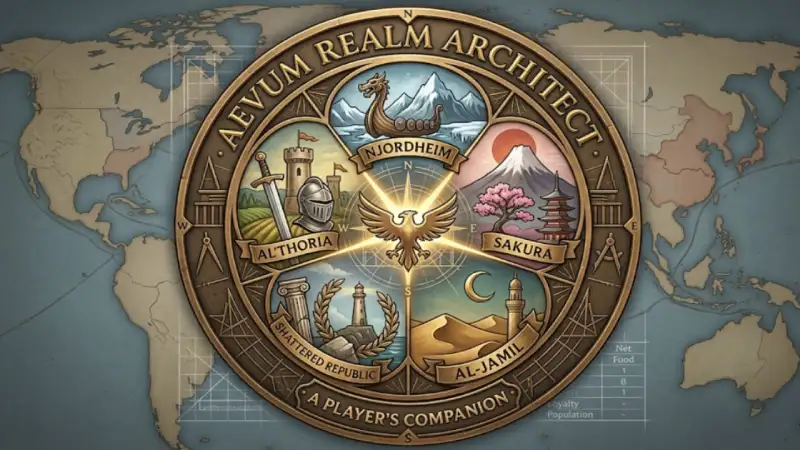
You choose a starting ambition — Merchant, Warlord, Baron, Artisan, or a blend — and a starting region from the five nations of the continent: feudal Al’thoria at the center, Viking-inspired Njordheim in the icy north, samurai Sakura in the mountainous east, the desert trade empire of Al-Jamil in the south, and the crumbling Greco-Roman Shattered Republic in the west. Each nation has distinct resources, trade dependencies, and political dynamics defined in the Atlas. The path to the throne looks different depending on where you begin and what you choose to become.
Player Tools
A /fix_state command pauses the game, re-reads the GM’s internal notepad, and presents a corrected HUD — a manual reset for the rare cases where the model drifts from the established state. An Agency Check rewinds any narration that overstepped by speaking for you. The GM is forbidden from inventing dialogue or choices on your behalf.
Who This Game Is For
Aevum is for players who want an AI RPG that functions like a strategy game — where planning, preparation, and resource management are the actual skills being tested, not conversational performance. If you want a world that pushes back, a social system with real teeth, and a rise that feels genuinely earned because every rung of the ladder has a cost, this is what that looks like.
Download the files, load them into your model of choice, and read the full review and install guide for step-by-step setup on ChatGPT, Claude, and Gemini.
↓ Download the files
Create a new Project (Claude), GPT (ChatGPT) or Gem (Gemini), then attach these files and paste the master prompt. Install steps above.
This game is free. If it gave you a good night at the table, a coffee keeps the worlds coming.
☕ Support on Ko-fiWant a world built just for you? Commissions are open — custom AI RPG worlds, made to order.
✉ Arcanum Weekly
The pulse of the AI RPG field, once a week — what launched, what changed, and what is worth your time. For anyone who takes this genre seriously.
Handled by Kit. Details in our privacy policy.